


The Mine You Cannot See
In-Situ Recovery — Did You Know?
- Crushing and grinding consume 30 - 40% of a copper site’s energy. In-situ recovery removes the step entirely.
- Across every ore grade modelled, in-situ recovery has the lowest energy intensity of any copper processing route.
- Mine waste is the single largest waste stream on Earth by mass. ISR leaves the orebody in place - no tailings, no waste rock.
- Florence Copper produced first cathode in February 2026, the world’s first greenfield commercial-scale ISR copper operation.
- Chalcopyrite holds roughly 70% of global copper reserves, and remains the major prize that ISR is yet to unlock.
Dissolving the Copper Is the Easy Part
The constraint is the ground. ISR depends on moving leach solution through the orebody under controlled conditions, yet many deposits have low permeability and complex fracture networks. Gangue can consume acid, precipitation can restrict flow and heterogeneity can cause solutions to bypass ore. The frontier is not just better chemistry - it is moving fluid through complex rock and proving where it went.
The Collaboration Proof Point
First-of-a-kind field trials are hard for juniors to fund alone. At Kapunda, Commonwealth CRC-P funding helped EnviroCopper, CSIRO and the University of Adelaide de-risk the science; BHP then funded a 90-day in-ground lixiviant trial to prove ISR under field conditions - government, research, a major and a specialist, each carrying a different part of the risk.
Innovation Spotlight — Mining Without Digging
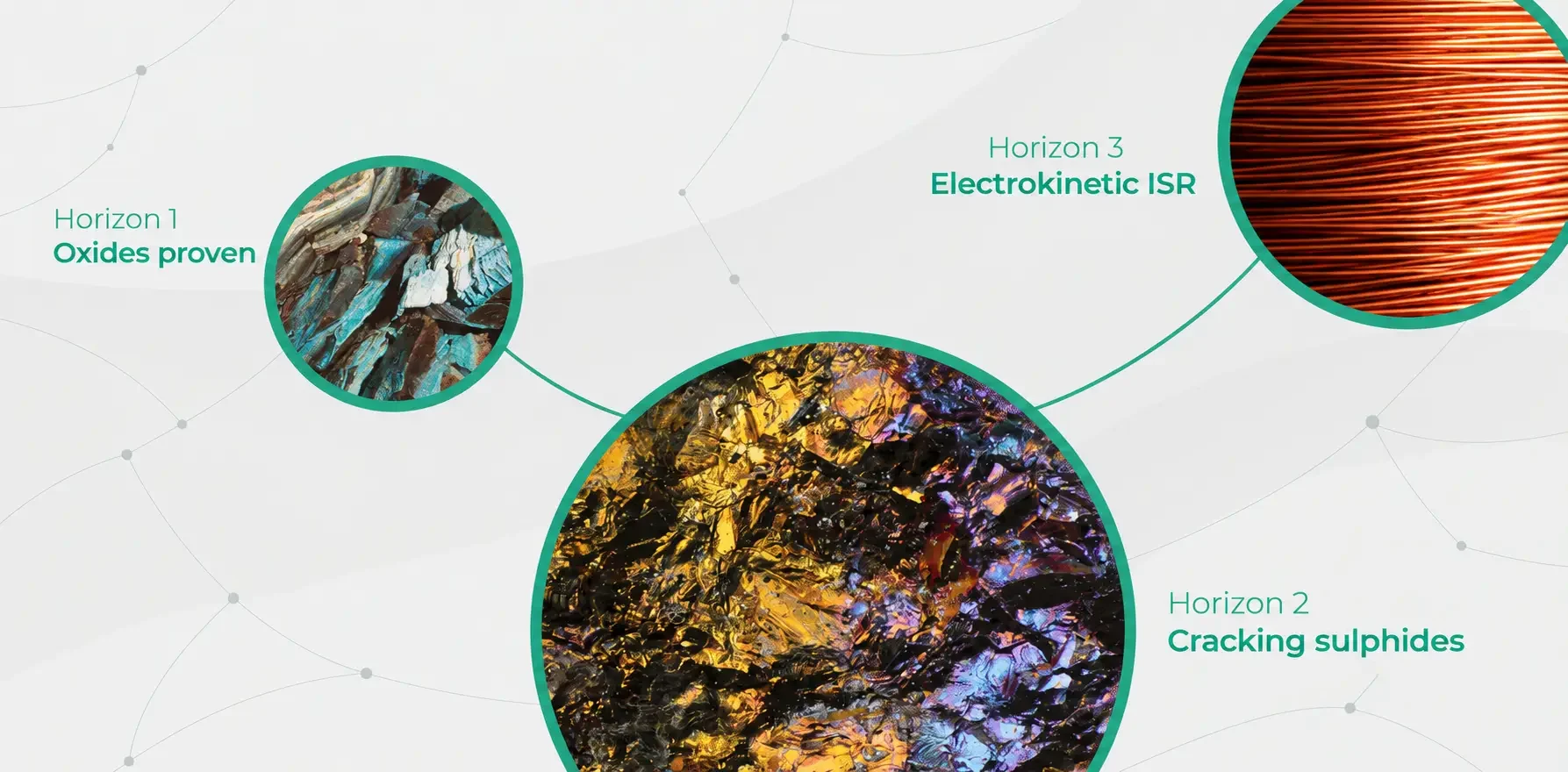
Horizon 1 — Available
- Commercial ISR is real: Florence Copper began cathode production in February 2026, targeting 30 - 35 million pounds this year and 85 million at capacity.
- Australia’s proof of concept: a BHP-supported lixiviant trial ran at EnviroCopper’s Kapunda project into early 2026.
- Oxides and SX/EW: where copper sits in permeable, fractured oxide zones, solution mining plus solvent extraction can deliver LME Grade A cathode on site.
Horizon 2 — Evolving
- Cracking the sulphides: Jetti, Ceibo and Rio Tinto’s Nuton are demonstrating leaching chalcopyrite in heaps today - the chemistry in-situ methods need next.
- Gentler lixiviants: glycine and other benign reagents, with ion exchange and membrane recovery, to cut acid load and risk.
- Modelling as licence to operate: reactive-transport models, tracer testing and real-time hydraulic control could turn a trial into a mining lease.
Horizon 3 — Emerging
- Electrokinetic ISR - the permeability breakthrough: electric fields carry solution through rock that pressure alone cannot. Lab work on intact porphyry has recovered over 90% of the copper.
- Australian science, commercialising now: UWA and CSIRO pioneered EK-ISL; Perth-based Ekion is taking it toward the field.
- The waste case is the real prize: electrification can slash copper’s carbon footprint, but it does not eliminate the waste. EK-ISR changes both.
Who Is Solving It?
| Category | Organisations |
|---|---|
| Operators & Projects | Taseko (Florence Copper) · BHP · Rio Tinto Nuton · Alligator Energy |
| Australian Innovators | EnviroCopper · Ekion · Mining3 · Thor Energy |
| Technology Providers | Jetti Resources · Ceibo · Endolith · Metso |
| Research & Enablers | CSIRO · UWA · Curtin · DTU Denmark · SA Dept for Energy |
