


It is focused on six broad challenges: Energy supply and storage; Design and infrastructure; Equipment and data; Energy and processing; Policy and skills; and Carbon. These challenges, when brought together, provide an integrated approach to the whole of mine.
Value Chain Redesign
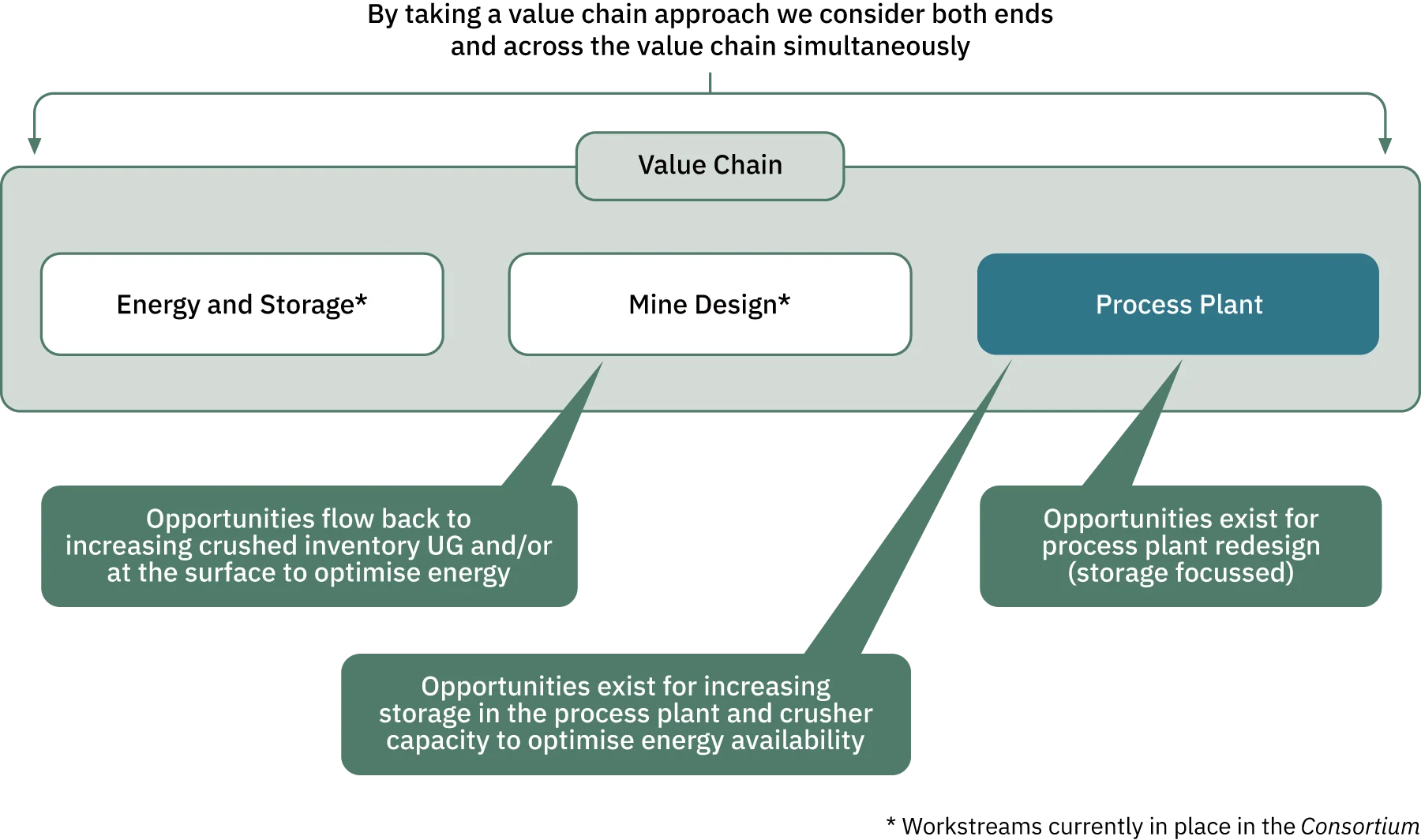
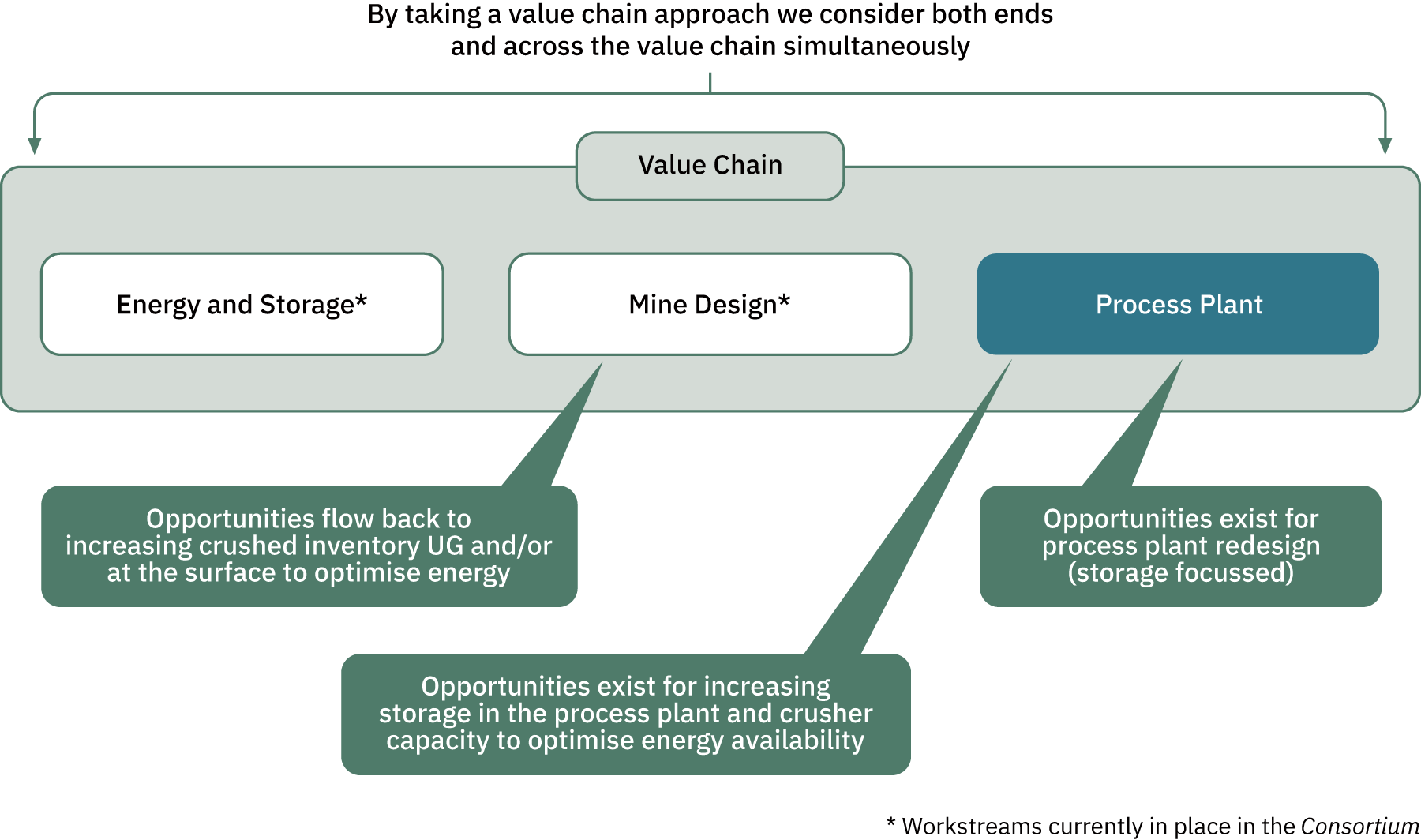
The opportunity to reduce emissions through a whole of value chain approach (mining and processing), and plant redesign is impactful, yet poorly understood. Companies will need to change the objective function of new mines, moving from solely production and grade, to also include energy optimisation.
Most mining assets are increasing their supply of renewables – an energy source that is characterised by its intermittency. Today’s mine typically only consider parts of the value chain, and as such, many companies within EMC recognise that whole-of-operations energy use is not optimised in this situation. However, by taking a full value chain view, the opportunity exists to optimise deployment and use of all renewable energy available.
There are four priorities the Consortium considers when evaluating whole-of-system energy optimisation options:
• Value chain energy supply-demand review
• Process storage and inline storage redesign
• Waste energy use/thermal energy
• Process plant automation (energy optimisation focus)
Noting that while there are many other process plant technologies also under consideration by the Consortium members, to create a step change in energy and water use, the focus in the Consortium is about optimising for energy use within current and future plants.
Scope
The Consortium is discussing new forms of energy storage inside the process plant and across the value chain leading up to the process plant, including:
Underground crushed inventory storage
Surface stockpiles
Leach tanks, and
Process heat
Planning
Over the remainder of 2023, the Consortium energy supply and storage working group will consider alternate approaches to energy storage available through operating model changes that enable flexibility, including the capital associated to deliver. The working group will also review energy optimisation approaches of the combined process plant and mine design, for example, alternate process plant or mine designs consistent with new forms of storage.
EMC will be actively applying the power of collaboration to consider first principles value chain design in the context of the rapidly changing climate, social and financial context. It will revisit site studies analysis, capital decision making, energy storage design and the approach to energy supply design. In the following months, the Consortium will continue its engagement with process plant partners, including technology suppliers and investment houses, as well as with other collaborative groups such as the ICAA.
Open Innovation
The challenge and importance of long-duration storage have been recognised by the EMC, which in late 2022 launched an energy storage challenge. The Consortium set out to gather expressions of interest (EOI) from providers to deliver long-duration energy storage systems at nominated sites.80
The EMC recognises that the mining industry’s transition to zero-carbon remains reliant on its ability to store and dispatch vast amounts of intermittent renewable energy, such as wind and solar, to displace fossil fuels.
While renewable energy technology is becoming mature, the long-duration energy storage technologies required to smooth its variability are largely not proven at the scale required in mining.
Through an open call, the EMC is engaging with providers of energy storage technologies that can, individually or through collaboration, provide long-duration energy storage systems at one or more of several nominated sites. The challenge is open to identifying a range of storage capacities and technologies with no restriction on the form of technology – thermal, electric, gravity, chemical or other.
Successful proponents will showcase their developing technologies and demonstrate their commercialisation pathway. Learnings will be used to further understand the near-term and long-term commercial viability of storage solutions. They will be shared with the mining and other industries as deemed appropriate by the Consortium.
The challenge associated with long-duration storage underscores the importance of a sustained, holistic approach to energy demand efficiency and process optimisation in mineral processing. Specifically, this approach is crucial for creating options that reduce, stabilise, or introduce flexibility in the required energy loads and ultimately create options for a range of long-duration energy storage solutions.
For more information: electricmine.com
