

As ventilation air travels through the mining network, it encounters different heat sources, which can impact its temperature. Positional efficiency addresses this issue by aligning cooling with the actual requirements of different mining zones. In traditional ventilation systems, the cooling occurs at the surface, necessitating the design of a system to the warmest sections in the mine, which is typically at the deepest levels. Surface cooling can lead to overcooling in the shallower regions, which results in wasted energy consumption. To mitigate this, the cooling systems can be relocated closer to the ‘hotspot’ to better match the cooling resources to the cooling demands of the mine. This approach optimises the ventilation system by reducing wasted energy consumed and improving consistent working temperatures throughout the mine.
The Palabora Mining Company’s (PMC) underground block cave mining operation located in Limpopo, South Africa, is a relevant case study on the effects of positional efficiency.104 PMC mines copper below discontinued open pit workings at a depth of 1,200m below the surface. In 2012, the operation underwent an expansion by 20 per cent in their loading crosscuts, and this development required additional air and cooling. In addition, the underground crusher airflow was to be increased to account for dust dilution. To accommodate a changing ventilation requirement, PMC completed trade-off studies to determine an optimal refrigeration and cooling design.105 Five options were selected, including:
- Surface refrigeration supplying low-pressure underground cooling system.
- Surface refrigeration supplying high-pressure underground cooling system.
- Surface refrigeration supplying a low-pressure underground cooling system via a Pelton turbine.
- Surface refrigeration supplying a low-pressure underground cooling system via a 3-chamber- pipe-feeder.
- Underground refrigeration supplying a low-pressure underground cooling system.
PMC considered increasing the capacity of the 15,000 kW bulk air cooler (BAC) to meet the additional air- cooling requirement of 3,000 kW. However, the heat load in the block cave was concentrated in the loading crosscuts, deep in the development. Thus, to meet the cooling requirement, other areas like the conveyor belts, crushers and workshops would be ‘overcooled’. It was determined that PMC’s mining layout is best suited to Option 5; however, the engineering design’s major challenge was ensuring that the refrigeration systems and electrical systems could cater for future developments.106
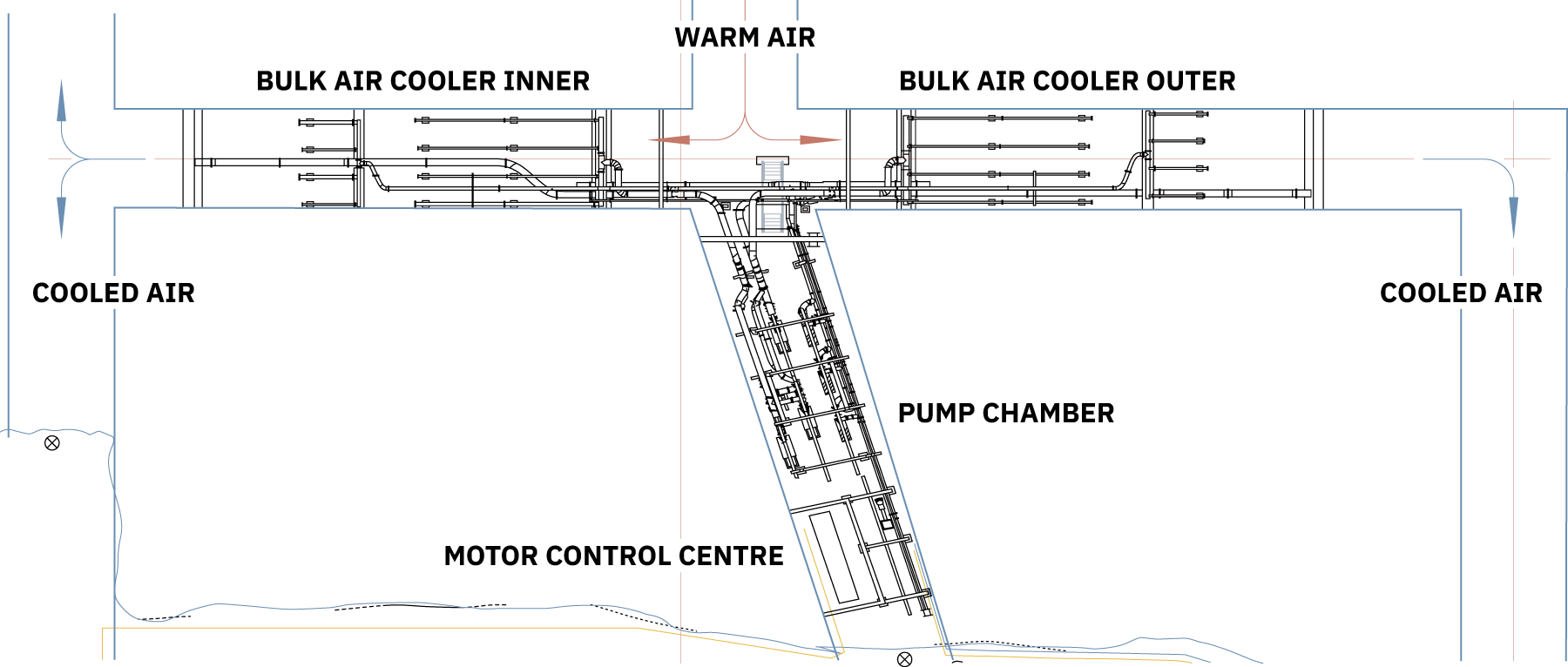
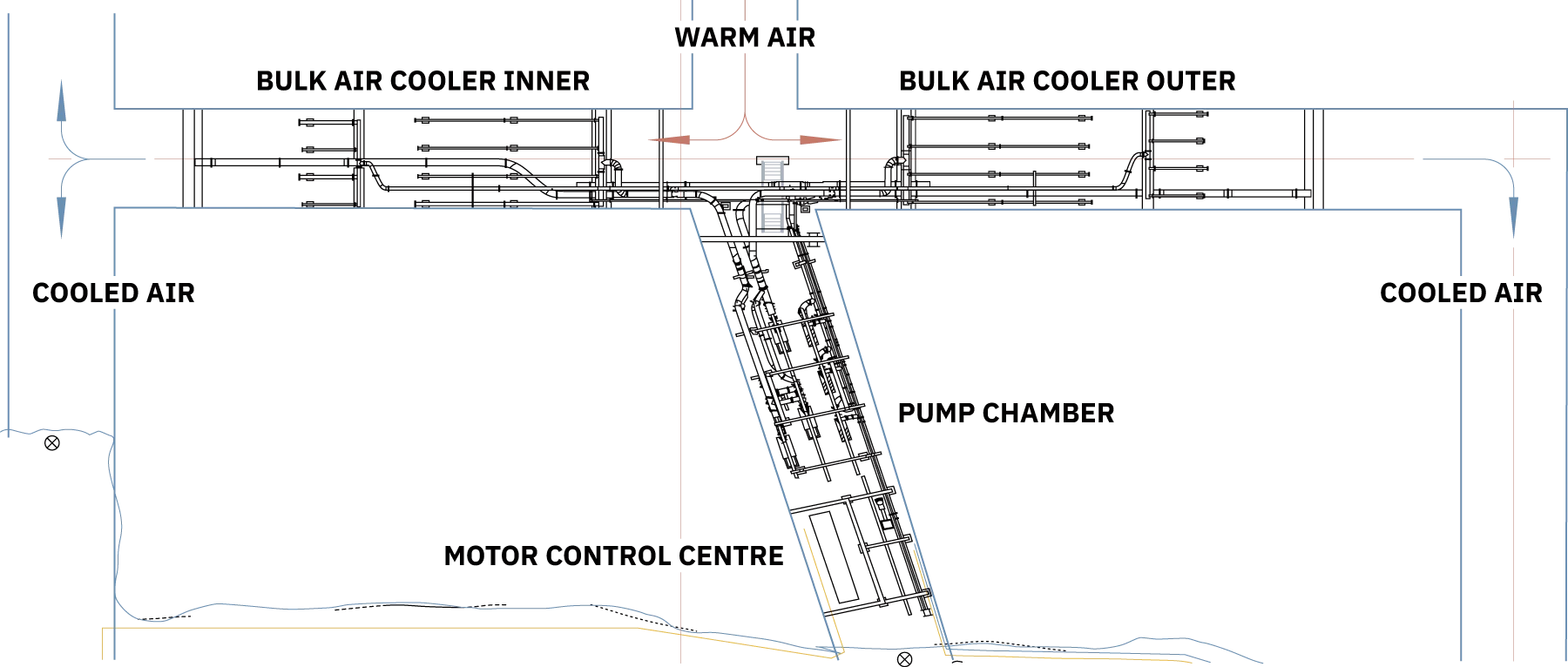
Two underground BAcs and cooling coils were selected to meet the 12,500 kW cooling requirements, with one BAC to capture and recondition the return air from the crusher and belt level. This re-use model would deliver 320 kgs of air back into the mining footprint. Figure 27 shows the configuration of the re-use BAC.
Figure 27 - Case Study: Positional Efficiency - Configuration of the Re-Use BAC