

ConnectOre is an industry-wide collaboration to unlock innovation, advance responsible practices, and tackle mining industry challenges that are beyond the scope of any single organisation.
The bottleneck has moved from truck to battery chemistry. Haul trucks are proven; range, charging and cost now depend on battery chemistry maturing across three horizons. Shared trials have already pulled zero-emission haulage forward a decade. Producers who collaborate on chemistry choices will electrify first.
Haulage Electrification — Did You Know?
- Around 28,000 large haul trucks are in service globally - almost all of them diesel.
- Diesel mobile equipment generates 30 - 50% of a mine’s Scope 1 emissions up to 80% at some sites.
- Electricity to run a battery-electric truck costs about one-third of the diesel equivalent.
- As ore grades decline, haulage demand could grow 125% by 2050 without technology intervention.
- Collaboration has pulled zero-emission haul trucks at scale forward to 2030 a decade early.
The Truck Was Never the Hard Part
The challenge has moved. Drivetrains and platforms have matured. The constraints have migrated to the ‘system’ (energy transfer, renewable supply, grid capacity, fleet-renewal timing and policy), and to the cell chemistry that sets how far and how fast a truck can work.
The Collaboration Proof Point
No single operator can de-risk this alone. In December 2025 two competitors - BHP and Rio Tinto - shared a trial site, supply chain and learnings with Caterpillar in the Pilbara. That is the innovation. For smaller producers, pooling demand through consortia unlocks technology no mid-tier operator could reach alone.
Innovation Spotlight — Cell Chemistries
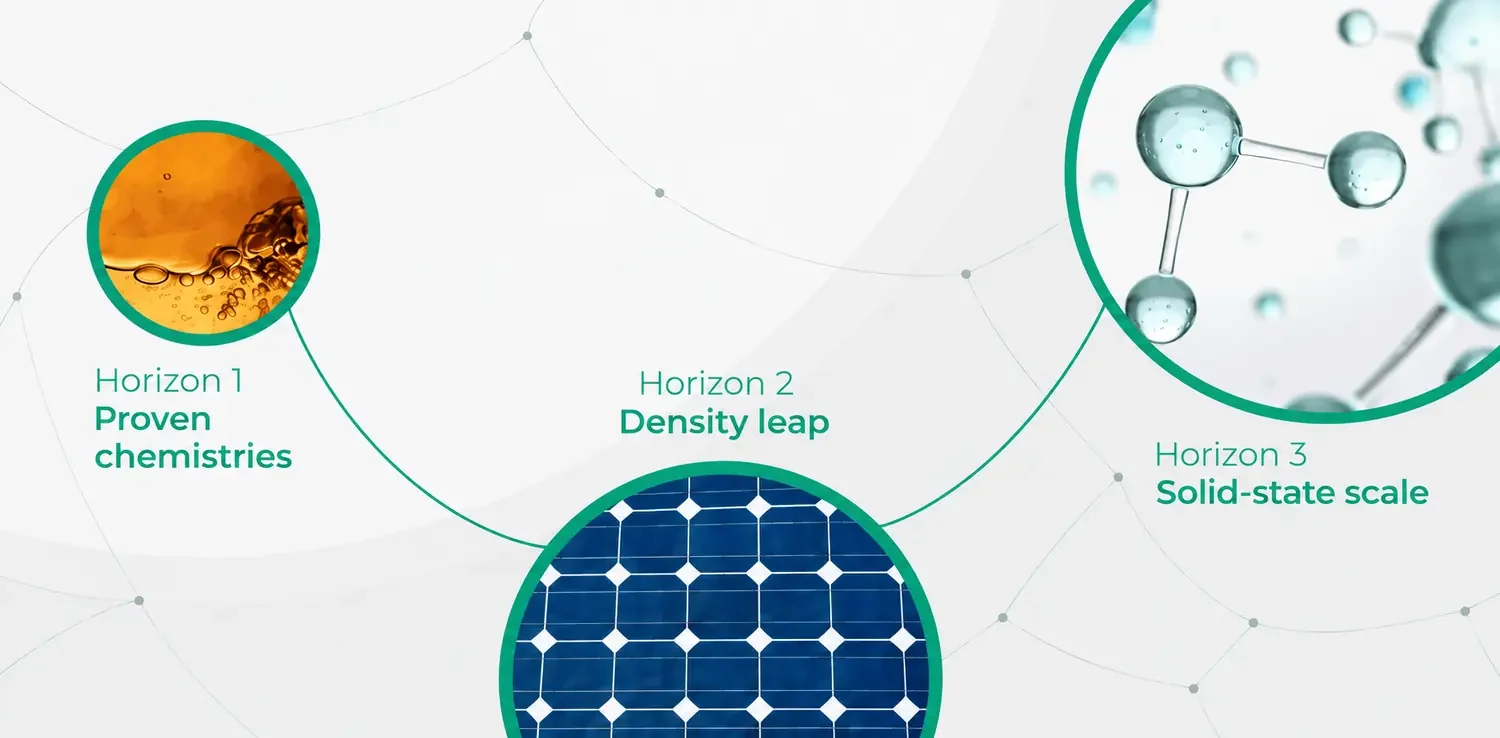
Horizon 1 → 3
Horizon 1 — Available
- LFP – the proven workhorse: Thermally stable, reliable and powering Fortescue’s battery-electric locomotives.
- Sodium-ion now in mining: demonstrated in the HiNa - Tonly TLE120 haul truck.
- Lithium-titanate – built for rapid charging: Ultra-fast charging and improved cycle life where uptime matters most.
Horizon 2 — Evolving
- Silicon-carbon - the near-term density leap: +20% energy density and 40% faster charging
- All-solid-state - moving from lab to pilot: Major players including Samsung SDI, BMW and Toyota targeting commercialisation from 2027–28.
- Lithium-sulphur - scaling toward commercial production: Australian technology is advancing toward 1 GWh annual capacity, backed by ARENA funding.
Horizon 3 — Emerging
- All-solid-state - a step-change in energy density: Targets of 500 Wh/kg by 2030, with potential to reduce pack mass and charging constraints.
- Second-life batteries - extending value beyond vehicles: Retired packs for site microgrids and vehicle-to-grid applications, improving whole-of-life economics.
- Policy shaping chemistry choices: Emerging incentives, (including China’s tax exemptions), could accelerate next-generation technologies.
Who Is Solving It?
| Category | Organisations |
|---|---|
| Cells & Chemistry | CATL · BYD · HiNa · Samsung SDI · Toyota · QuantumScape · Solid Power · Factorial · ProLogium |
| Australian Innovators | Sicona · Li-S Energy · Gelion · CSIRO · Future Battery Industries CRC |
| Integrators | Fortescue Zero · Liebherr · Caterpillar · Komatsu · Epiroc · Sandvik · XCMG · Tonly |
| Enablers | ARENA (Battery Breakthrough Initiative) · ICMM Cleaner, Safer Vehicles · GMG |
