


Introduction
Mineral processing, whether oxide or sulphide ore types, is a critical function in primary copper production. It is a process that transforms copper ore into a higher-value concentrate or copper metal. It is also the most energy-intensive stage of upstream copper production and can contribute significantly to a site’s emission profile depending on the energy source.1
Comminution refers to the process or a set of processes where the valuable component of an orebody is liberated from the host rock until the separation of the mineral can be achieved by the most appropriate methods. Comminution processes are often called “size reduction” due to the conversion of large particles of ore to smaller ones. However, the primary goal of comminution is to liberate the target mineral rather than simply reduce the particle size.
The process of comminution is typically the largest single consumer of energy for a copper operation and alongside gold, iron ore, nickel and lithium operations is estimated to consume up to 1 per cent of energy generated on the planet.2 3 Within a copper operation it typically accounts for 30 to 40 per cent of total site energy use, and inside the concentrator itself the crushing and grinding process can draw 50 to 65 per cent of electrical energy consumption.4 5 In a sector facing a near doubling of refined copper demand by 2050, comminution is where energy use optimisation and cost discipline converge most forcefully.
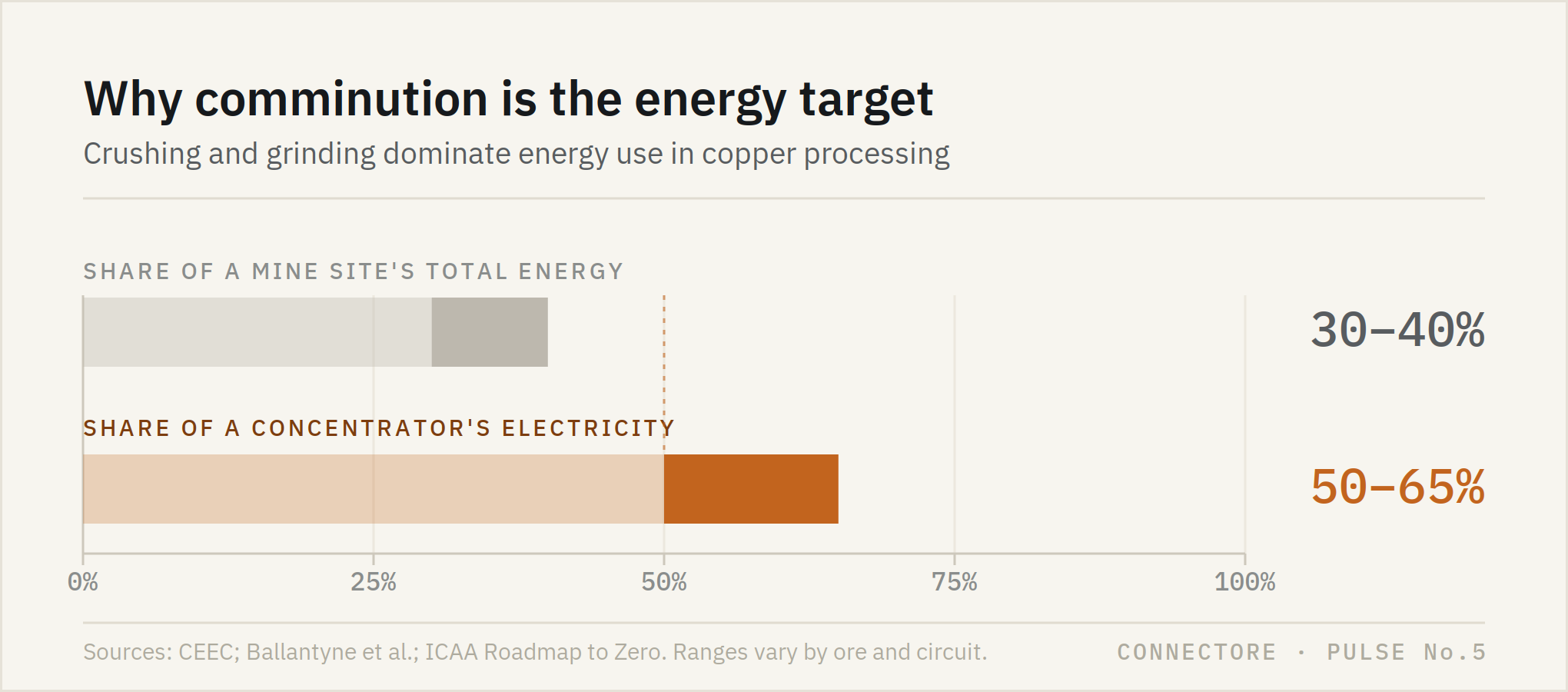
Figure 1. Crushing and grinding dominate energy use in upstream copper production, making comminution a natural energy optimisation and decarbonisation target.
The economics are unforgiving in one direction: as copper ore grades decline, more rock must be moved and ground to recover the same tonne of metal, so energy, water and emissions intensity rise unless technology or methodology intervenes. CEEC's benchmarking of more than 400 copper sites confirms that ore grade is the single greatest determinant of comminution energy, which means the largest gains often come not from a bigger mill, but from rejecting waste rock and liberating minerals before they ever reach it.3 6 Small percentage improvements in such an energy-dominant process can translate into large absolute savings in power, cost and emissions.
What makes comminution strategically distinct today is that the conversation has shifted. For decades, efficiency advanced in small increments inside conventional ball and semi-autogenous grinding (SAG) circuits. The question now is no longer simply “how do we grind more efficiently?” but “how much grinding can we avoid, and how do we power what remains with firmed, low-carbon or renewable energy?” Answering that requires coordinated action across producers, OEMs, METS innovators, energy providers, researchers and government, and a pragmatic approach to determine which pathways are deployable today versus aspirational.
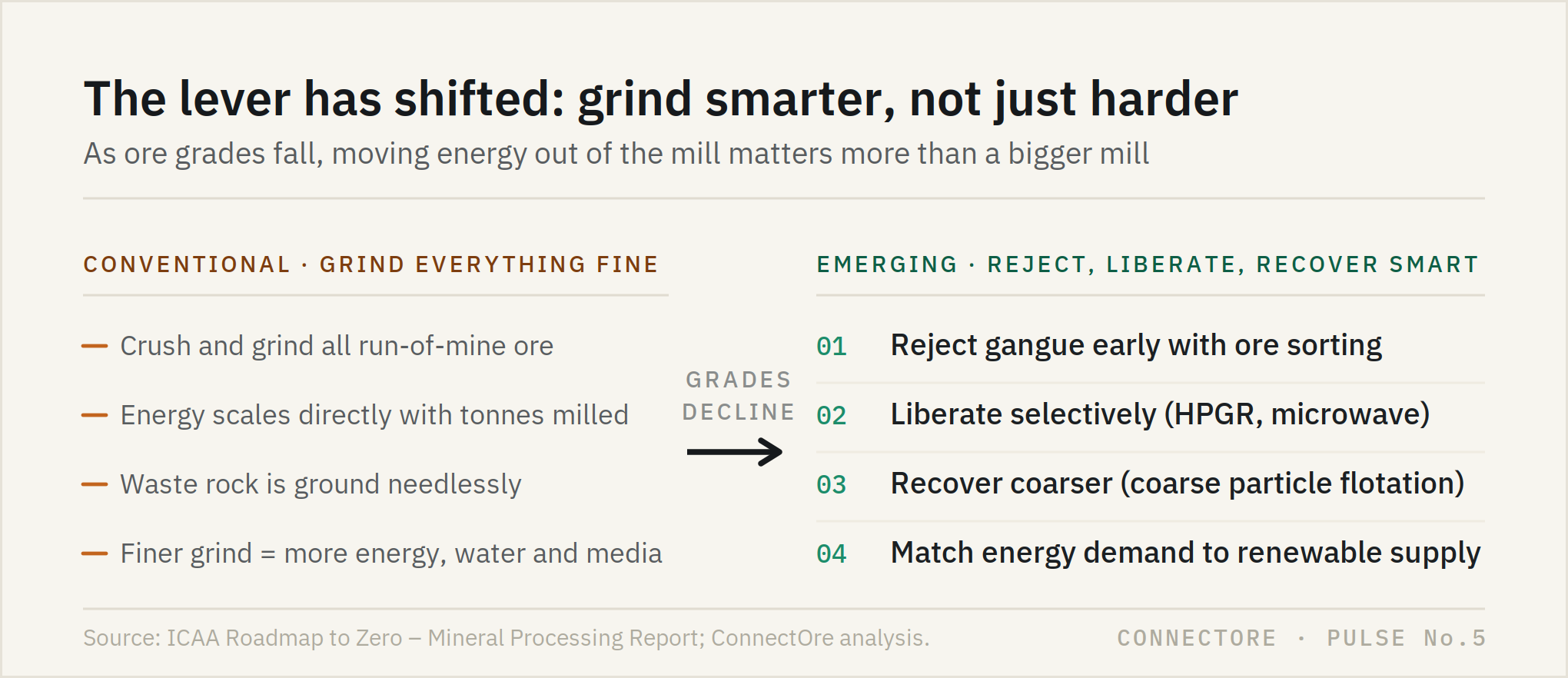
Figure 2 For comminution, the strategic lever has shifted from grinding harder to grinding smarter - rejecting, liberating and recovering before energy is spent.
Comminution at a glance
Technology readiness across three innovation horizons: ore sorting, high-pressure grinding rolls (HPGR) and coarse particle flotation lead near-term deployment; dry grinding, real-time liberation analysis and digital twins define the medium term; while selective-fracturing, electric-pulse and in-situ approaches that avoid comminution altogether remain emerging.
| H1 Available | Leading technologies Sensor-based ore sorting and pre-concentration; high-pressure grinding rolls (HPGR) and stirred mills; coarse particle flotation; wear monitoring and AI process control; demand-side energy management. Representative players Weir, Metso, FLSmidth, Eriez, TOMRA, Scantech, Jord, Loesche, CEEC, NextORE |
|---|---|
| H2 Evolving | Leading technologies Vertical roller mills and dry grinding; real-time and rapid liberation analysis; classification and circuit redesign; digital twins at scale; energy storage and firming for flexible power. Representative players Loesche, Magotteaux, FLSmidth, JKMRC / UQ Sustainable Minerals Institute, CEEC, Dassault Systèmes, OEM-agnostic METS providers. |
| H3 Emerging | Leading technologies Microwave and selective fracturing; electric-pulse fragmentation; in-situ recovery (avoiding comminution); AI and machine learning applications. Representative players Canadian Mining Innovation Council, SELFRAG, Amira Global, Mining3, EnviroCopper, university research centres, METS innovators. |
Figure 3. Comminution innovation mapped across three horizons, with a selection of players and programs in each.
Top of Mind for Mining Executives
Executives are no longer debating whether comminution efficiency matters, but how to capture it without disrupting production or stranding capital in long-life processing assets. Several themes feature across the agenda.
The energy-grade squeeze is a central commercial challenge. Declining head grades push grinding energy use up exponentially. Because grade is the dominant driver of specific energy, the highest-leverage response is to keep low-value rock out of the mill. This is achieved through ore sorting and pre-concentration rather than simply installing more grinding power.
More efficient breakage is moving from option to expectation. High-pressure grinding rolls and stirred mills are now mainstream in copper, delivering reported energy savings of roughly 15 to 35 per cent over conventional ball and SAG circuits; one analysis suggests broad HPGR adoption could cut the global mining industry's grinding-related emissions by up to 43.5 per cent.7 8
Coarse particle flotation reframes the grind target. If minerals can be recovered at a coarser size, the mill can run a coarser grind and save energy. Technologies such as Eriez HydroFloat and FLSmidth coarseAIR now recover particles up to roughly 850 µm in sulphides, well beyond the conventional 10 - 150 µm window, provided the ore is sufficiently liberated.9 10 11
Capital intensity and brownfield risk weigh heavily. Comminution equipment is long-life and capital-intensive, typically optimised for run-time and reliability. Retrofitting novel technology into a producing circuit carries real risk: disruption, optimisation, and a potential loss of sunk capital. This pushes much of the boldest innovation toward greenfield projects and/or staged, modular adoption.
The hidden energy in media and ancillaries is now counted. Grinding-media wear and ancillary equipment (pumps, conveyors) add, on average, around 45 per cent to the electrical energy of a comminution circuit once embodied energy is included. This sharpens the case for wear-resistant media, condition monitoring and circuit design that minimises recirculating load.14
Digital twins and AI offer delivering measurable gains. Major producers now run digital twins of grinding circuits: BHP uses advanced analytics and a digital twin at Escondida to understand how ore characteristics and granulometry affect SAG-mill performance, while AI is applied to predictive maintenance of liners and media.15
Firm, low-carbon energy is the enabling constraint. Comminution demands a secure, stable baseload. Decarbonising it depends as much on the availability of firm renewable power, storage and demand-side flexibility as on the mill itself, reflecting the same system-level challenge that defines the wider energy transition.
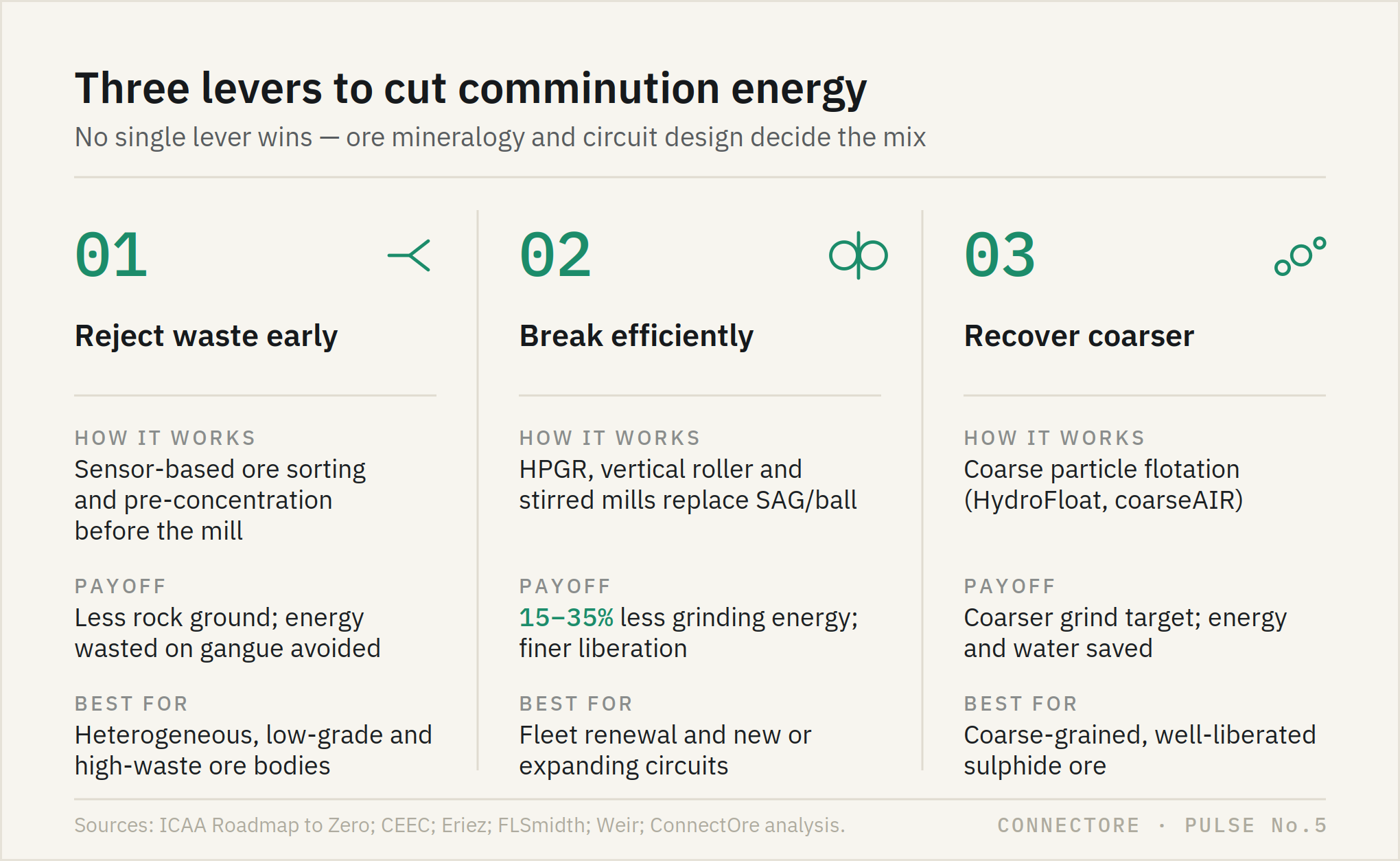
Figure 4. Three complementary levers to cut comminution energy; ore mineralogy and circuit design determine the mix.
Innovations Horizon 1 (Available)
The near-term horizon is about deployment, integration and operational learning. Several solution classes are commercially available or in advanced use now.
Sensor-based ore sorting and pre-concentration solutions. Bulk and particle sorting using near-infrared (NIR), X-ray transmission (XRT) and magnetic-resonance sensors rejects gangue ‘on-belt’ before crushing or grinding, attacking energy waste at its largest source. Providers such as TOMRA, with on-belt analysers from Scantech, and NextORE are increasingly economic for heterogeneous, low-grade ore.
HPGR and stirred mills. High-pressure grinding rolls (a dry process that fractures particles between counter-rotating rolls and induces micro-cracks), and stirred mills for fine grinding are now widely deployed in copper, available through Weir, Metso and FLSmidth, with documented energy and liberation benefits over conventional circuits.7
Coarse particle flotation. Fluidised-bed flotation (Eriez HydroFloat, FLSmidth coarseAIR) recovers coarse, liberated particles that conventional cells lose to tailings, enabling a coarser, lower-energy grind. The University of Queensland's Coarse Particle Recovery Program has carried this from research into commercial installations.10 11 12
Wear monitoring and AI process control. Condition monitoring, artificial neural networks for liner and media life prediction, and digital twins of grinding circuits cut unplanned downtime and keep mills at their efficient operating point.14
Demand-side energy management. Structured monitoring, auditing and real-time control to use the minimum energy needed for the duty, increasingly paired with ESG and emissions reporting offers a whole-of-system optimisation.

Innovations Horizon 2 (Evolving)
The medium horizon is defined by solving liberation and classification more intelligently, embracing dry processing, and integrating comminution into a fully instrumented, energy-flexible plant.
Vertical roller mills and dry grinding. Dry grinding via vertical roller mills (a solution long used in cement industries) is advancing in minerals circuits, with pilot work indicating around 18 per cent lower energy than a comparable ball-mill circuit for copper ore. Loesche and partners are focusing R&D on integrating VRMs with dry sorting to remove coarse gangue before liberation-size grinding, reducing both energy and downstream water demand.8 13
Real-time and rapid liberation analysis. Moving beyond slow laboratory QEMSCAN/MLA toward advanced sensors, data analytics and AI for automated, optimised circuits is unlocking smarter classification that treats particle size as a true proxy for liberation.
Classification and circuit redesign. Forward and reverse classification (‘closed-circuit’ comminution) removes particles already at target size and recycles oversize, avoiding both over-grinding and under-liberation; CEEC leads initiatives promoting energy-efficient circuit design.
Digital twins at fleet scale. Whole-plant virtual replicas let operators simulate changes, debottleneck circuits and manage ore variability. This practice is evolving at leading producers and extending across multiple sites.
Energy storage and firming. Pairing efficiency and process-optimisation technologies with storage and firming enables flexible power consumption, helping match a baseload-hungry process to variable renewable supply.

Innovations Horizon 3 (Emerging)
The long horizon points toward step-changes in how rock is broken, and ultimately, toward recovering copper with as little comminution as possible.
Microwave and selective fracturing. Exposing ore to microwaves induces micro-fractures along grain boundaries, selectively weakening rock before comminution. The CanMicro technology that won Canada's Crush It! Challenge integrated microwave treatment with multi-sensor sorting and claimed energy reductions exceeding 35 per cent across several commodities.9
Electric-pulse fragmentation. High-voltage pulsed power (e.g. SELFRAG) selectively breaks ore along mineral boundaries and can pre-concentrate by grade, offering a fundamentally different, lower-energy breakage mechanism for complex ores.16
In-pit and mobile comminution. Crushing, and potentially grinding, close to the point of extraction could reduce the energy and cost of hauling ore to a central plant, optimising the whole mine-to-mill system and lowering capital tied up in haulage and fixed infrastructure.
In-situ recovery - avoiding comminution. Dissolving copper in place and recovering it as a liquid sidesteps crushing and grinding entirely. Constrained today by orebody type, chemistry and setting, it is an active research priority (Mining3, EnviroCopper) for suitable deposits.
AI orchestration of fleet-level energy. Treating energy as a plant-wide resource includes dynamically sequencing mills, classification and recovery against real-time renewable availability and price.
Case Study - Models to accelerate advanced technology adoption
The defining lesson of comminution innovation is that no single operator or supplier can de-risk a step-change alone: the capital, the development cost and the ore-specific uncertainty are too great. Two models stand out. The Crush It! Challenge, launched in 2018 by Natural Resources Canada under the Impact Canada initiative, used an outcomes-based prize to crowdsource comminution solutions. Over 60 teams applied; six finalists shared early funding before the Canadian Mining Innovation Council won a CAD $5 million grand prize for CanMicro, its microwave-plus-sorting technology. The challenge demonstrated how a mission-led, technology-agnostic competition can pull breakthrough ideas forward.9
The Coarse Particle Recovery Program at the University of Queensland's Julius Kruttschnitt Mineral Research Centre shows the complementary, consortium model. Having completed its first five-year phase (2020-2025), it has entered a second phase running to 2030, assembling diversified majors, specialist copper producers, equipment makers and contract miners around a single research agenda - a cross-section of the global copper industry rarely convened together.11
The common thread is risk-sharing: producers aggregating demand and operational data to give OEMs the confidence to invest; OEMs and METS co-developing with operators rather than in isolation; and government and research closing the gap on first-of-a-kind funding and standards. For mid-tier and smaller producers, joining such consortia offers access to de-risked technologies and supplier commitments that no single operation could unlock alone.
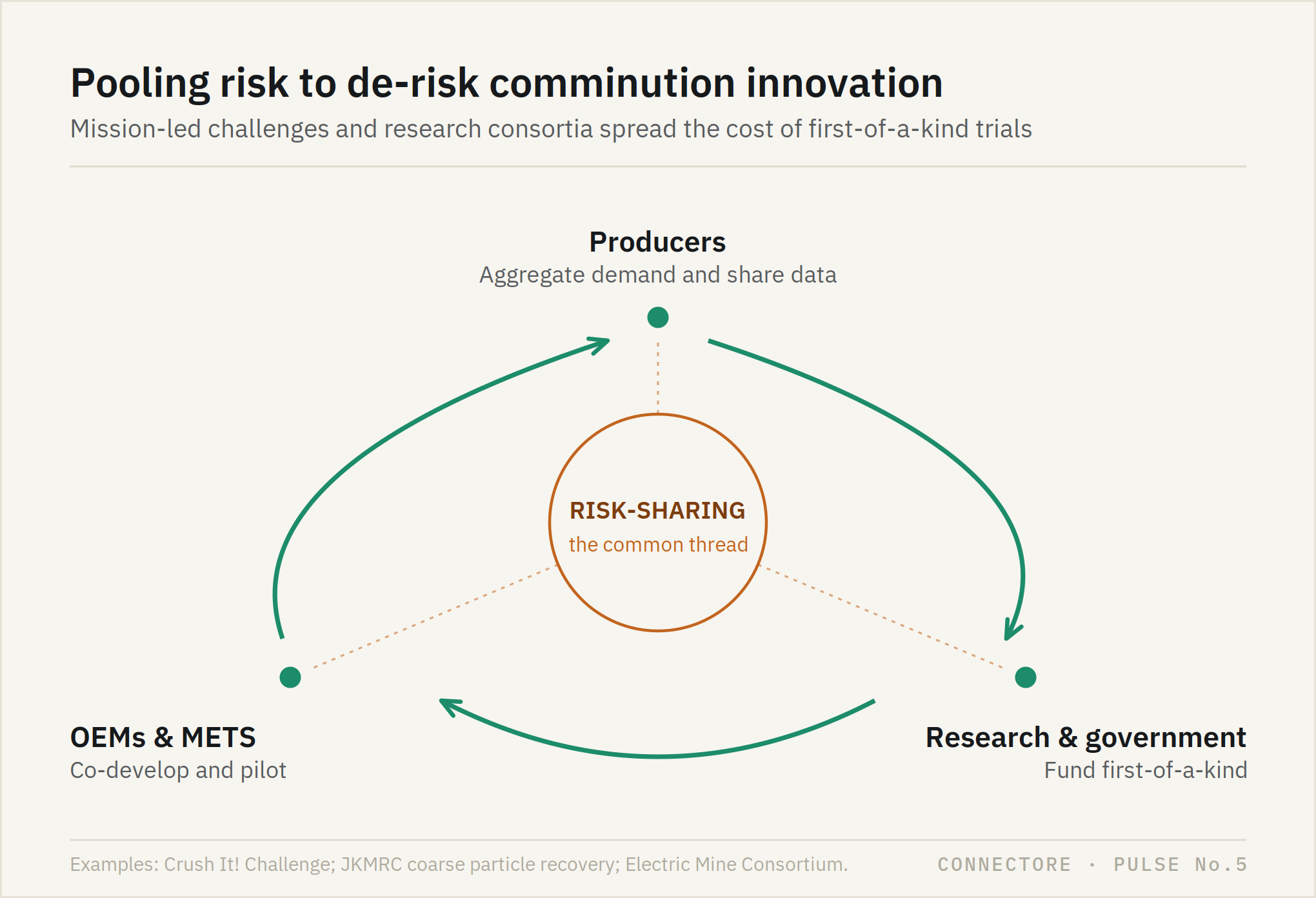
Figure 5. Collaboration models that pool demand and share the cost of de-risking comminution innovation.
The Pulse of Policymakers
Policymakers play a role in setting the pace of comminution decarbonisation through both economic signals and direct support. Australia's Safeguard Mechanism imposes declining emissions baselines on large facilities, creating a regulatory pull on the most energy-intensive processing steps. Comminution, as the dominant electrical load, sits squarely in scope. The decisive variable is the cost and firmness of low-carbon electricity, which determines whether efficiency gains could translate into emissions reductions.
Direct funding instruments do meaningful work in moving first-of-a-kind technologies down the cost curve, from Canada's Impact Canada challenges to Australian Research Council training centres and CRC research priorities focused on integrated operations, in-situ recovery and energy-efficient comminution. Industry bodies such as CEEC accelerate progress by benchmarking circuits through its Energy Curve Program and making best-practice data openly available, creating a competitive incentive for operators to move ‘down the curve’ toward greater energy productivity.6
Across jurisdictions, the highest-leverage policy moves are aligning carbon signals with the real cost of energy, funding demonstration plants, accelerating grid connection and renewable approvals for processing loads, and supporting pre-competitive research consortia and interoperability standards. Workforce capability, the specialist metallurgical and data skills that modern comminution circuits demand, rounds out the agenda.
Conclusion
Comminution is the largest single lever in the energy and emissions profile of copper production, and various technologies are available and maturing to optimise this aspect of the value chain. Ore sorting, HPGR and coarse particle flotation are deployable today; dry grinding, real-time liberation analysis and digital twins are scaling; and selective-fracturing, electric-pulse and in-situ approaches point toward a future that breaks less rock to recover more metal.
There is no single winning technology. The realistic technology adoption strategy is a portfolio matched to each orebody: reject waste early where ore is heterogeneous and low-grade; break more efficiently through HPGR and stirred mills at every fleet-renewal opportunity; recover coarser where mineralogy allows; and reserve selective-fracturing, in-pit and in-situ options for the hardest or most suitable cases. Underpinning all of it is shifting to firm, low-carbon energy and the data systems to integrate and optimise the process.
The implications for industry leaders are to treat grind size and liberation as commercial decisions, not just metallurgical ones. Design new circuits around energy efficiency from the outset, where the risk of retrofitting is lowest. Count the hidden energy in media, ancillaries and recirculating load. Pair every efficiency investment with a credible firm-power pathway. And collaborate pre-competitively to aggregate demand and share the cost of de-risking. The producers who treat comminution as a system-level transformation, not an equipment-replacement decision, will produce copper more cheaply, more cleanly, and help define how the world's most critical electrification metal is produced in a low-carbon future.
About
ConnectOre is an industry-wide collaboration to unlock innovation, advance responsible practices, and tackle mining industry challenges that are beyond the scope of any single organisation.
Get Involved
Sources
1 Copper - The Pathway to Net Zero, International Copper Association, 2023.
2 Mining Energy Consumption 2021, Allen, M. (engeco), commissioned by The Weir Group / CEEC.
3 Benchmarking comminution energy consumption for the processing of copper and gold ores, Ballantyne, G. & Powell, M., Minerals Engineering, 2014 (CEEC).
4 Roadmap to Zero - Mineral Processing Report, International Copper Association Australia (ICAA), 2023.
5 Energy and greenhouse gas impacts of mining and mineral processing operations, Norgate, T., Haque, N., Journal of Cleaner Production, 2010.
6 Energy Curve Program and comminution benchmarking resources, CEEC.
7 Helping to reduce mining industry carbon emissions: sizing and selection of energy-efficient HPGR circuits, Morrell, S., Minerals Engineering, 2022.
8 Copper ore grinding in a mobile vertical roller mill pilot plant, Altun, D. et al., International Journal of Mineral Processing, 2015.
9 Crush It! Challenge results, Impact Canada / Natural Resources Canada (CanMicro, Canadian Mining Innovation Council).
10 Coarse Particle Recovery Program, Phase 2 (2025-2030), University of Queensland, Sustainable Minerals Institute (JKMRC).
11 Benefits of Coarse Particle Flotation (HydroFloat), Eriez Flotation.
12 Energy and emissions reduction - HPGR and coarseAIR coarse particle flotation, FLSmidth.
13 Breaking down comminution’s most pressing challenges - Weir and Loesche on dry processing, E&MJ, 2025.
14 Quantifying additional energy consumed by ancillary equipment and embodied in grinding media in comminution circuits, CEEC.
15 The role of digital twins and AI in enhancing decision-making in the mining industry, BHP, 2025 (Escondida SAG performance).
16 High Voltage Pulses resources - Electric Pulse Fragmentation (EPF / HVPP), CEEC, SELFRAG.
