



Introduction
The International Energy Agency (IEA) highlights the critical role of minerals in the clean energy transition, and with it the necessity to effectively manage the environmental and social impacts of mineral development, including significant greenhouse gas emissions (GHG) from energy-intensive mining and processing.1 For copper, the essential electrification metal, understanding and managing these impacts requires robust and transparent reporting: baselines, target setting, tracking and disclosure. Done well, emission reporting underpins the sector’s social licence, protects access to capital and demonstrates the industry’s contribution to the United Nations Sustainable Development Goals.2
Doing it well, however, is not straightforward. Producers must navigate inconsistencies across standards, uncertainty over the depth of information to report, and multiple overlapping frameworks and reporting requirements that vary across jurisdictions. Technological limitations add to the challenge: data availability, verification and monitoring are difficult in complex operating environments, where pre-determined emission factors and poor interoperability between equipment data systems persist.2
What makes this moment strategically distinct is the pace of consolidation and regulation. Since the International Copper Association Australia (ICAA) Roadmap to Zero - Ventilation and Emission Reporting Report was published, the landscape has shifted decisively: the ISSB’s IFRS S1 and S2 standards have become the global baseline and are now adopted, voluntarily or mandatorily, in 28 jurisdictions3 Australia’s mandatory climate-related financial disclosure regime commenced on 1 January 20254 the GRI 14 Mining Sector Standard took effect for reporting on 1 January 20265 and the industry’s four leading voluntary standards, The Copper Mark, ICMM’s Mining Principles, Towards Sustainable Mining and the Responsible Gold Mining Principles are being consolidated into a single global mining standard.6 The challenge for producers is to report once, credibly, and have it count everywhere?
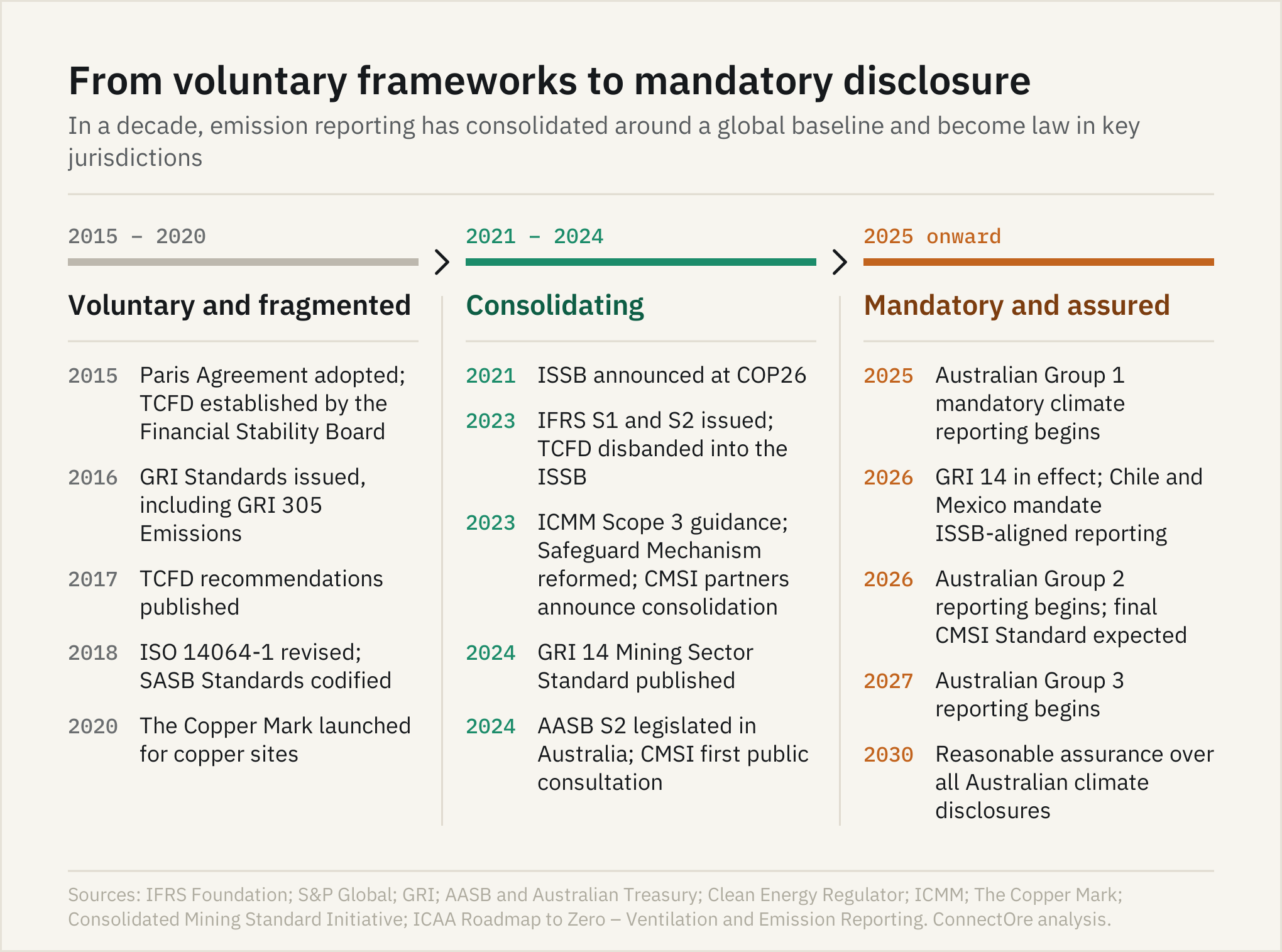
Figure 1. Emission reporting for copper producers is consolidating around a global baseline and moving from voluntary practice to mandatory, assured disclosure.
Emission reporting at a glance
Framework maturity across three horizons: established accounting and disclosure standards underpin today’s reporting; a wave of consolidation and mandatory regimes defines the near term; while nature-related disclosure, natural capital accounting and harmonised product-level carbon accounting are emerging.
| H1 Established | Leading frameworks GHG Protocol corporate and value-chain (Scope 3) standards; ISO 14064 series quantification and verification; GRI Universal and Topic Standards; CDP disclosure; national schemes such as Australia’s NGER; ICMM Scope 3 Emissions Accounting and Reporting Guidance. Representative frameworks and players GHG Protocol (WRI/WBCSD), ISO, GRI/GSSB, CDP, Clean Energy Regulator, ICMM, SBTi. |
|---|---|
| H2 Consolidating | Leading frameworks ISSB IFRS S1/S2 as the global baseline (absorbing TCFD and SASB) and jurisdictional adoptions such as Australia’s AASB S2; GRI 14 Mining Sector Standard (effective 1 January 2026); The Copper Mark assurance framework and Chain of Custody; the Consolidated Mining Standard Initiative (CMSI). Representative frameworks and players IFRS Foundation/ISSB, AASB and Treasury, GRI, The Copper Mark, ICMM, Mining Association of Canada (TSM), World Gold Council. |
| H3 Emerging | Leading frameworks Nature-related disclosure (TNFD and proposed ISSB nature standards); natural capital accounting (SEEA, Natural Capital Protocol); harmonised product-level carbon accounting for mineral supply chains (COMET); digital emissions benchmarking and traceability tools (CRU Emissions Analysis Tool, chain-of-custody digital platforms). Representative frameworks and players TNFD, ISSB, UN SEEA, Capitals Coalition, COMET (MIT/Columbia/RMI), CRU, CSIRO, METS and ESG-data innovators. |
Top of Mind for Mining Executives
Executives are no longer debating whether emission reporting matters, but how to meet proliferating obligations efficiently, credibly and without duplicating effort. Several themes feature across the agenda.
- The reporting burden is real and recognised. Benchmarking of 42 copper producers for the Roadmap to Zero found a wide spread of frameworks in use. Notably GRI, TCFD, SASB and the ICMM principles were preferred, with companies citing inconsistency, overlap and duplication risk. Varying formats, measurement methodologies, definitions, assurance requirements and reporting periods place a significant burden on companies’ ability to report.2
- The voluntary-to-mandatory shift is now live in Australia. Under AASB S2, Group 1 entities began reporting for periods commencing 1 January 2025, with the first sustainability reports lodged in early 2026; Group 2 follows from 1 July 2026 and Group 3 from 1 July 2027. Scope 3 disclosure becomes mandatory from the second reporting year, and assurance requirements escalate to reasonable assurance by the early 2030s.4
- Scope 3 dominates the emissions profile. Value chain emissions can account for up to 95 per cent of a mining company’s total emissions. ICMM’s Scope 3 Emissions Accounting and Reporting Guidance (2023) and companion Target Setting Guidance provide the sector-specific playbook, and ICMM members are required to disclose Scope 1 and 2 emissions annually and set reduction targets at the corporate level.7 8
- Targets remain uneven across the sector. The Roadmap to Zero benchmark found almost half of surveyed producers had no stated emissions targets; of those with targets, most covered Scope 1 and 2, 38 per cent had announced net zero targets (largely 2050), and less than a third had mine-site level data available, the granularity now required by GRI 14 and The Copper Mark.2
- Assurance and greenwashing risk are rising up the agenda. The proliferation of verification frameworks can fuel greenwashing concerns and increase exposure for companies reporting against multiple, inconsistent frameworks. Mandatory regimes bring director-level liability, making data quality, boundary definitions and independent assurance board-level issues.2 4
- Jurisdictional divergence cuts both ways. While the ISSB baseline spreads – with Chile, Mexico and Qatar mandating ISSB-aligned reporting from 2026 – the United States SEC has proposed rescinding its climate disclosure rules entirely, and the EU’s Omnibus package has substantially narrowed the scope of the CSRD. Multi-jurisdiction producers must plan for a patchwork, anchored to the global baseline.3 9 10
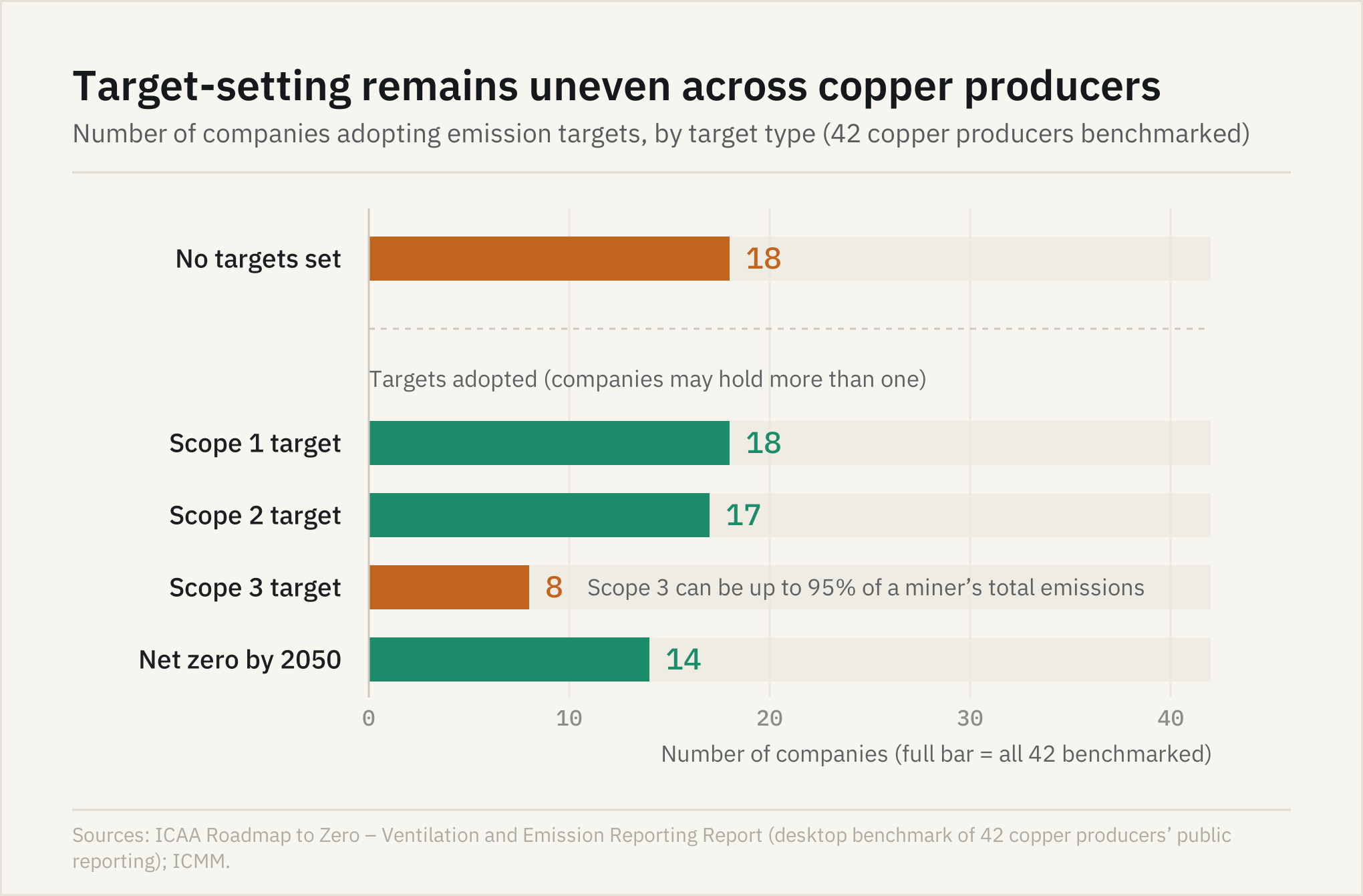
Figure 3. Target-setting maturity varies widely across copper producers; harmonised, mine-site level reporting is the emerging expectation.
The Reporting Landscape - What Has Changed
The Roadmap to Zero Report catalogued the key frameworks relevant to upstream copper production, notably the GHG Protocol, GRI, ICMM principles, CDP, TCFD, SBTi, ISO 14064, NGER, ISSB, TSM, SASB and TNFD.2 The architecture has since simplified and hardened in four important ways.
- The ISSB baseline has absorbed TCFD and SASB. With the TCFD dissolved in late 2023 and its recommendations integrated into IFRS S2, and the SASB standards maintained under the ISSB, the fragmented voluntary landscape anticipated by the Report is consolidating. As of April 2026, 28 jurisdictions have adopted the ISSB standards on a voluntary or mandatory basis, with a further 12 planning to, collectively representing well over half of global GDP.3
- Australia has legislated mandatory climate disclosure. The Treasury Laws Amendment (Financial Market Infrastructure and Other Measures) Act 2024 embedded AASB S2 climate statements in the Corporations Act, phased across three groups from 1 January 2025. This operates alongside NGER and the reformed Safeguard Mechanism, which continues to apply declining Scope 1 baselines to facilities emitting more than 100,000 tonnes CO2-eq – squarely capturing large copper operations.4 11
- GRI 14 sets the sector benchmark for impact reporting. Published in February 2024 and effective for reporting from 1 January 2026, the GRI 14 Mining Sector Standard covers 25 topics, with GHG emissions and climate adaptation at the top of the list. This requires mine-site level reporting, sharpening the granularity expectation flagged in the Report’s benchmarking. Version 1.1, published in January 2026, aligns GRI 14 with the revised GRI 102 Climate Change and GRI 103 Energy topic standards.5
- Nature is next. The TNFD recommendations are being taken up by early adopters, the ISSB has announced it will propose nature-related disclosure requirements to complement IFRS S1 and S2, and natural capital accounting pilots. BHP’s Beenup pilot with CSIRO and partners, point to the mining sector requiring its own set of natural capital accounts.2 3 12
Case Study – The Copper Mark: from copper assurance to a global mining standard
The Copper Mark® is the leading voluntary assurance framework for responsible practices across the copper, molybdenum, nickel and zinc value chains. Launched in 2020, it independently assesses sites against 33 environmental, social and governance criteria – including greenhouse gas emissions under Criteria 15, underpinned by Responsible Minerals Initiative recommendations – with results published site by site.2 13 Around 40 per cent of the world’s mined copper now comes from Copper Mark-assured sites.13 14 15
The framework has also matured. Since 2024, participants have been assessed against version 3.0 of the Risk Readiness Assessment Criteria Guide. This is mandatory for all participants from 1 January 2025 and the criteria has extended coverage beyond copper to molybdenum, nickel and zinc.16 On emissions specifically, the Copper Mark’s partnership with CRU integrates assurance status into CRU’s Emissions Analysis Tool, enabling standardised, like-for-like benchmarking of greenhouse gas intensity across hundreds of copper-producing assets and process steps.2 17
The most consequential development is the Consolidated Mining Standard Initiative (CMSI). The Copper Mark, ICMM, the Mining Association of Canada and the World Gold Council are consolidating their four standards into a single global responsible mining standard with a multi-stakeholder oversight system. A draft standard of 24 Performance Areas with requirements tiered from “Towards Good Practice” to “Leading Practice” has been shaped by two rounds of public consultation, the second closing in November 2025, following ISEAL’s Codes of Good Practice. The Copper Mark itself is evolving into the independent entity that will govern the consolidated standard, expanding its board to 17 members with equal participation of industry and stakeholder representatives, with the final Standard, Assurance Process and Claims Policy ready for implementation throughout 2026.6, 14, 18
Once adopted by existing ICMM, WGC and MAC members and Copper Mark participants, the consolidated standard is expected to cover almost 100 mining companies across approximately 600 operations in around 60 countries, the widest coverage of any voluntary mining standard to date, and a direct answer to the harmonisation challenge identified in the Roadmap to Zero Report. For copper producers, the lesson mirrors that of the broader innovation landscape: no single operator or standard-setter can solve the fragmented reporting setting alone; consolidation, consistent criteria and shared assurance de-risk the reporting task for everyone.6 18
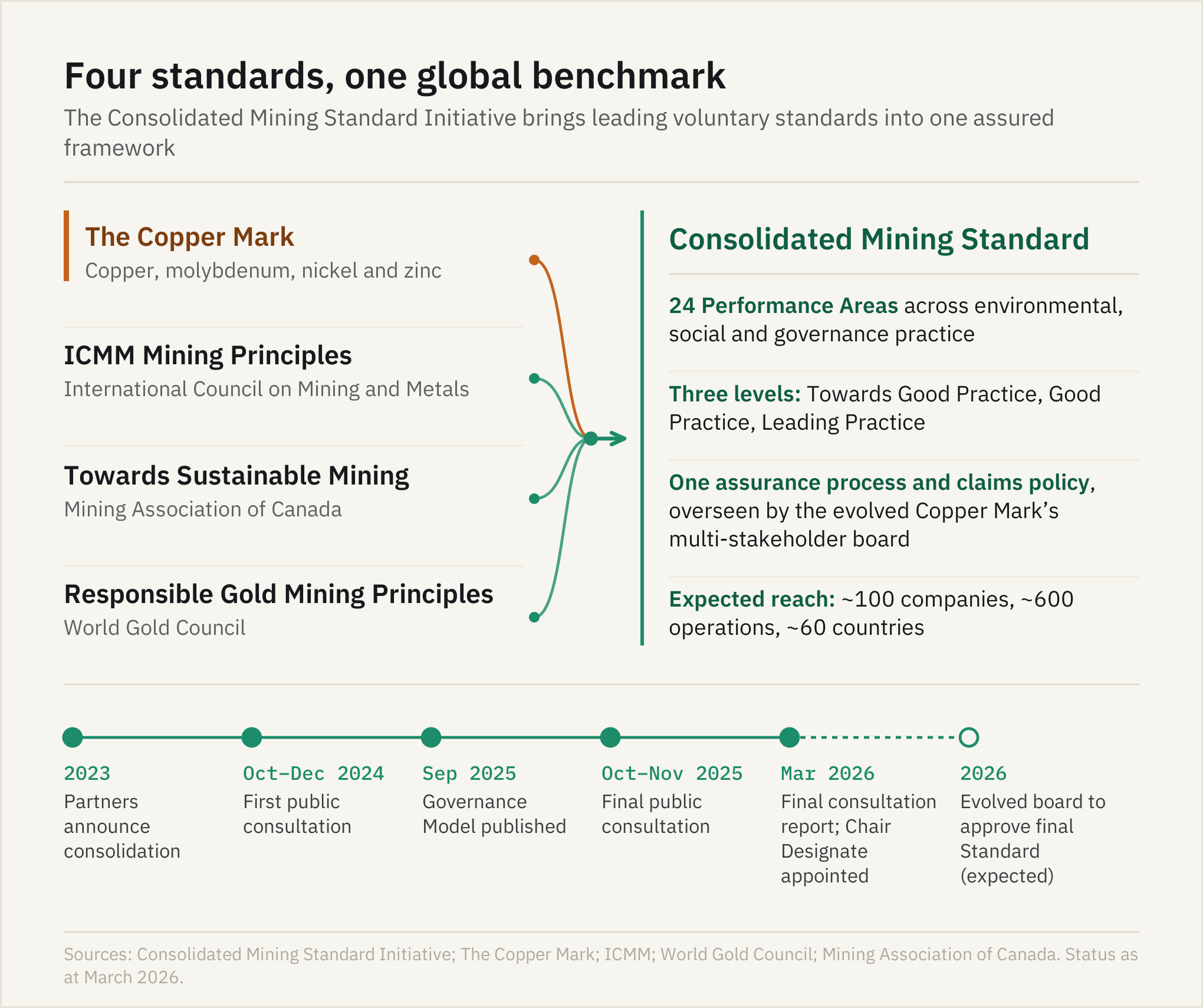
Figure 4. The Consolidated Mining Standard Initiative brings four leading voluntary standards into one global framework governed by a multi-stakeholder board.
The Pulse of Policymakers
Policymakers set the pace of emission reporting through both disclosure mandates and carbon signals, and jurisdictional approaches across the major copper-producing countries continue to diverge. Australia now pairs NGER and the reformed Safeguard Mechanism with declining baselines, Safeguard Mechanism Credits and a trajectory consistent with the 43 per cent 2030 target and net zero by 2050, with mandatory AASB S2 climate statements carrying civil penalties for directors.4 11 Chile, the world’s largest copper producer, has moved from its Energy Efficiency and Climate Change Framework Laws to mandating ISSB-aligned disclosure from 2026, while Peru requires listed companies to publish sustainability reports and the DRC remains reliant on conditional NDC commitments with limited domestic reporting infrastructure.2 3 In the United States, the SEC has proposed rescinding its climate disclosure rules in their entirety, although state-level regimes (such as California’s) continue. This leaves multi-jurisdiction producers to reconcile the world’s most stringent and most permissive settings simultaneously.9 10
Across jurisdictions, the highest-leverage policy moves remain those identified in the Roadmap to Zero Report: supporting a clear, sector-specific definition of reporting boundaries; standardising quantitative measurement (calculation methods, emission factors and direct measurement); establishing relevant sector-specific KPIs; and building a consistent review and assurance process.2 The ISSB baseline, GRI 14 and the CMSI each advance this agenda, but interoperability between them, and with national schemes such as NGER, is where policymakers and standard-setters can do the most to cut duplication without diluting rigour.
Conclusion
Emission reporting has moved from the periphery of copper production to a central area of commercial strategy. Recent development includes: consolidation around a global baseline, mandatory disclosure with escalating assurance, mine-site granularity, and value-chain (Scope 3) coverage. The frameworks catalogued in the Roadmap to Zero Report have not multiplied, they have converged, and hardened into law in key jurisdictions including Australia.
The implications for industry leaders are practical. Treat emission reporting as financial-grade disclosure, with the same data governance, controls and assurance readiness as the annual accounts. Anchor to the global baseline ISSB-aligned reporting to satisfy the widest set of obligations, and use GRI 14 to meet impact and mine-site expectations. Engage with the Consolidated Mining Standard Initiative now, since one credible assurance outcome that counts across four legacy standards is the single biggest efficiency gain on offer. Close the Scope 3 gap using ICMM’s accounting and target-setting guidance before regulators close it for you. And invest in the digital systems, emissions benchmarking, chain of custody and interoperable site data, that turn reporting from a compliance cost into a source of trust, market access and premium positioning. The producers who treat emission reporting as a system-level capability, not an annual publishing exercise, will be best placed to supply the world’s most critical electrification metal in a low-carbon future.
About
ConnectOre is an industry-wide collaboration to unlock innovation, advance responsible practices, and tackle mining industry challenges that are beyond the scope of any single organisation.
Get Involved
Sources
1 IEA, 2021, The Role of Critical Minerals in Clean Energy Transitions.
2 International Copper Association Australia (ICAA), Roadmap to Zero - Ventilation and Emission Reporting Report (Emission Impact Theme).
3 S&P Global Sustainable1, 2026, Where does the world stand on ISSB adoption? (May 2026 update).
4 Australian Accounting Standards Board / Treasury, AASB S2 Climate-related Disclosures; PwC Australia, 2026, AASB S2 unpacked: how did Australia’s Group 1 climate reporting fare?.
5 GRI, 2024, GRI 14: Mining Sector 2024 (effective 1 January 2026; V1.1 published January 2026).
6 Consolidated Mining Standard Initiative (The Copper Mark, ICMM, Mining Association of Canada, World Gold Council).
7 ICMM, 2023, Scope 3 Emissions Accounting and Reporting Guidance.
8 ICMM, 2023, Scope 3 Emissions Target Setting Guidance.
9 US Securities and Exchange Commission, 2026, SEC Proposes Rescission of Climate-Related Disclosure Rules (Release No. 33-11421).
10 Sabin Center for Climate Change Law, Columbia Law School, 2026, Climate Disclosure in Retreat (EU Omnibus Directive (EU) 2026/470 and CSRD scope changes).
11 Clean Energy Regulator, Safeguard Mechanism.
12 Meney et al, 2023, Natural capital accounting for the mining sector: Beenup site pilot case study (BHP, CRC TiME, CSIRO and partners).
13 The Copper Mark, Participants and Partners; Standards (Risk Readiness Assessment Criteria Guide; Chain of Custody Standard).
14 MINING.COM, October 2025, Copper Mark to unify ESG standards for metal producers.
15 Global Mining Review, 2024, The Copper Mark reaches 100 participating sites; Aurubis, 2026, Aurubis Italia becomes first site in Italy to be awarded The Copper Mark.
16 The Copper Mark, Core Documents for the Standards (RRA Criteria Guide 3.0 transition timeline).
17 The Copper Mark, Copper Mark’s assurance framework incorporated into CRU’s Emissions Analysis Tool.
18 Consolidated Mining Standard Initiative, Frequently Asked Questions (final consultation 8 October - 17 November 2025; implementation in 2026).
