
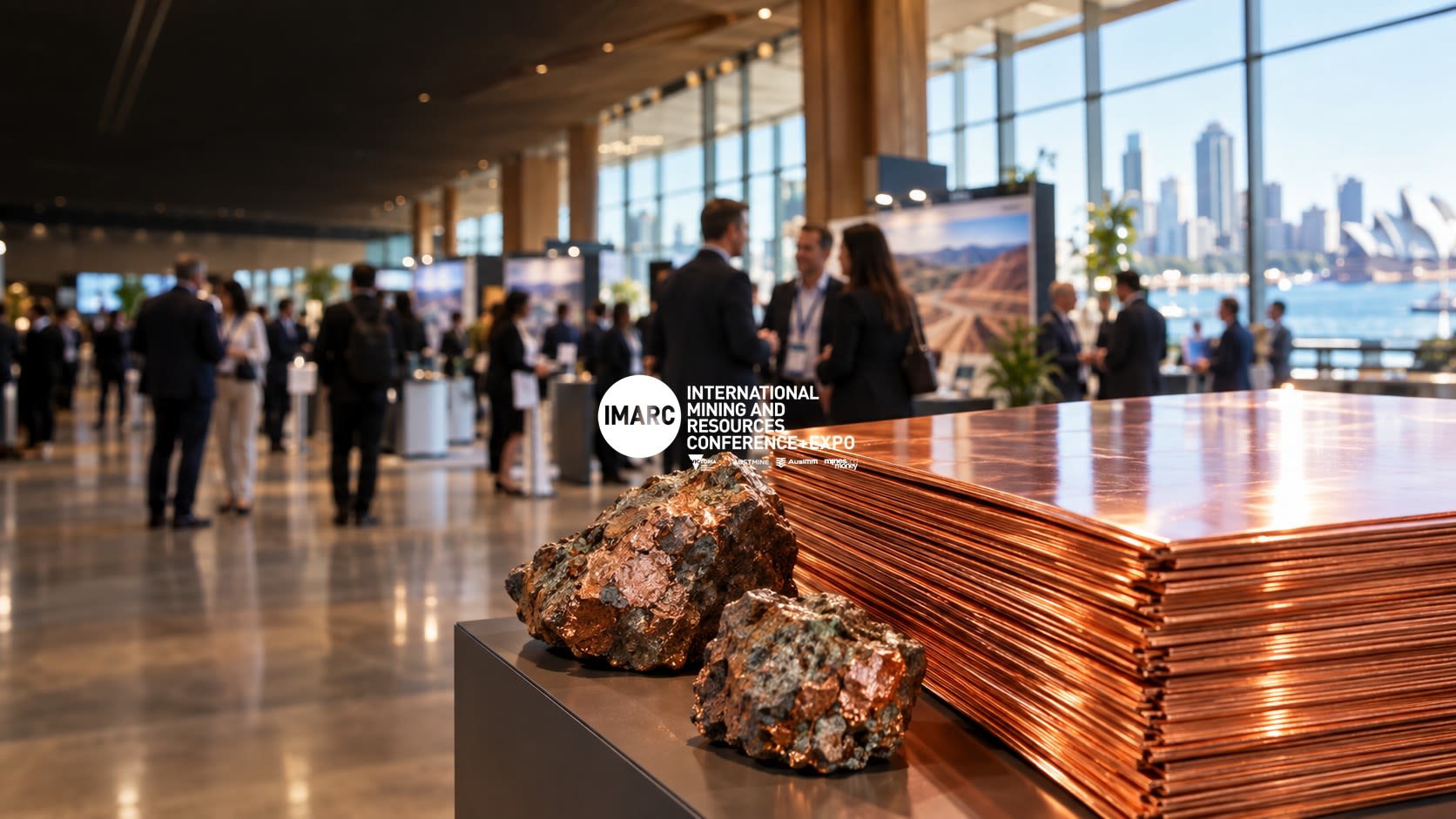


Copper firms to a two-week high as IMARC turns the spotlight on getting mines built faster Copper: US$14.68/kg (US$14,678/t) on COMEX, 28 October settlement; LME three-month about US$14,430–14,490/t (27–28 October)
COMEX December copper settled at US$14.68/kg on 28 October, up about 1.2% on the week and 4% above the 22 October low of US$14.10/kg. In London, the three-month contract touched US$14,490/t (US$14.49/kg) on 27 October, its strongest since 16 October, and was holding near US$14,430/t ahead of the Fed. Prices are up about 28% on a year ago, according to Trading Economics. This week’s highlight: COMEX is back above LME. New York copper now trades at a premium of roughly US$0.20–0.25/kg (US$200–250/t) over London, reversing last week’s discount of about US$0.08/kg. The swing suggests traders are again pricing the risk of a US refined-copper tariff ahead of the 3 November midterm elections.
IMARC 2026: the view from Sydney
Two days into IMARC at ICC Sydney (27–29 October), the message for copper was clear: the world wants more critical minerals, and the bottleneck is now execution, not ambition. Around 12,500 delegates and more than 50 government delegations attended, and copper, lithium, nickel and rare earths now dominate a programme once led by iron ore and coal.
What came out of the first two days: • Policy reset in Canberra: Federal Resources Minister Madeleine King released a refreshed Australian Critical Minerals Strategy and a review of the critical minerals and strategic materials lists, focusing support on the projects and supply chains with the best prospects.
• NSW pitches its endowment: Premier Chris Minns launched an Australian-first Critical Minerals Skills Plan, noting NSW holds 21 of Australia’s 31 critical minerals, including copper. Ministers also stressed faster approvals for greenfield projects in the Cobar and Lachlan Fold Belt. Neither announcement carried a new dollar figure.
• Offtake unlocks finance: Export Finance Australia, US EXIM and Germany’s KfW IPEX-Bank told delegates that binding offtake is still what makes projects bankable. EXIM outlined Project Vault, a US strategic minerals reserve backed by up to US$10 billion in EXIM finance, while Australia builds its own Critical Minerals Strategic Reserve.
• Productivity before technology: BHP’s Chief Enterprise Performance Officer Edgar Basto warned that automating a bad process simply delivers “poor outcomes faster”. BHP is using technology to lift recovery at its copper operations in South Australia and Chile.
• UNSW’s NextGenMIN Hub: UNSW, the NSW Government, Epiroc and partners launched a A$28 million ARC research hub for zero-waste, zero-emission and zero-entry mining of critical minerals, linking five other universities and more than 20 industry partners.
Market overview
Copper recovered the week’s losses on a rebound in AI stocks and stronger Chinese buying, though a firmer US dollar capped gains. Reuters reported that China’s Yangshan import premium hit a near 13-year high of US$188/t on 27 October, and LME cash traded about US$200/t over three-month, the widest backwardation since late August.
The stock picture is split. LME stocks rose last week but sit mostly in North American warehouses, while Shanghai Futures Exchange stocks fell more than 25% to about 54,000 t as Chinese smelters entered maintenance. Sucden Financial sums it up: US stockpiling caps the headline price, while tight ex-US availability and scarce concentrate keep a floor under it.
Supply risk returned. Antamina in Peru halted operations after a worker died, with no restart date yet. Codelco relocated 74% of workers at El Teniente’s Andes Norte, suspended since August on seismic risk. On the growth side, Capstone announced a US$3 billion plan to double production in Chile’s Atacama.
Macro themes
The Fed held, hawkishly. On 28 October the FOMC kept rates at 3.75–4.00% by a 10–2 vote, with Lisa Cook and Beth Hammack voting for a hike. The statement described growth as strong and inflation as elevated, so a December move stays on the table. A firm dollar and higher yields are the near-term headwind for metals; Thursday’s PCE print is the next test.
Energy is feeding inflation. Brent traded above US$115/bbl after an attack on a Saudi refinery revived Middle East supply fears. The World Bank warns that higher fuel, power and acid costs are lifting prices across commodities while squeezing producer margins.
China is buying. The near 13-year-high Yangshan premium and a 25% fall in SHFE stocks show Chinese fabricators restocking despite high prices, a shift from the caution seen after Golden Week. US tariffs and the US election
The US still charges 50% on semi-finished copper and 25% on copper-intensive products, but refined cathode remains untaxed. Commerce’s recommended 15% tariff from 1 January 2027, rising to 30% in 2028, has not been approved. Reuters reported in September that the White House had stalled the decision over affordability concerns before the midterms.
Those elections are on 3 November, five days away. A ruling is unlikely before the vote, and the outcome will shape how hard the administration leans on tariffs in 2027. The market is already hedging: COMEX has moved back to a premium of roughly US$0.20–0.25/kg (US$200–250/t) over LME this week, from a discount of about US$0.08/kg (US$80/t) a week ago. The World Bank warns that uncertainty over a January start could trigger another round of US stockpiling and regional shortages elsewhere.
Supply and demand outlook
The new forecast this week came from the World Bank, which lifted its 2027 copper price estimate 18% to US$13,000/t, just below its projected 2026 average of US$13,200/t. It notes that global demand slipped in the first half; prices were driven by mine disruptions and metal moving into US warehouses. Mine growth stays subdued in Chile and Indonesia, and the bank counts 147 trade-restrictive measures on critical minerals this year, including the DRC’s concentrate export ban.
The bank also cites the theme that ran through IMARC: exploration and mine construction can take more than a decade, so higher prices cannot quickly call up new supply.
ConnectOre – A new technology update
Discovery to production: closing the 20-year gap
IMARC’s loudest message was that the world cannot wait two decades for new copper. S&P Global’s latest study puts the average copper discovery-to-production lead time at 17.5 years, and Australian projects have historically taken around 20 years. Industry projections for the next wave of mines run at 18 to 21 years.
ICAA, working with UNSW, aims to develop a strategy paper that makes the economic case for cutting that timeline to 12 years, and ultimately to 8. The paper will quantify what faster development is worth to Australia in jobs, GDP and exports, giving government and industry a shared evidence base for reform.
The levers are already on the table at IMARC: • Faster discovery: AI, geospatial data and new drilling and sensing tools, as set out in ICAA’s Roadmap to Zero: Discovery report. • Faster approvals: coordinated permitting, which NSW and Canberra both flagged this week. • Faster finance: offtake, export credit and strategic reserves that make projects bankable sooner.
In short: every year cut from the development cycle brings forward production, royalties and jobs. The ICAA–UNSW paper will put a number on that prize.
Go to the ConnectOre website: connectore.org
Sources • IMARC, Offtake agreements key to unlocking critical minerals investment (28 Oct 2026) • IMARC, BHP warns AI could accelerate poor performance (28 Oct 2026) • IMARC, UNSW unveils NextGenMIN Hub (27 Oct 2026) • IMARC, News and press releases • Mining Weekly, Minns and King to open IMARC 2026 (27 Oct 2026) • Australian Mining, NSW launches Critical Minerals Skills Plan (27 Oct 2026) • International Mining, Ministers promote NSW mineral wealth at IMARC (27 Oct 2026) • Reuters via MINING.COM, Copper climbs on AI rebound, China demand (27 Oct 2026) • Bloomberg, Copper wavers near two-week high ahead of Fed (28 Oct 2026) • COMEX copper futures historical data, Investing.com (28 Oct 2026) • Trading Economics, Copper price • Rio Times, Fed holds at 3.75–4%, two vote to hike (28 Oct 2026) • CNBC, Gold slips on oil-fuelled inflation fears ahead of Fed (28 Oct 2026) • MINING.COM, World Bank lifts copper price outlook by 18% (28 Oct 2026) • MINING.COM, Codelco relocates 74% of workers at Andes Norte (28 Oct 2026) • MINING.COM, Capstone to invest US$3B in Chile (27 Oct 2026) • Reuters via Kitco, White House copper tariff plan stalls (10 Sep 2026) • Congressional Research Service, Section 232 tariffs on copper • S&P Global, Copper discoveries 2026 (3 Sep 2026) • ICAA, Roadmap to Zero: Discovery • ICAA, Copper Weekly Brief — 22 October 2026 • ConnectOre • Further reading: Australian Financial Review · Financial Times · The New York Times · The Economist · CRU · Wood Mackenzie · LME Copper · CME Group COMEX copper · Reuters Commodities · Bloomberg Metals · Goldman Sachs Research · Morgan Stanley Research
