

AI in Exploration — Did You Know?
- The discovery rate for economic deposits has halved in a decade, while average cost has risen four times to around US$220 million.
- Mines that started up in 2020–23 took almost 18 years from first exploration to production, about 12 in exploration alone.
- Roughly 50 deposits are found worldwide each year, half the rate before 2005. Australia makes 12–15 a year, down from 15–25.
- Juniors carry the risk: around 45% of exploration spend, but 73% of Australian discoveries.
- Conventional greenfield drilling succeeds less than 1% of the time. That is the number AI is aimed at.
The data was always there
The constraint is interpretation at speed. Australia has filed every drill result and survey since the 1970s, but much of it is unstructured or re-examined. AI’s advantage is not new data – it is reading decades of old data at once, processing more variables than any geologist can, and turning a continent into a ranked list of targets. The caution is unchanged: a model is a hypothesis until the drill confirms it.
The collaboration proof point
AI in exploration shares risk rather than selling software. Earth AI partners with tenement holders on discovery success-based alliances; its work with Legacy Minerals in NSW hit PGE-nickel-copper mineralisation on the first drill test, opening a new terrain in the Lachlan Fold Belt. Ground and geology from one side, prediction and capital from the other.
Innovation Spotlight — From Data to Drill Target
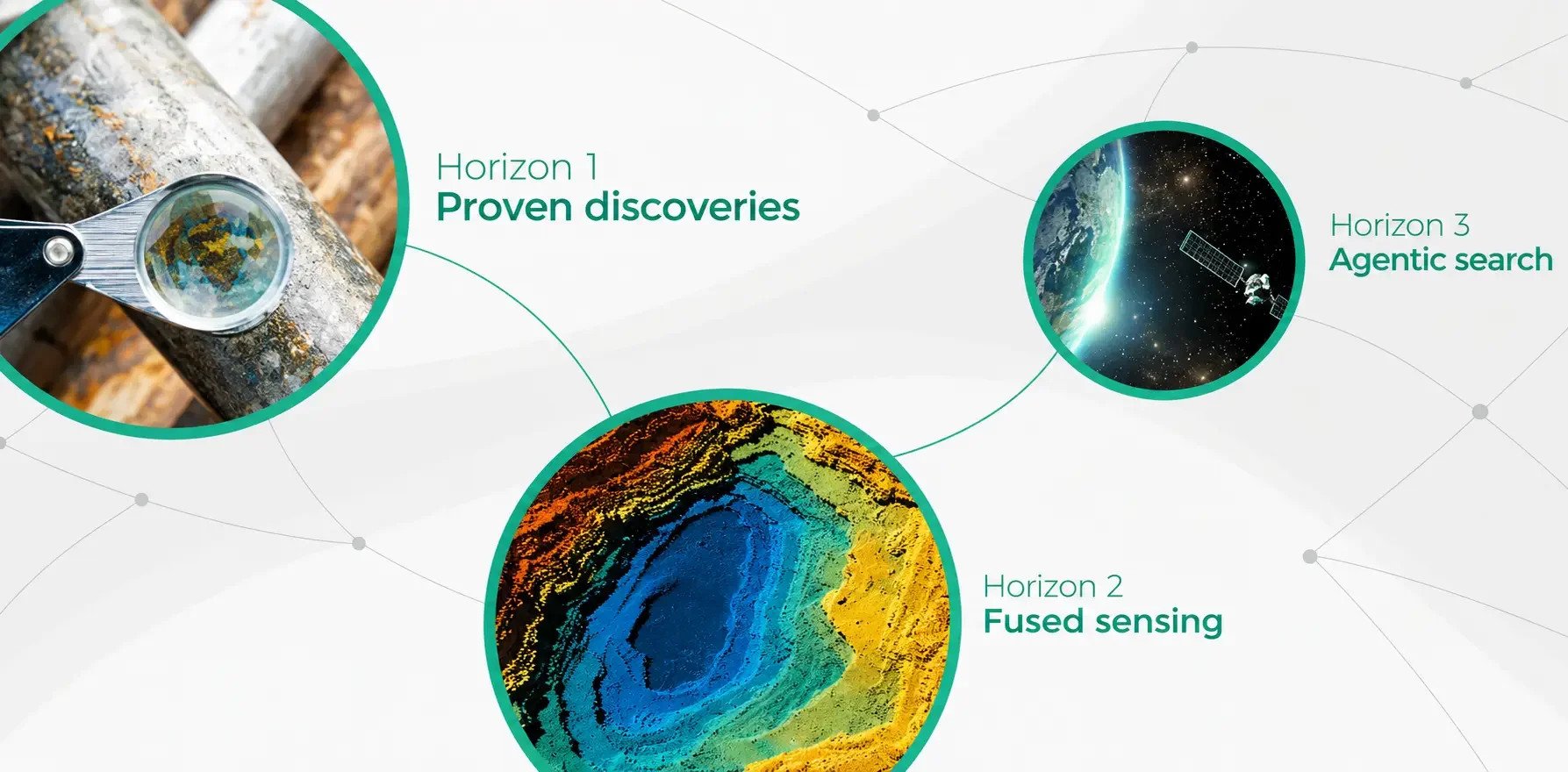
Horizon 1 Available
- AI found a real mine: KoBold read legacy Copperbelt data to define an unknown deep resource at Mingomba – a US$2.3bn mine targeting over 300,000t of copper a year.
- Prospectivity mapping at continental scale: models trained on national datasets cut search areas by up to 95% while still capturing most known deposits.
- Prediction plus drilling: Earth AI trains on 400 million geological cases and moves from prospect to drill test in three to six months.
Horizon 2 Evolving
- Sensing and AI as one system: Adelaide’s Fleet Space fuses satellites, seismic sensors and ML into real-time 3D subsurface imaging, used by Rio Tinto and Barrick across five continents.
- Deep learning on core: automated logging and hyperspectral mineral ID, turning core sheds into structured training data.
- Foundation models for geoscience: architectures that generalise from one belt to untrained ground – the start of transferable models.
Horizon 3 Emerging
- Agentic exploration: models that choose the next survey, not just the next target – optimising what to collect to cut uncertainty.
- Off-Earth transfer: Fleet Space’s SPIDER sensor heads to the Moon in 2026 – imaging built for exploration becomes planetary science.
- The pre-competitive data commons: standardised national geochemistry is the training-set bottleneck. Whoever solves it sets the pace.
Who Is Solving It?
| Category | Organisations |
|---|---|
| AI Explorers | KoBold Metals · Earth AI · VerAI · GoldSpot · MineDSS |
| Australian Innovators | Fleet Space · Legacy Minerals · MinEx CRC · Unearthed |
| Majors & Partners | BHP · Rio Tinto · Barrick · Midnight Sun |
| Research & Data | CSIRO · Geoscience Australia · State geological surveys |
