{
"componentChunkName": "component---src-gatsby-entities-sub-topic-tsx",
"path": "/sub-topics/ultimate-pit-and-pushbacks",
"result": {"data":{"platform":{"subTopic":{"__typename":"Platform_SubTopic","_schema":{"label":"Sub Topic","pluralLabel":"Sub Topics"},"openGraph":{"title":"Ultimate Pit and Pushbacks","description":{"text":"[ultimate pit](/sub-topics/ultimate-pit-and-pushbacks) optimisation provides the first estimate of value and ore reserves for..."},"image":null},"id":"65d2edd7ebf7bb9388ffb18e","slug":"ultimate-pit-and-pushbacks","name":"Ultimate Pit and Pushbacks","path":"/sub-topics/ultimate-pit-and-pushbacks","outlineNumber":"2.5.2","color":{"__typename":"Platform_Color","id":"65d2ed7febf7bb9388ffab3a","slug":"core-12","name":"Core 12","value":"#3b6673","darkValue":"#2b4b56","veryDarkValue":"#1c3239"},"intro":{"id":"65d2edd7ebf7bb9388ffb18e_intro","text":"[ultimate pit](/sub-topics/ultimate-pit-and-pushbacks) optimisation provides the first estimate of value and ore reserves for a mineral deposit. "},"description":{"id":"65d2edd7ebf7bb9388ffb18e_description","text":"However, the [ultimate pit](/sub-topics/ultimate-pit-and-pushbacks) optimisation does not account for time-based constraints of production and the timing of cashflows for valuation. It also does not generate mineable volumes that maximise the [NPV](https://en.wikipedia.org/wiki/Net_present_value) of production. To do this, mining pushbacks are designed to provide a rudimentary sequence of extraction from the highest value to the lowest value material within the [ultimate pit](/sub-topics/ultimate-pit-and-pushbacks). The design of pushbacks also accounts for the maximum slope angles and minimum mining width of benches and provide greater detail for the optimisation of the production schedule , which accounts for time-based constraints to maximise the [NPV](https://en.wikipedia.org/wiki/Net_present_value) of production.\n\nIn the context of [Grade Engineering](/pages/wikiore-introduction-to-grade-engineering), the [ultimate pit](/sub-topics/ultimate-pit-and-pushbacks) and pushback optimisation evaluates the possible expansion of reserves due to potential changes in pit [geomet](https://en.wikipedia.org/wiki/Geometallurgy)ry and pushback design as a result of GE increasing the value of marginal material and lowering the [cut-off](/sub-topics/scheduling-and-cut-off-optimisation) grade for economic treatment of material previously classified as mineralised waste. The [Grade Engineering](/pages/wikiore-introduction-to-grade-engineering) [ultimate pit](/sub-topics/ultimate-pit-and-pushbacks) can be calculated using the [Grade Engineering](/pages/wikiore-introduction-to-grade-engineering) economic [block model](https://en.wikipedia.org/wiki/Mineral_resource_estimation#Resource_block_model) and the Lerchs-Grossman algorithm to develop a series of nested shells by adjusting the revenue factor applied to each block. These nested shells provide guidance to the selection of the [ultimate pit](/sub-topics/ultimate-pit-and-pushbacks) and design of pushbacks to be mined. The material can then be scheduled, and [cut-off](/sub-topics/scheduling-and-cut-off-optimisation) optimised, for all processing destinations in the operation.\n\nThe parameters that need to be imported from the [Grade Engineering](/pages/wikiore-introduction-to-grade-engineering) economic [block model](https://en.wikipedia.org/wiki/Mineral_resource_estimation#Resource_block_model) are the optimised maximum value ($/t) per block, and the highest value destination for each block (plant, [leach](https://en.wikipedia.org/wiki/Leaching_%28metallurgy%29)ing,waste dump, [Grade Engineering](/pages/wikiore-introduction-to-grade-engineering)). In the case that a block has chosen GE as its highest value destination, then the final destination for each of the separated streams need to be imported, together with the mass and grade for each of the streams. This information allows quantification of the amount of material that ultimately could report to ore and waste.\n\nIt is critical to note that the GE [ultimate pit](/sub-topics/ultimate-pit-and-pushbacks) and pushbacks are designed using the maximum value processing pathway for each block. This will only occur when the maximum value processing pathway is free of all constraints. In most cases the maximum value path becomes a bottleneck, meaning that material must compete for treatment at the process bottleneck. This competition introduces an opportunity cost to production through the bottleneck which raises the [cut-off](/sub-topics/scheduling-and-cut-off-optimisation) required for material to be treated at the process bottleneck. Period costs to keep processing equipment available also influence the highest net cash path.\n\nFor pit sizing, it is fair to assume, at the base of the pit the processing limits are no longer [bottlenecks](https://en.wikipedia.org/wiki/Bottleneck_%28production%29) and therefore opportunity costs of processing pathways do not need to be considered in calculating the maximum cash path for each block. Only the mining and processing, variable and period costs need to be considered. The opportunity cost to production is considered in the optimisation of the production schedule and [cut-off](/sub-topics/scheduling-and-cut-off-optimisation) grades.\n\nIncreasing Reserves Through Grade Engineering[](#Increasing_Reserves_Through_Grade_Engineering)\n===============================================================================================\n\n \n\nAccording to JORC (2014), the definition of Ore is as follows; “An ‘ore reserve ’ is the economically mineable part of a Measured and/or Indicated Mineral Resource.”\n\nTwo most used techniques to estimate the [final pit limit](/sub-topics/ultimate-pit-and-pushbacks) and reserves of a mineral resource are ‘floating cone’ and ‘Lerchs and Grossmann’. These two techniques assume as a base that mining value ($/t) of each block in a GEEBM has been calculated. This mining value ($/t) is critical in terms of economic decision during a [final pit limit](/sub-topics/ultimate-pit-and-pushbacks) optimisation. Usually mining value or maximum value ($/t) are estimated through the value equation.\n\nBlocks that have negative value ($/t) may also be considered ore if they are to be removed (economically) to access economical blocks with positive and higher value ($/t). At the same time, not every positive value ($/t) block in the resource will be considered as ore, as there might be several uneconomical blocks that need to be removed (pre-stripping) to be able to access them, therefore making those positive value blocks uneconomical. This is the logic typically followed by the ‘floating cone’ and ‘Lerchs and Grossmann’ techniques. GE pre-concentration techniques however, present the opportunity to turn uneconomical blocks into economical blocks, by turning negative blocks into positive blocks and/or by increasing the value of positive blocks. This is achieved through the [Grade Engineering](/pages/wikiore-introduction-to-grade-engineering) capability of separating blocks into a higher and lower value component and sending each of these components to the best destination to maximise the value of production.\n\nA simple example to show how these properties influence the [final pit limit](/sub-topics/ultimate-pit-and-pushbacks) optimisation process is depicted in the next figures. Figure 1 shows a 2D cross section of a GEEBM, where each block has a unique mining value ($/t) calculated with the traditional destinations (milling, [leach](https://en.wikipedia.org/wiki/Leaching_%28metallurgy%29)ing, and waste), and three different extraction pushbacks or phases. The first extraction phase commences with the red block, followed by the green phase blocks, and finishing with the yellow phase blocks. Note that blocks with positive values ($/t) at the bottom of the resource where not extracted, as they were not economically extractable. Therefore, the reserves and [final pit limit](/sub-topics/ultimate-pit-and-pushbacks) [geomet](https://en.wikipedia.org/wiki/Geometallurgy)ry are limited by the coloured blocks.\n\nFigure 2 shows the same 2D cross section but this time with Grade Engineered blocks at the bottom of the resource coloured in light red. These GE blocks have a higher value than the original blocks shown in Figure 1, which were treated with conventional economic destinations.\n\nFigure 3 shows the same GEEBM, where the FPLO finds three more economical extraction phases (light blue, yellow, and dark blue), due to the new mining value ($/t) in the blocks due to GE processing. This results in a better utilization of the resource, increment of reserves, and increment of the [final pit limit](/sub-topics/ultimate-pit-and-pushbacks) [geomet](https://en.wikipedia.org/wiki/Geometallurgy)ry.\n\n [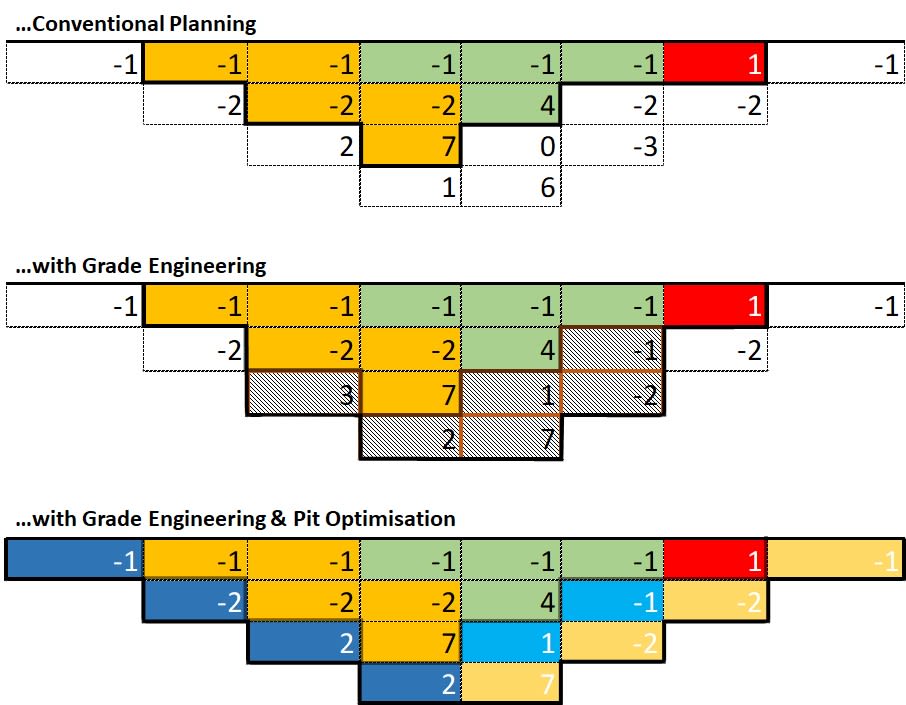](https://res.cloudinary.com/shapeable/image/upload/v1687316166/wikiore/88.jpg)"},"organisations":[],"embeds":{"citations":[],"imageAssets":[]},"video":null,"banner":null,"fileAssets":[],"citations":[],"feedEntries":[],"posts":[],"moderators":[]}}},"pageContext":{"lang":{"id":"en","path":"","iso":"en","name":"English","label":"English"},"availableEntities":["Catalyst","CommodityGroup","Innovation","Organisation","Page","Person","Post","SubTopic","Topic","Trend","OrganisationType","HorizonType","Economy","FeedEntry","Video","Citation","Objective","ProfileType","ExpertiseLevel"],"detailEntities":["Catalyst","CommodityGroup","Innovation","Organisation","Page","Person","Post","SubTopic","Topic","Trend"],"site":{"id":"65d2edd1ebf7bb9388ffb0df","slug":"connect-ore","name":"ConnectOre","url":"https://connectore.org","title":"ConnectOre","twitter":null,"threads":null,"facebook":null,"linkedin":null,"instagram":null,"flickr":null,"tiktok":null,"youtube":null,"ownerName":"ICAA","recaptchaKey":"6LfG2J0qAAAAAHDCFfJnrWOj6DiWJGik5BAa_7p8","googleSiteVerification":null,"platformName":"ConnectOre","platformUrl":"https://platform.connectore.org","supportEmail":null,"contactEmail":null,"mainMenu":{"id":"65d2edaaebf7bb9388ffaf79","slug":"website-navigation"},"linearMenu":null,"entityViews":[{"id":"67528c24c135ebcfc668f1ba_65d2edd1ebf7bb9388ffb0df","name":"Value Chain","hash":"value-chain","label":null,"slug":"value-chain","count":0,"showCount":null,"disabled":null,"icon":{"id":"6752a61b8b51dfa7b77b1e37","name":"Connections Navigator Icon Glyph","slug":"connections-navigator-icon-glyph","component":"ConnectionsNavigatorIconGlyph"},"childEntityTypes":[{"id":"6667fa4ff794dd6e045135c1","name":"Value Chain Theme","internalName":"Trend"},{"id":"6667fa58f794dd6e045135c6","name":"Topic","internalName":"Topic"}],"type":{"id":"67528b63c135ebcfc668f19c","name":"Explorer","slug":"explorer"},"slices":[]},{"id":"6757ef1ede8adbd45cf19474_65d2edd1ebf7bb9388ffb0df","name":"Bulletin Board","hash":"bulletin-board","label":null,"slug":"bulletin-board","count":0,"showCount":null,"disabled":null,"icon":{"id":"681c2cebbccc5a72d8382f31","name":"Tag Icon","slug":"tag-icon","component":"TagDotIconGlyph"},"childEntityTypes":[],"type":{"id":"67528b63c135ebcfc668f19c","name":"Explorer","slug":"explorer"},"slices":[]},{"id":"67528d88c135ebcfc668f31b_65d2edd1ebf7bb9388ffb0df","name":"Innovations","hash":"innovations","label":null,"slug":"innovations","count":0,"showCount":null,"disabled":null,"icon":{"id":"67528cddc135ebcfc668f304","name":"Grid Icon Glyph","slug":"grid-icon-glyph","component":"GridIconGlyph"},"childEntityTypes":[{"id":"67528d74c135ebcfc668f315","name":"Innovation","internalName":"innovation"}],"type":{"id":"67528b63c135ebcfc668f19c","name":"Explorer","slug":"explorer"},"slices":[]},{"id":"67625640fbc7c50d8644c592_65d2edd1ebf7bb9388ffb0df","name":"Community","hash":"community","label":null,"slug":"community","count":0,"showCount":null,"disabled":null,"icon":{"id":"67528cddc135ebcfc668f304","name":"Grid Icon Glyph","slug":"grid-icon-glyph","component":"GridIconGlyph"},"childEntityTypes":[{"id":"67528404c135ebcfc668ee1c","name":"Person","internalName":"Person"}],"type":{"id":"67528b63c135ebcfc668f19c","name":"Explorer","slug":"explorer"},"slices":[]},{"id":"67528e1bc135ebcfc668f33a_65d2edd1ebf7bb9388ffb0df","name":"Stakeholder Map","hash":"stakeholder-map","label":null,"slug":"stakeholder-map","count":0,"showCount":null,"disabled":null,"icon":{"id":"67528cddc135ebcfc668f304","name":"Grid Icon Glyph","slug":"grid-icon-glyph","component":"GridIconGlyph"},"childEntityTypes":[{"id":"66680141f794dd6e0451367a","name":"Organisation","internalName":"Organisation"}],"type":{"id":"67528b63c135ebcfc668f19c","name":"Explorer","slug":"explorer"},"slices":[]},{"id":"67529040c135ebcfc668f4ae_65d2edd1ebf7bb9388ffb0df","name":"References","hash":"references","label":null,"slug":"references","count":0,"showCount":null,"disabled":null,"icon":{"id":"67528cddc135ebcfc668f304","name":"Grid Icon Glyph","slug":"grid-icon-glyph","component":"GridIconGlyph"},"childEntityTypes":[{"id":"6752902fc135ebcfc668f4a4","name":"Article","internalName":"FeedEntry"},{"id":"67529039c135ebcfc668f4aa","name":"Citation","internalName":"Citation"},{"id":"67528de9c135ebcfc668f328","name":"Catalyst","internalName":"catalyst"},{"id":"67528df9c135ebcfc668f32d","name":"Page","internalName":"page"}],"type":{"id":"67528b63c135ebcfc668f19c","name":"Explorer","slug":"explorer"},"slices":[]}],"entityAppViews":[],"entityOnboardingViews":[{"id":"680c3a4ebc80e4d0f3cfa2ef_65d2edd1ebf7bb9388ffb0df","name":"Trend Expertise Step","hash":"trend-expertise-step","label":null,"slug":"trend-expertise-step","count":0,"showCount":null,"icon":null,"childEntityTypes":[],"type":{"id":"680c394fbc80e4d0f3cfa2d8","name":"Onboarding","slug":"onboarding"},"slices":[{"id":"680c39f2bc80e4d0f3cfa2e0_65d2edd1ebf7bb9388ffb0df","name":"Trend Expertise Onboarding Grid","slug":"trend-expertise-onboarding-grid","label":null,"updated":"2025-04-26T01:42:10.20","layout":{"id":"680c3993bc80e4d0f3cfa2dd","name":"Slice Onboarding Trend Expertise Grid","slug":"slice-onboarding-trend-expertise-grid","component":"SliceLayoutOnboardingTrendExpertiseGrid"},"connectedEntities":[],"headerFontType":null,"pretitle":null,"pretitleRich":{"id":"680c39f2bc80e4d0f3cfa2e0_65d2edd1ebf7bb9388ffb0df_pretitleRich","text":""},"title":null,"titleRich":{"id":"680c39f2bc80e4d0f3cfa2e0_65d2edd1ebf7bb9388ffb0df_titleRich","text":"Are you **an industry expert** in any of these Value Chain Themes?"}}]},{"id":"680c3a85bc80e4d0f3cfa2fa_65d2edd1ebf7bb9388ffb0df","name":"Profile Types Step","hash":"profile-types-step","label":null,"slug":"profile-types-step","count":0,"showCount":null,"icon":null,"childEntityTypes":[],"type":{"id":"680c394fbc80e4d0f3cfa2d8","name":"Onboarding","slug":"onboarding"},"slices":[{"id":"680c3a82bc80e4d0f3cfa2f7_65d2edd1ebf7bb9388ffb0df","name":"Profile Types Onboarding Grid","slug":"profile-types-onboarding-grid","label":null,"updated":"2025-04-26T01:44:34.63","layout":{"id":"680c3a13bc80e4d0f3cfa2e4","name":"Slice Onboarding Profile Types Grid","slug":"slice-onboarding-profile-types-grid","component":"SliceLayoutOnboardingProfileTypesGrid"},"connectedEntities":[],"headerFontType":null,"pretitle":null,"pretitleRich":{"id":"680c3a82bc80e4d0f3cfa2f7_65d2edd1ebf7bb9388ffb0df_pretitleRich","text":""},"title":"Which best describes you?","titleRich":{"id":"680c3a82bc80e4d0f3cfa2f7_65d2edd1ebf7bb9388ffb0df_titleRich","text":""}}]},{"id":"680c3aaabc80e4d0f3cfa2ff_65d2edd1ebf7bb9388ffb0df","name":"Objectives Step","hash":"objectives-step","label":null,"slug":"objectives-step","count":0,"showCount":null,"icon":null,"childEntityTypes":[],"type":{"id":"680c394fbc80e4d0f3cfa2d8","name":"Onboarding","slug":"onboarding"},"slices":[{"id":"680c3aa8bc80e4d0f3cfa2fc_65d2edd1ebf7bb9388ffb0df","name":"Objectives Onboarding Grid","slug":"objectives-onboarding-grid","label":null,"updated":"2025-04-26T01:45:12.76","layout":{"id":"680c3a3fbc80e4d0f3cfa2ea","name":"Slice Onboarding Objectives Grid","slug":"slice-onboarding-objectives-grid","component":"SliceLayoutOnboardingObjectivesGrid"},"connectedEntities":[],"headerFontType":null,"pretitle":null,"pretitleRich":{"id":"680c3aa8bc80e4d0f3cfa2fc_65d2edd1ebf7bb9388ffb0df_pretitleRich","text":""},"title":"What are your priority objectives?","titleRich":{"id":"680c3aa8bc80e4d0f3cfa2fc_65d2edd1ebf7bb9388ffb0df_titleRich","text":""}}]}],"gptLanguages":[{"id":"65d2eda5ebf7bb9388ffaf1f","name":"English","slug":"english","iso":"en","locale":"en_US","path":"/en","label":"English","menuLabel":null},{"id":"666f70b6e051ad9ef086d1be","name":"Arabic","slug":"arabic","iso":"ar","locale":"ar_AE","path":"/ar","label":"عربي","menuLabel":null},{"id":"666f7161e051ad9ef086d1c4","name":"Spanish","slug":"spanish","iso":"es","locale":"es_ES","path":"/es","label":"español","menuLabel":null},{"id":"666f71c9e051ad9ef086d1c8","name":"German","slug":"german","iso":"de","locale":"de_DE","path":"/de","label":"Deutsch","menuLabel":null},{"id":"65d2eda5ebf7bb9388ffaf20","name":"French","slug":"french","iso":"fr","locale":"fr_FR","path":"/fr","label":"Français","menuLabel":null}],"gptQuestionTemplate":{"id":"662c7f6e81ef1920e3638518","name":"Standard Open Question","slug":"standard-open-question","path":"/prompt-templates/standard-open-question","__typename":"PromptTemplate","_entityTypeName":null,"label":"CopperAI","type":{"id":"662c7f1981ef1920e363850f","name":"Ask","slug":"ask"},"description":{"text":"This template is tailored for providing accurate responses based on specific context. It integrates contextual details from \"contextual information\" and addresses the \"target question\". The response is always in English, prioritizing clarity. If the answer is unknown, the template openly acknowledges this, ensuring honesty and avoiding speculation. This format is ideal for precise, context-sensitive, and truthful answering."},"summary":{"text":"Ask a general question about Website content"},"gptModel":{"id":"67564c4f2f6749787d0e03dc","name":"OpenAI GPT 4o","slug":"open-ai-gpt-4-o","dataSetId":"openai:gpt-4o"},"variablesPrompt":{"text":""},"submitLabel":"Ask","languages":[],"icon":{"id":"67528b9cc135ebcfc668f1a3","name":"AI Lower Case Icon Glyph","slug":"ai-lower-case-icon-glyph","component":"AiLowerCaseIconGlyph"},"variables":[{"id":"6668076bf794dd6e045138d9","name":"question","slug":"question","useVectorStore":true,"label":"What would you like to know?","labelAnother":null,"help":{"text":""},"options":{"text":""},"defaultValue":null,"entityTypes":[],"controlType":{"id":"6667ff19f794dd6e04513656","name":"Textarea","slug":"textarea"},"labelContextual":null,"labelAnotherContextual":null,"helpContextual":{"text":""},"optionsContextual":{"text":""},"defaultValueContextual":null,"entityTypesContextual":[],"controlTypeContextual":{"id":"6667ff19f794dd6e04513656","name":"Textarea","slug":"textarea"}}]},"advertisements":[],"logoVerticalOffset":null,"logoHorizontalOffset":null,"logoVerticalOffsetMobile":null,"logoHorizontalOffsetMobile":null,"logoVerticalOffsetTablet":null,"logoHorizontalOffsetTablet":null,"logoVerticalOffsetDesktop":null,"logoHorizontalOffsetDesktop":null,"logoHeightMobile":44,"logoHeightTablet":null,"logoHeightDesktop":null,"headerHeightMobile":null,"headerHeightTablet":null,"headerHeightDesktop":null,"logo":{"url":"https://res.cloudinary.com/shapeable/image/upload/v1738807465/copper-connect/site/copper-connect_logo__CopperOre_Master_Brand_Identity-colour_cd4vgg.webp","type":"image/webp","width":945,"height":266},"logoInverted":{"url":"https://res.cloudinary.com/shapeable/image/upload/v1738807452/copper-connect/site/copper-connect_logoInverted__CopperOre_Master_Brand_Identity-white_chnucx.webp","type":"image/webp","width":945,"height":266},"footerMenu":null,"footerSecondaryMenu":null,"footerContent":{"text":"© {year} ConnectOre. All Rights Reserved\n"},"creator":null,"poweredBy":{"id":"65d2edadebf7bb9388ffafc8","name":"Shapeable","slug":"shapeable","url":"https://shapeable.ai","logo":{"url":"https://res.cloudinary.com/shapeable/image/upload/v1674010034/platform/organisation/shapeable_logo__shapeable.png","type":"image/png","width":1174,"height":368},"logoInverted":{"url":"https://res.cloudinary.com/shapeable/image/upload/v1729474494/copper-connect/organisation/shapeable_logoInverted__shapeable-logo-inverted_sdcfpk.png","type":"image/png","width":392,"height":118},"logoSubtle":null},"poweredByLabel":null,"poweredByContent":{"text":""},"explorerPage":{"name":"Explorer","title":null,"slug":"explorer","path":"/explorer"},"termsPage":{"name":"Terms of Use","title":null,"slug":"terms-of-use","path":"/terms-of-use"},"homePage":null,"knowledgeHubPage":{"name":"News","title":null,"slug":"news","path":"/news"},"privacyPolicyPage":{"name":"Privacy Policy","title":null,"slug":"privacy-policy","path":"/privacy-policy"},"summary":{"text":"A platform to accelerate industry-wide innovation through collective intelligence and collaborative action"},"thumbnail":{"url":"https://res.cloudinary.com/shapeable/image/upload/v1713942350/copper-connect/site/copper-connect_thumbnail__site-thumb_bmicl8.png"},"openGraph":{"title":"ConnectOre","date":"2026-07-31T04:44:47.80","description":{"plain":"A platform to accelerate industry-wide innovation through collective intelligence and collaborative action\n"},"image":{"url":"https://res.cloudinary.com/shapeable/image/upload/v1713942350/copper-connect/site/copper-connect_thumbnail__site-thumb_bmicl8.png","type":"image/png","thumbnails":{"full":{"url":"https://res.cloudinary.com/shapeable/image/upload/v1713942350/copper-connect/site/copper-connect_thumbnail__site-thumb_bmicl8.png"}}}},"termsAndConditions":{"text":""},"privacyPolicy":{"text":"At ConnectOre we respect your privacy. We want to ensure that you get the information, content, and experiences that matter most to you. ConnectOre is committed to protecting the privacy of its stakeholders, communities, and other contacts.\n\n## Scope\n\nThis privacy policy applies to all personal data processed by full-time and part-time employees, volunteers when acting on behalf of ConnectOre contractors and partners doing business on behalf of ConnectOre, as well as all legal entities, all operating locations in all countries, and all business processes conducted by ConnectOre.\n\n## Information Collected\n\n#### What information do we collect?\n\nConnectOre collects the following personal data in line with the use purposes explained in a subsequent section:\n\n * Your name and contact details\n * Online profile data/usage\n * Contact information\n * Social media profile information\n * Education and professional information\n * Registration and participation in ConnectOre events and activities \n * Information about service usage\n * Cookies\n * Authentication data\n * Location information\n * Author and peer review information\n * Other information you upload or provide to us\n\n#### How do we use your information?\n\nConnectOre uses (and, where specified, shares) your personal information for the following purposes:\n\n * To provide support or other services. ConnectOre may use your personal information to provide you with support or other services that you have ordered or requested. ConnectOre may also use your personal information to respond directly to your requests for information, including registrations for webinars, or other specific requests, or pass your contact information to the appropriate ConnectOre supplier or reseller for further follow-up related to your interests.\n * To provide information based on your needs and respond to your requests. ConnectOre may use your personal information to provide you with notices of new product releases and service developments.\n * To administer products. ConnectOre may contact you if you make use of (digital) products we offer, to confirm certain information (for example, that you did not experience problems in a download process). We may also use this information to confirm compliance with licensing and other terms of use and may share it with your company/institution.\n * To assist in your participation in ConnectOre activities. ConnectOre will communicate with you, if you are participating in certain ConnectOre activities such as ConnectOre Summit, authoring or reviewing a ConnectOre article, or ConnectOre humanitarian activities. ConnectOre may send you information such as update messages related to those activities (such as but not limited to the event's content, and event logistics)\n * To update you on relevant ConnectOre events and opportunities. ConnectOre may communicate with you regarding relevant ConnectOre events and opportunities.\n * To protect ConnectOre content and services. We may use your information to prevent potentially illegal activities and to enforce our terms and conditions.\n * To get feedback or input from you. In order to deliver products and services of most interest to our stakeholders, from time to time, we may ask you to provide us input and feedback (for example through surveys).\n\n#### How can you control your information?\n\nYou can control the information we have about you and how we use as follows:\n\n * If you are a registered guest for ConnectOre Annual Summit 2021, any request for review, revise or correction of your personal data can be sent to john.fennell@copper.com.au specifying your request.\n\n#### Personal data about minors and children\n\nConnectOre does not knowingly collect data from or about children under 16 without the permission of parent(s)/guardian(s). If we learn that we have collected personal information from a child under 16, we will delete that information as quickly as possible. If you believe that we might have any information from or about a child under age 16, please contact us.\n\n#### How will you know if the Privacy Policy is changed?\n\nConnectOre may update its Privacy Policy from time to time. If we make any material changes you will be notified by means of a notice on our website prior on the date the change becomes effective. We encourage you to periodically review this page for the latest information on our privacy practices.\n\n## Technical And Regulatory Information\n\n#### Logging practices\n\nConnectOre automatically records the Internet Protocol (IP) addresses of visitors. The IP address is a unique number assigned to every computer on the internet. Generally, an IP address changes each time you connect to the internet (it is a \"dynamic\" address). Note, however, that if you have a broadband connection, depending on your individual circumstance, the IP address that we collect may contain information that could be deemed identifiable. This is because, with some broadband connections, your IP address doesn't change (it is \"static\") and could be associated with your personal computer.\n\nAs well as recording the IP addresses of users, ConnectOre may also keep track of sites that users visited immediately prior to visiting ConnectOre's website and the search terms they used to find it. We keep track of the pages visited on ConnectOre's website, the amount of time spent on those pages and the types of searches done on them. Your searches remain confidential and anonymous. ConnectOre uses this information only for statistical purposes to find out which pages users find most useful and to improve the website.\nConnectOre also captures and stores information that you transmit. This may include:\n\n * Browser/Device type/version\n * Operating system used\n * Media Access Control (MAC) address\n * Date and time of the server request\n * Volume of data transferred\n\n#### External links behaviour\n\nSome of the links on ConnectOre's websites link to other sites created and maintained by other public- and/or private-sector organizations. ConnectOre provides these links solely for your information and convenience. When you transfer to an outside website, you are leaving ConnectOre domain, and ConnectOre's information management policies no longer apply. ConnectOre encourages you to read the privacy statement of each external website that you visit before you provide any personal data.\n\n#### Cookies and web beacons\n\nCookies and web beacons are electronic placeholders that are placed on your device by websites to track your individual movements on that website over time. ConnectOre uses both session-based cookies (which last only for the duration of the user's session) and persistent cookies (which remain on your device and provide information about the session you are in and waits for the next time you use that site again).\n\nThese cookies and web beacons provide useful information to ConnectOre, enabling us to recognize repeat users, facilitate the user's access to and use of our sites, allows us to track usage behavior, and to balance the usage of our websites on all ConnectOre web servers.\nTracking cookies, third-party cookies, and other technologies such as web beacons may be used to process additional information, enable non-core functionalities on ConnectOre website and enable third-party functions (such as a social media \"share\" link). We may also include web beacons and other similar technology in promotional email messages to determine whether the messages have been opened.\n\n#### Do Not Track (DNT)\n\nThe online advertising industry has self-regulatory initiatives designed to provide consumers a choice in the types of ads they may see online and to conveniently opt-out from online behavioral ads served by some or all of the companies participating in these programs. Our websites do not respond to DNT consumer browser settings.\n\n#### Responses to legal requests\n\nConnectOre reserves the right to share your information to respond to duly authorized information requests of governmental authorities or where required by law.\n\n#### Your data rights\n\nConnectOre complies with all applicable data privacy laws and regulations including, but not limited to, the General Data Protection Regulation (GDPR) and the California Consumer Privacy Act (CCPA). Under these laws and regulations, you may have certain rights to your data. Should you wish to exercise any of these rights, please send an email request to john.fennell@copper.com.au with \"Data Privacy Request'' in the subject line and in the email please identify the specific privacy right you request assistance with. Please note additional information may be requested prior to fulfilling a request and that ConnectOre reserves the right to charge a fee, where permitted, to cover the cost of certain requests.\n\n#### How do I contact you if there is an issue?\nIf you have any questions or concerns about this Privacy Policy or about the use of your personal information, please feel free to contact us by email at john.fennell@copper.com.au"},"welcomeUrl":"https://connectore.org/app/welcome","welcomeTitle":"Welcome to ConnectOre and thanks for joining us! ","invitationAction":"join the ConnectOre community","setupCompletionMessage":null,"languages":[],"brandColors":[],"showLogin":true,"showShareMenu":null,"showFollowMenu":true,"showPlatformLogin":null,"showContactUs":null,"loginLabel":"Explorer Login","platformLoginLabel":"Community Platform","headerButtons":[]},"includeProfile":true,"disableProfileEditing":false,"dynamicEntityTypeNames":["Person","Organisation"],"profilePath":"/app/profile","welcomePath":"/app/welcome","id":"65d2edd7ebf7bb9388ffb18e","slug":"ultimate-pit-and-pushbacks","entityPath":"/sub-topics/ultimate-pit-and-pushbacks","openGraph":{},"entityTypeName":"SubTopic","name":"Ultimate Pit and Pushbacks","updated":"2024-12-20T01:04:17.18","__type":"SubTopic"}},
"staticQueryHashes": ["1044227382","1158597448","1242646999","1427075558","1452322194","1520036161","1545705019","1586309863","1606754935","1816168740","1864381666","1903214493","1945056504","1989845544","2034981229","2181044613","2409034939","2463401854","2526615987","2642656775","2862279633","2867243664","2910164142","2912920178","296816903","3073584486","3150399266","3172506128","3320076387","3447680494","3453148481","3624873332","364221563","3692255024","3778988535","3782604890","4091857177","4216505212","591477963","701411134","758936535","80004486","857137463","881103158"]}