{
"componentChunkName": "component---src-gatsby-entities-sub-topic-tsx",
"path": "/sub-topics/sampling",
"result": {"data":{"platform":{"subTopic":{"__typename":"Platform_SubTopic","_schema":{"label":"Sub Topic","pluralLabel":"Sub Topics"},"openGraph":{"title":"Sampling","description":{"text":"Depending on the level of study being undertaken sampling design and requirements range from straightforward to more complex full [geomet](https://en.wikipedia.org/wiki/Geometallurgy)allurgical..."},"image":null},"id":"65d2edd7ebf7bb9388ffb183","slug":"sampling","name":"Sampling","path":"/sub-topics/sampling","outlineNumber":"2.2.1","color":{"__typename":"Platform_Color","id":"65d2ed7febf7bb9388ffab3a","slug":"core-12","name":"Core 12","value":"#3b6673","darkValue":"#2b4b56","veryDarkValue":"#1c3239"},"intro":{"id":"65d2edd7ebf7bb9388ffb183_intro","text":"Depending on the level of study being undertaken sampling design and requirements range from straightforward to more complex full [geomet](https://en.wikipedia.org/wiki/Geometallurgy)allurgical style programs."},"description":{"id":"65d2edd7ebf7bb9388ffb183_description","text":"[opportunity assessment](/sub-topics/opportunity-assessments)s utilise current site domains as a basis for generating a simple testing matrix. This then generates a first order result which is used to refine a second phase of testing. If separation potential is found, subsequent characterisation steps are designed to increase confidence and understanding of key response drivers. Alternatively, if no separation is found, then subsequent testing campaigns refocus efforts onto other options more likely to impact a given site.\n\nThe purpose of the [grade by size](/pages/wikiore-natural-deportment) testing is to define if specific [assay](https://en.wikipedia.org/wiki/Assay) elements (as a proxy for mineralogy) are preferentially deporting into specific size fraction s. This typically involves a systematic increase in finer fractions. [assay](https://en.wikipedia.org/wiki/Assay)s from a series of size fractions for each sample are used to generate **Response Curves**. A mathematical function is fitted to individual curves to generate a **[Response Ranking](/sub-topics/natural-deportment-characterisation) (RR)** \\- a single number used to describe the magnitude of a Response Curve. [Response Ranking](/sub-topics/natural-deportment-characterisation)s are used as inputs into [Grade Engineering](/pages/wikiore-introduction-to-grade-engineering) process simulation. Testing can be carried out at drill core, blast hole chip or RC - though both these methods tend to provide less robust data most probably due to the impact or percussion impact nature of the breakage - or mill feed production scale although there are obviously transforms required to compare different scales.\n\n [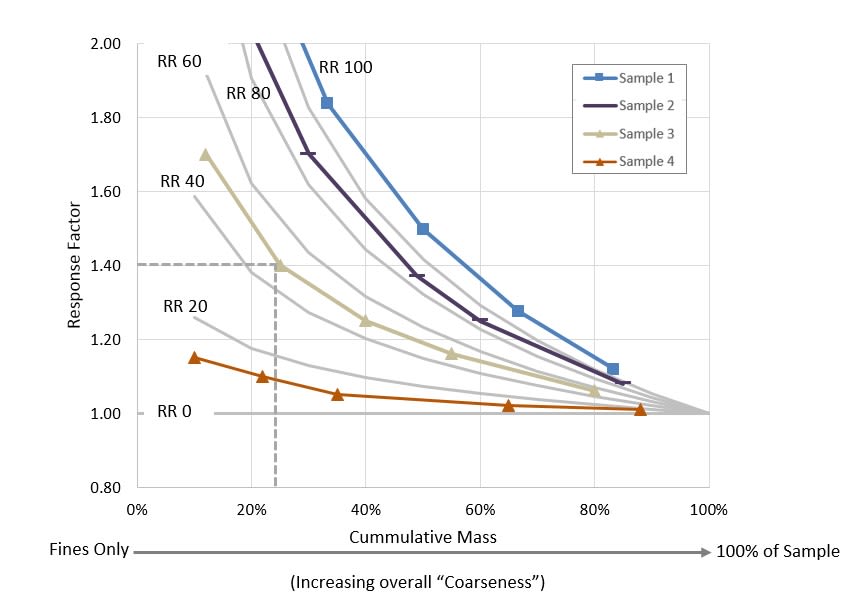](https://res.cloudinary.com/shapeable/image/upload/v1687255674/wikiore/186.jpg) \n\nDrill Core Sampling[](#Drill_Core_Sampling)\n===========================================\n\n[grade by size](/pages/wikiore-natural-deportment) testing can be carried out using coarse residues generated by [crushing](https://en.wikipedia.org/wiki/Crusher) during routine laboratory [assay](https://en.wikipedia.org/wiki/Assay) preparation as a precursor to pulverisation. Many projects/sites routinely store coarse residues specifically for future testing or check [assay](https://en.wikipedia.org/wiki/Assay)ing. In this case stored coarse residues can be used for cost effective [grade by size](/pages/wikiore-natural-deportment) testing. Stored pulps are not suitable for [grade by size](/pages/wikiore-natural-deportment) testing as the material is too fine.\n\n \nIntrinsic rock characteristics can be measured using a range of tools available (e.g. core scanning devices, visual logging etc…) pre breakage and then linked to subsequent separation characteristics to aid in model development.\n\n \nSpecific samples should be selected to ensure coverage of both relevant domains and production years. As a guide to commence a study, each domain as defined by the resource model is a good statrting point. Ideally each domain should have at least 10 samples included in the first round of testing.\n\nIn many cases drill core testing is the only method to evaluate future ores/domains in the mine plan, unless they are exposed in the current mine workings.\n\n[crushing](https://en.wikipedia.org/wiki/Crusher) Protocols[](#crushing_Protocols)\n----------------------------------------------------------------------------------\n\n[crushing](https://en.wikipedia.org/wiki/Crusher) protocols for coarse residues vary between sites and companies. The protocol is capable of being replicated in almost any onsite lab, and all commercial laboratories. It requires no special or unique methodology or equipment.\n\nThe prime purpose of coarse residues is to reduce the size of a drill core sample to a [particle size](https://en.wikipedia.org/wiki/Particle_size) distribution that is statistically suitable for splitting off a fraction which can be used for fine pulverising prior to chemical [assay](https://en.wikipedia.org/wiki/Assay)ing. A typical top size for coarse residues is 99% passing -3.35mm or the equivalent #6 mesh. This is sometimes expressed as 80% passing 2mm.However, very little quality control on the [particle size](https://en.wikipedia.org/wiki/Particle_size) distribution of coarse residues is generally carried out. [particle size](https://en.wikipedia.org/wiki/Particle_size) distributions are a function of the crusher gap setting, size of the initial drill core and hardness of the rock. Crusher gap settings in particular can vary between laboratories or drift over time.Within limits this variability does not affect use of coarse residues for [grade by size](/pages/wikiore-natural-deportment) testing. However, it is necessary to establish actual [particle size](https://en.wikipedia.org/wiki/Particle_size) distributions for site specific coarse residues as part of an initial evaluation program in order to select optimal sieve sizes for routine testing. Mass of specific sieve size fractions is also monitored during routine testing before samples are sent off for [grade by size](/pages/wikiore-natural-deportment) [assay](https://en.wikipedia.org/wiki/Assay)ing to provide a qa/qc flag for samples that show unusual mass distribution that may not be suitable for grade by size testing.The key overriding decision point on sieve size selection is generation of the minimum number of data points to define a statistically meaningful Response Curve and Ranking. This requires a minimum of three sieve sizes (generating four size fractions) that cover the cumulative mass range as shown. \n \nFor an initial orientation program it is recommended that 5 sieves are used generating six size fractions. An example is shown below.\n\n [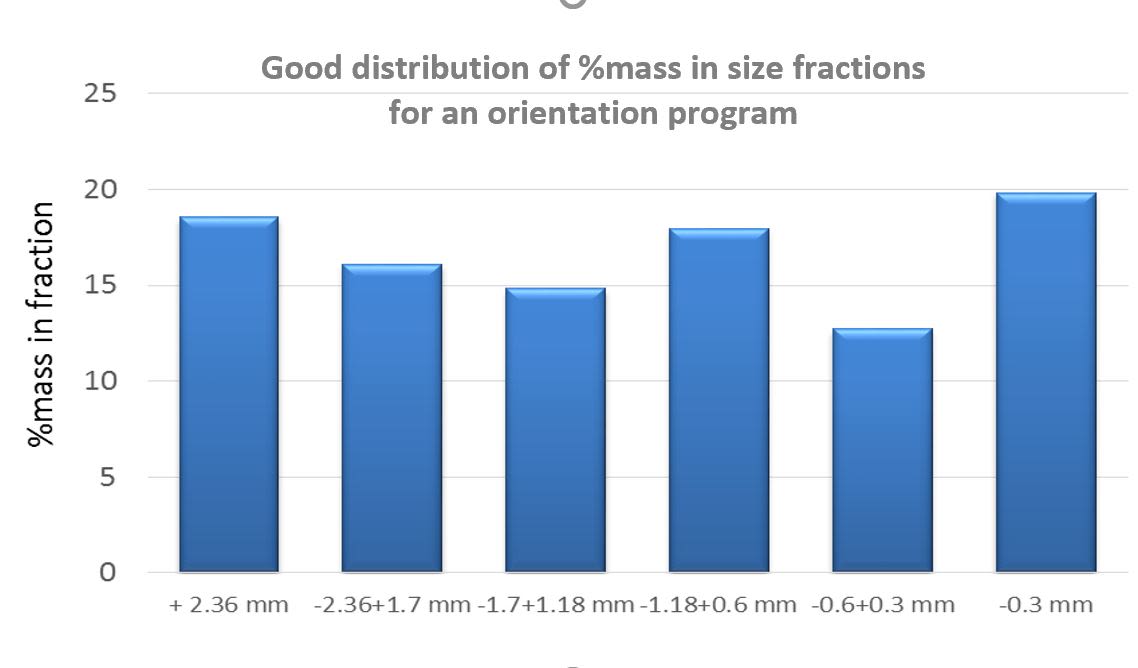](https://res.cloudinary.com/shapeable/image/upload/v1687255675/wikiore/189.jpg)\n\nBulk Sampling Options[](#Bulk_Sampling_Options)\n===============================================\n\nIn Pit or Stockpile Meso Sample[](#In_Pit_or_Stockpile_Meso_Sample)\n-------------------------------------------------------------------\n\nThis method can be used as a guide to determine the \"real world\" response of the RR from run of mine ore. Note the sample is NOT fully representative of the rock mass to be sampled, and will contain a bias that is unquantified at this stage.\n\nThe actual method to be deployed will vary to the equipment and resources available, but may follow the below as a guide. It is reccommended to sample minimum of 500-600kg with small [loader](https://en.wikipedia.org/wiki/Loader_%28equipment%29), escavator or bobcat (or 2 x 44 gallon drum equivalent) and upto 4-5 tonnes at the maximum.\n\nSample WILL be biased as the method will likely avoid rocks >200-300mm. However it is relatively easy to collect and process and will provide initial guide to [natural deportment](/pages/wikiore-natural-deportment) response. Second stage representative bulk sampling can be completed later, if initial test work warrants follow up\n\nLaboratory Screening[](#Laboratory_Screening)\n=============================================\n\n**Meso Sample**[](#Meso_Sample)\n-------------------------------\n\nAt either the onsite lab, or a commercial lab the sample needs to undergo preparation for screening, weighing and [assay](https://en.wikipedia.org/wiki/Assay). The method will vary from location to location. As a guide the below method has been utilised several times, with the ability to process approximately 100 meso samples in 2 weeks on site.\n\n* Transport sample to onsite/offsite lab\n* Dump sample onto a large tarp for contamination purposes, and ease of retaining the fines\n* Several technicians manually screen entire pile manually with sequentially reduced sized Gilson screens\n* Finer fractions screened with RoTap in the lab\n* Initial screen sizes need to be assessed but the sites prior knowledge of blasting [particle size](https://en.wikipedia.org/wiki/Particle_size) distribution should assist. Otherwise a common starting point may be: +110mm, -110+60mm, -60+30mm and -30mm\n* Weigh each fraction when entire sample has been processed\n* Crush and split for [assay](https://en.wikipedia.org/wiki/Assay) (all material) each fraction for [assay](https://en.wikipedia.org/wiki/Assay)\n* Multiple spliiting and reduction stages maybe required depending on starting mass\n* [assay](https://en.wikipedia.org/wiki/Assay)ing method, [assay](https://en.wikipedia.org/wiki/Assay) suite and repeats/duplicates etc should be determined by sites current knowledge, requirements and methods\n* It may be important to [assay](https://en.wikipedia.org/wiki/Assay) not only for target elements, but delaterious elements in case they are also upgraded (or downgraded) by [metal deportment](/pages/wikiore-natural-deportment)\n\n**Bulk Sample - Manual Preparation**[](#Bulk_Sample_-_title_Create_page:_Manual_Preparation_class_wiki_wikinew_text-danger_tips_Manual_Preparation__)\n---------------------------------------------------------------------------------------------------------------------------------------------------------\n\nPreparation for a bulk sample is essentially the same for meso samples, but the starting sample is larger and is more represenataive of the entire PSD.\n\n* Collect 3 to 4 tonne of run of mine sample collected by [excavator](https://en.wikipedia.org/wiki/Excavator) or [loader](https://en.wikipedia.org/wiki/Loader_%28equipment%29) - expit or stockpile\n* Dump sample onto a large tarp for contamination purposes, and ease of retaining the fines\n* Several technicians manually screen entire pile manually with sequentially reduced sized Gilson screens\n* Finer fractions screened with RoTap in the lab\n* Initial screen sizes need to be assessed but the sites prior knowledge of blasting [particle size](https://en.wikipedia.org/wiki/Particle_size) distribution should assist. Otherwise a common starting point may be: +110mm, -110+60mm, -60+30mm and -30mm\n* Weigh each fraction when entire sample has been processed\n* Crush and split for [assay](https://en.wikipedia.org/wiki/Assay) (all material) each fraction for [assay](https://en.wikipedia.org/wiki/Assay)\n* Multiple spliiting and reduction stages maybe required depending on starting mass\n* [assay](https://en.wikipedia.org/wiki/Assay)ing method, [assay](https://en.wikipedia.org/wiki/Assay) suite and repeats/duplicates etc should be determined by sites current knowledge, requirements and methods\n* It may be important to [assay](https://en.wikipedia.org/wiki/Assay) not only for target elements, but delaterious elements in case they are also upgraded (or downgraded) by [metal deportment](/pages/wikiore-natural-deportment)\n\nCommercial Gilson Screen (or equivalent)[](#Commercial_Gilson_Screen_or_equivalent_)\n------------------------------------------------------------------------------------\n\nThis sample preparation is effectively the same as a meso sample however with some modifications. They key difference is the use of a large Gilson Screen (or equivalent) to remove the manual labour. Size is generally limited to several 100's kilograms.\n\n* Top screen size is generally 100mm. Visually remove oversize manually\n* Sequentially fed balance through Gilson in smalerl batches\n* Trays emptied and material stockpiled as required\n* Repeat until entire sample processedInitial screen sizes need to be assessed but sites knowledge, but approximately +110mm, 110 - 60mm, 60 - 30mm and -30mm\n* Weigh each fraction\n* Crush and split for [assay](https://en.wikipedia.org/wiki/Assay) (all material) each fraction for [assay](https://en.wikipedia.org/wiki/Assay)\n* Multiple spliting and reduction stages maybe required depending on starting mass\n* [assay](https://en.wikipedia.org/wiki/Assay)ing method, [assay](https://en.wikipedia.org/wiki/Assay) suite and repeats/duplicates etc should be determined by sites current knowledge, requirements and methods\n* It may be important to [assay](https://en.wikipedia.org/wiki/Assay) not only for target elements, but delaterious elements in case they are also upgraded (or downgraded) by [metal deportment](/pages/wikiore-natural-deportment)\n\n \nNote: This process is readily available in commercial laboratories. It is reccommended to closely supervise all sample preparation methods as the preparation is labourious. CRC ORE has found \"short cutting\" has been an issue on several occassions where supervision is lacking.\n\n**[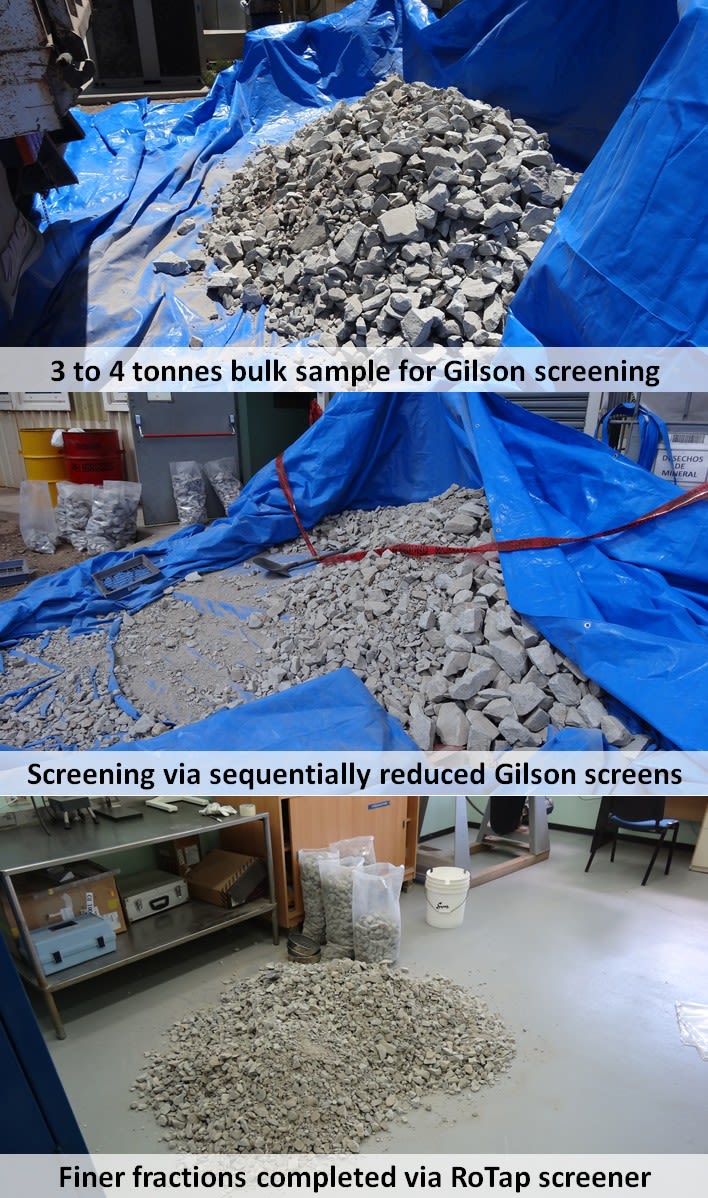](https://res.cloudinary.com/shapeable/image/upload/v1687255677/wikiore/103.jpg)**\n\n**Bulk Sample - Custom Jig**[](#Bulk_Sample_-_Custom_Jig)\n=========================================================\n\n \nCRC ORE has built and supervised a custom screening [JIG](https://en.wikipedia.org/wiki/Jig_concentrators) that has proven to be effective and efficient. All parts are generally available on most mine sites. It is particlarly effective when utilised for screening the [sub-sample](https://en.wikipedia.org/wiki/Sub-sampling_%28chemistry%29)s collected by either [loader](https://en.wikipedia.org/wiki/Loader_%28equipment%29)s or [excavator](https://en.wikipedia.org/wiki/Excavator)s from a mobile [jaw crusher](https://en.wikipedia.org/wiki/Crusher#Jaw_crusher) as discussed below.\n\n* Collect appropriate sized [sub-sample](https://en.wikipedia.org/wiki/Sub-sampling_%28chemistry%29)s in free fall from a mobile crusher\n* Collected by either [excavator](https://en.wikipedia.org/wiki/Excavator) (preferred - less sample bias) or [loader](https://en.wikipedia.org/wiki/Loader_%28equipment%29) (potential sample bias)\n* Standard screens maybe sourced from a screening deck that are commonly used on site for roadbase and/or stemming\n* A topsize screen maybe welded up from re-bar if standard screens are not available\n* Requires appropriate sized collection box for final fines at the bottom - or a heavy duty tarp for subsequent collection\n* Spacers are required for each screen\n* Material fed in 50-100kg batches onto screen jig\n* Manually shake/roll screens\n* As screens fill transfer topsize material directly into a storage container, and smaller \"middling\" fractions into double bagged sample bags\n* [shovel](https://en.wikipedia.org/wiki/Power_shovel) finest fraction into bags and clean up with dustpan & brush to ensure all material is collected\n* Weighing, [crushing](https://en.wikipedia.org/wiki/Crusher) and [assay](https://en.wikipedia.org/wiki/Assay) is as per above methods\n\n **[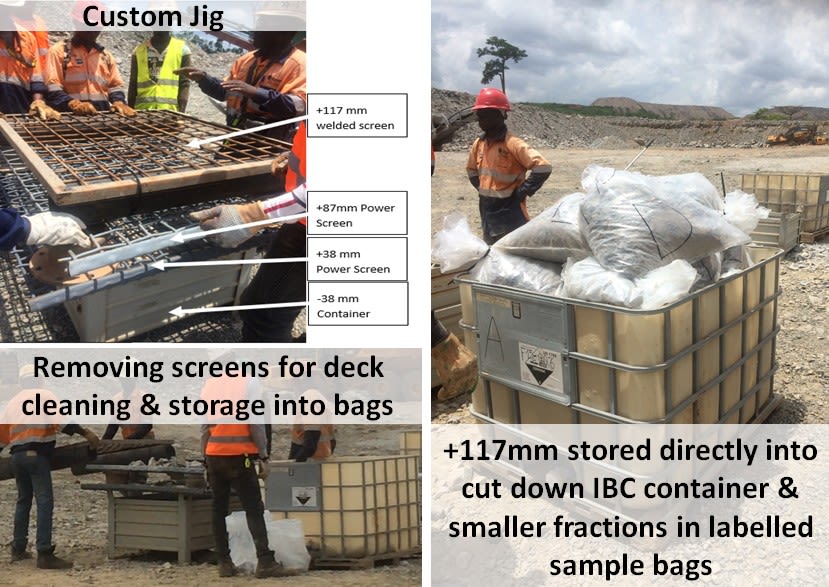](https://res.cloudinary.com/shapeable/image/upload/v1687255679/wikiore/104.jpg)**\n\n**Manual Belt Cuts**[](#Manual_Belt_Cuts)\n=========================================\n\n [meso scale](/sub-topics/sampling) [belt cut](/sub-topics/sampling)s can also be obtained from [production conveyor](https://en.wikipedia.org/wiki/Conveyor_belt)s. [meta data](https://en.wikipedia.org/wiki/Metadata) relevant to the sample should try and be captured where possible, such as the source dig block, [truck](https://en.wikipedia.org/wiki/Haul_truck) number or [shovel](https://en.wikipedia.org/wiki/Power_shovel). This allows sample characterisation to be matched to ore types or domains.\n\nConsideratyions that need to be taken into account are;\n\n1. Sample [meta data](https://en.wikipedia.org/wiki/Metadata) - eg: Are samples from 1 source ([truck](https://en.wikipedia.org/wiki/Haul_truck)s or [shovel](https://en.wikipedia.org/wiki/Power_shovel)) or blended sources. Single sources are preferable.\n\n[primary crusher](https://en.wikipedia.org/wiki/Crusher) – Normal operating mode should be maintained and close size setting confirmed\n\n1. Sampling at the conveyor after primary [crushing](https://en.wikipedia.org/wiki/Crusher)\n2. If in a [crushing](https://en.wikipedia.org/wiki/Crusher) line/system a [grizzly](https://en.wikipedia.org/wiki/Trommel_screen#Grizzly_screen) screen is present before the crusher, the following considerations need to be considered before sampling:\n 1. Sample [truck](https://en.wikipedia.org/wiki/Haul_truck) should try to skip the [grizzly](https://en.wikipedia.org/wiki/Trommel_screen#Grizzly_screen) screen, and try to dump straight into the crusher. Only if operational and safety protocols permit.\n 2. If Grissly screen can not be skipped, sampling can go ahead with screen in place only if Grissley screen is not scalping or separating more than 2% of the total material. If the Grissly scalps less than 2% then the material not sampled is minimal and should not effect preliminary studies.\n 3. If Grissly screen scalps more than 2% of the material, then that specific [crushing](https://en.wikipedia.org/wiki/Crusher) line can not be utilized for sampling, or consideration needs to be given to rock breaking the oversize for sampling purposes. The need to sample the oversize is less critical for ortientation studies, but becomes increasingly relevant for operational deployment studies.\n\n **[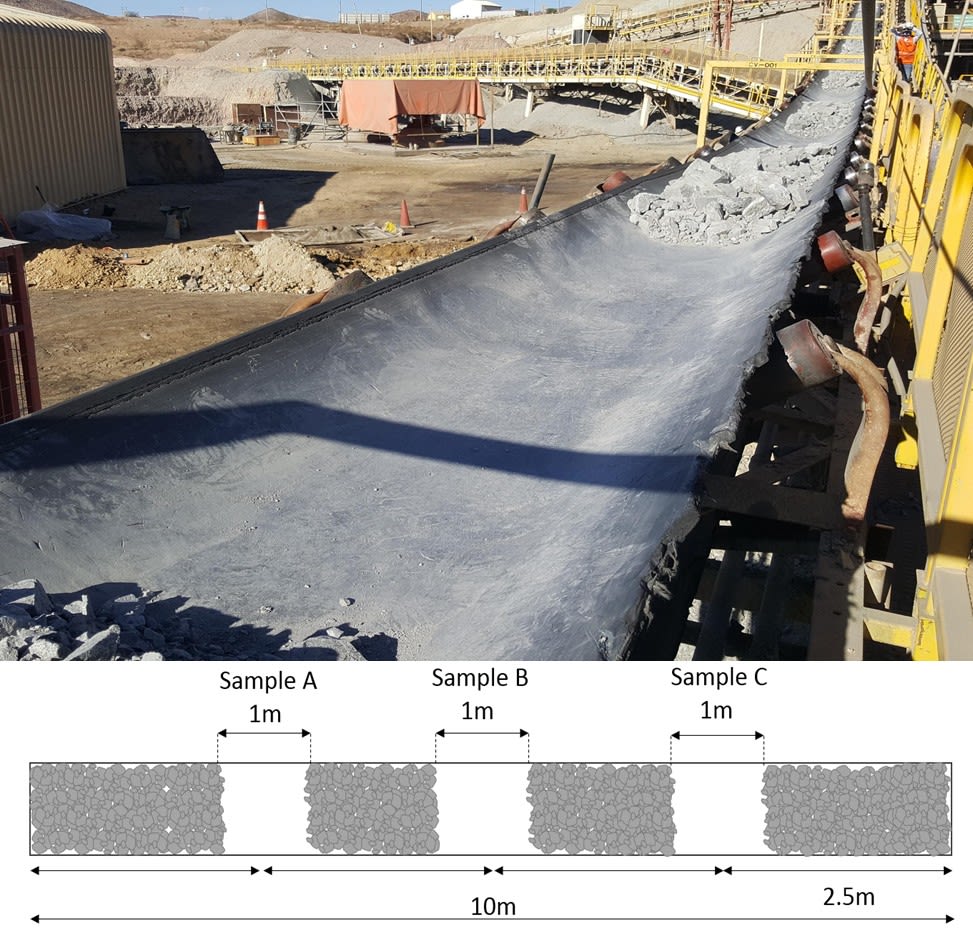](https://res.cloudinary.com/shapeable/image/upload/v1687255681/wikiore/105.jpg)**\n\nIdentify the following [meta data](https://en.wikipedia.org/wiki/Metadata) details before dumping at the [primary crusher](https://en.wikipedia.org/wiki/Crusher) for testing: \n - What region and polygon is the [truck](https://en.wikipedia.org/wiki/Haul_truck) load coming from. \n - Expected tonnage of [truck](https://en.wikipedia.org/wiki/Haul_truck) \n - Expected rock type \n - Expected average grades for elements of interest. \n - [truck](https://en.wikipedia.org/wiki/Haul_truck) ID, time of dumping, and final destination of material.\n\nIf practical ensure conveyor belt has no material from other [truck](https://en.wikipedia.org/wiki/Haul_truck) load before sample [truck](https://en.wikipedia.org/wiki/Haul_truck) dumps on [primary crusher](https://en.wikipedia.org/wiki/Crusher), or feed 3-4 [truck](https://en.wikipedia.org/wiki/Haul_truck)s of same material to \"flush\" the system. \nOnce sample [truck](https://en.wikipedia.org/wiki/Haul_truck) load dumps on [primary crusher](https://en.wikipedia.org/wiki/Crusher) and material is visible on at least 10 meters of conveyor belt, stop conveyor belt. Isollation and sampling practices should be developed and followed according to sites requirements. \nTake upto 3 samples as in the figure (e.g. Sample A, Sample B, Sample C) from conveyor belt, with a spacing of at least 1.5m between samples. Sample mass should be calculated from sampling theory according to [particle size](https://en.wikipedia.org/wiki/Particle_size)s, metal distribution and sampling constants if known.\n\nAfter samples have been taken, the rest of the [truck](https://en.wikipedia.org/wiki/Haul_truck) load passing through the crusher can continue to its original destination without further interruptions.\n\n* Each sample should be of around 1m (or more) of conveyor length. Each sample will have a weight between 200 to 400 kg.\n* Ensure that 100% of the sample is collected (fines and coarse) of the conveyor belt cross section. Use a broom and dustpan for final clean up.\n* As significant effort is required to stop and sample on the main conveyor it is reccommended to take 3 x coarse \"duplicates\" from the same sampling station. This allowes for;\n * Primary sample for [natural deportment](/pages/wikiore-natural-deportment) testwork\n * Secondary duplicate (or \"near duplicate\" as a true duplicate is not acheivable) for repeatability if required\n * Tertiary sample kept in reserve for follow up testwork and/or [geomet](https://en.wikipedia.org/wiki/Geometallurgy) synergies\n* Repeat this process for every [truck](https://en.wikipedia.org/wiki/Haul_truck) sample\n\n[crushing](https://en.wikipedia.org/wiki/Crusher), sub sampling and [assay](https://en.wikipedia.org/wiki/Assay)ing should follw one of the sample preparation methods discussed above.\n\n**Bulk Sample - Screen Deck Option**[](#Bulk_Sample_-_Screen_Deck_Option)\n=========================================================================\n\nBulk or small pilot trial options can be completed using a Mobile [jaw crusher](https://en.wikipedia.org/wiki/Crusher#Jaw_crusher) and a Screen Deck. The below image provides a pictorial guide.\n\nWhile suited to larger trials, and 100% of the sample is screened thus reducing the potential for bias, this method can be difficult for orientation studies due to the large sample masses generated. As 100% of the sample is seperated into size fractions, subsequent sub sampling of each pile is then required. The sub sampling method can then re-introduce substantial bias risk through partcile [segregation](https://en.wikipedia.org/wiki/Particle_segregation) on the stockpile cone, as well as biased sampling through mass reduction in the [subsample](https://en.wikipedia.org/wiki/Sub-sampling_%28chemistry%29).\n\n [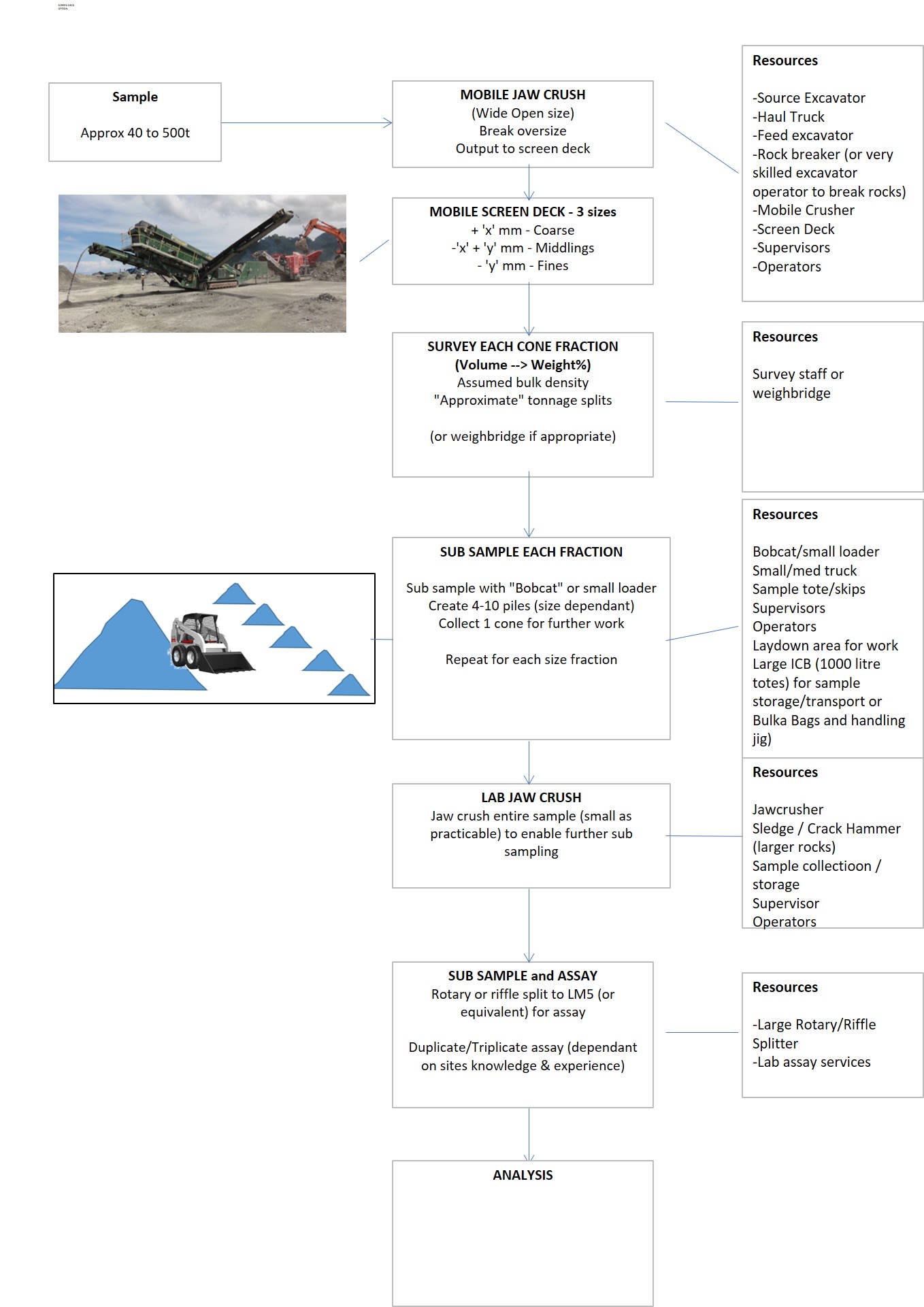](https://res.cloudinary.com/shapeable/image/upload/v1687255683/wikiore/190.jpg) \n\n**Bulk Sample – Mobile Crusher Option**[](#Bulk_Sample_Mobile_Crusher_Option)\n=============================================================================\n\nThe below discusses a methodolgy to [subsample](https://en.wikipedia.org/wiki/Sub-sampling_%28chemistry%29) directly post mobile [crushing](https://en.wikipedia.org/wiki/Crusher). Sampling via an inverted [excavator](https://en.wikipedia.org/wiki/Excavator) bucket is the prefrerred option as it reduces the bias potential due to the ability of the [excavator](https://en.wikipedia.org/wiki/Excavator) to make a single direction radial pass through the stream in freefall. Sub sampling by using a [loader](https://en.wikipedia.org/wiki/Loader_%28equipment%29) bucket to pass into the stream (either front on or side on) introduces bias potential as not all the rock stream is collected into the buccket for the same amount of time.\n\nThe below image provides a pictorial guide.\n\n [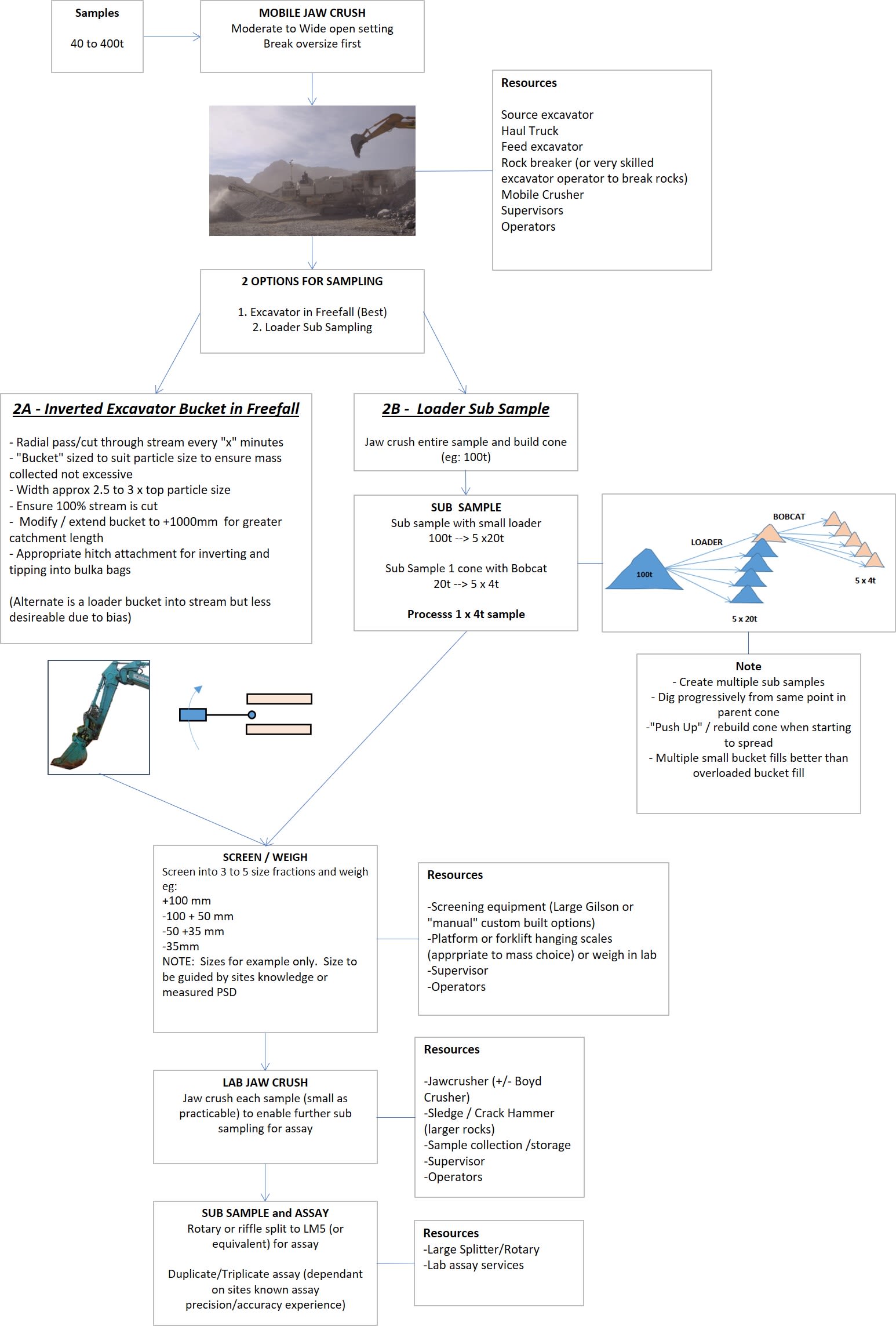](https://res.cloudinary.com/shapeable/image/upload/v1687255685/wikiore/191.jpg)"},"organisations":[],"embeds":{"citations":[],"imageAssets":[]},"video":null,"banner":null,"fileAssets":[],"citations":[],"feedEntries":[],"posts":[],"moderators":[]}}},"pageContext":{"lang":{"id":"en","path":"","iso":"en","name":"English","label":"English"},"availableEntities":["Catalyst","CommodityGroup","Innovation","Organisation","Page","Person","Post","SubTopic","Topic","Trend","OrganisationType","HorizonType","Economy","FeedEntry","Video","Citation","Objective","ProfileType","ExpertiseLevel"],"detailEntities":["Catalyst","CommodityGroup","Innovation","Organisation","Page","Person","Post","SubTopic","Topic","Trend"],"site":{"id":"65d2edd1ebf7bb9388ffb0df","slug":"connect-ore","name":"ConnectOre","url":"https://connectore.org","title":"ConnectOre","twitter":null,"threads":null,"facebook":null,"linkedin":null,"instagram":null,"flickr":null,"tiktok":null,"youtube":null,"ownerName":"ICAA","recaptchaKey":"6LfG2J0qAAAAAHDCFfJnrWOj6DiWJGik5BAa_7p8","googleSiteVerification":null,"platformName":"ConnectOre","platformUrl":"https://platform.connectore.org","supportEmail":null,"contactEmail":null,"mainMenu":{"id":"65d2edaaebf7bb9388ffaf79","slug":"website-navigation"},"linearMenu":null,"entityViews":[{"id":"67528c24c135ebcfc668f1ba_65d2edd1ebf7bb9388ffb0df","name":"Value Chain","hash":"value-chain","label":null,"slug":"value-chain","count":0,"showCount":null,"disabled":null,"icon":{"id":"6752a61b8b51dfa7b77b1e37","name":"Connections Navigator Icon Glyph","slug":"connections-navigator-icon-glyph","component":"ConnectionsNavigatorIconGlyph"},"childEntityTypes":[{"id":"6667fa4ff794dd6e045135c1","name":"Value Chain Theme","internalName":"Trend"},{"id":"6667fa58f794dd6e045135c6","name":"Topic","internalName":"Topic"}],"type":{"id":"67528b63c135ebcfc668f19c","name":"Explorer","slug":"explorer"},"slices":[]},{"id":"6757ef1ede8adbd45cf19474_65d2edd1ebf7bb9388ffb0df","name":"Bulletin Board","hash":"bulletin-board","label":null,"slug":"bulletin-board","count":0,"showCount":null,"disabled":null,"icon":{"id":"681c2cebbccc5a72d8382f31","name":"Tag Icon","slug":"tag-icon","component":"TagDotIconGlyph"},"childEntityTypes":[],"type":{"id":"67528b63c135ebcfc668f19c","name":"Explorer","slug":"explorer"},"slices":[]},{"id":"67528d88c135ebcfc668f31b_65d2edd1ebf7bb9388ffb0df","name":"Innovations","hash":"innovations","label":null,"slug":"innovations","count":0,"showCount":null,"disabled":null,"icon":{"id":"67528cddc135ebcfc668f304","name":"Grid Icon Glyph","slug":"grid-icon-glyph","component":"GridIconGlyph"},"childEntityTypes":[{"id":"67528d74c135ebcfc668f315","name":"Innovation","internalName":"innovation"}],"type":{"id":"67528b63c135ebcfc668f19c","name":"Explorer","slug":"explorer"},"slices":[]},{"id":"67625640fbc7c50d8644c592_65d2edd1ebf7bb9388ffb0df","name":"Community","hash":"community","label":null,"slug":"community","count":0,"showCount":null,"disabled":null,"icon":{"id":"67528cddc135ebcfc668f304","name":"Grid Icon Glyph","slug":"grid-icon-glyph","component":"GridIconGlyph"},"childEntityTypes":[{"id":"67528404c135ebcfc668ee1c","name":"Person","internalName":"Person"}],"type":{"id":"67528b63c135ebcfc668f19c","name":"Explorer","slug":"explorer"},"slices":[]},{"id":"67528e1bc135ebcfc668f33a_65d2edd1ebf7bb9388ffb0df","name":"Stakeholder Map","hash":"stakeholder-map","label":null,"slug":"stakeholder-map","count":0,"showCount":null,"disabled":null,"icon":{"id":"67528cddc135ebcfc668f304","name":"Grid Icon Glyph","slug":"grid-icon-glyph","component":"GridIconGlyph"},"childEntityTypes":[{"id":"66680141f794dd6e0451367a","name":"Organisation","internalName":"Organisation"}],"type":{"id":"67528b63c135ebcfc668f19c","name":"Explorer","slug":"explorer"},"slices":[]},{"id":"67529040c135ebcfc668f4ae_65d2edd1ebf7bb9388ffb0df","name":"References","hash":"references","label":null,"slug":"references","count":0,"showCount":null,"disabled":null,"icon":{"id":"67528cddc135ebcfc668f304","name":"Grid Icon Glyph","slug":"grid-icon-glyph","component":"GridIconGlyph"},"childEntityTypes":[{"id":"6752902fc135ebcfc668f4a4","name":"Article","internalName":"FeedEntry"},{"id":"67529039c135ebcfc668f4aa","name":"Citation","internalName":"Citation"},{"id":"67528de9c135ebcfc668f328","name":"Catalyst","internalName":"catalyst"},{"id":"67528df9c135ebcfc668f32d","name":"Page","internalName":"page"}],"type":{"id":"67528b63c135ebcfc668f19c","name":"Explorer","slug":"explorer"},"slices":[]}],"entityAppViews":[],"entityOnboardingViews":[{"id":"680c3a4ebc80e4d0f3cfa2ef_65d2edd1ebf7bb9388ffb0df","name":"Trend Expertise Step","hash":"trend-expertise-step","label":null,"slug":"trend-expertise-step","count":0,"showCount":null,"icon":null,"childEntityTypes":[],"type":{"id":"680c394fbc80e4d0f3cfa2d8","name":"Onboarding","slug":"onboarding"},"slices":[{"id":"680c39f2bc80e4d0f3cfa2e0_65d2edd1ebf7bb9388ffb0df","name":"Trend Expertise Onboarding Grid","slug":"trend-expertise-onboarding-grid","label":null,"updated":"2025-04-26T01:42:10.20","layout":{"id":"680c3993bc80e4d0f3cfa2dd","name":"Slice Onboarding Trend Expertise Grid","slug":"slice-onboarding-trend-expertise-grid","component":"SliceLayoutOnboardingTrendExpertiseGrid"},"connectedEntities":[],"headerFontType":null,"pretitle":null,"pretitleRich":{"id":"680c39f2bc80e4d0f3cfa2e0_65d2edd1ebf7bb9388ffb0df_pretitleRich","text":""},"title":null,"titleRich":{"id":"680c39f2bc80e4d0f3cfa2e0_65d2edd1ebf7bb9388ffb0df_titleRich","text":"Are you **an industry expert** in any of these Value Chain Themes?"}}]},{"id":"680c3a85bc80e4d0f3cfa2fa_65d2edd1ebf7bb9388ffb0df","name":"Profile Types Step","hash":"profile-types-step","label":null,"slug":"profile-types-step","count":0,"showCount":null,"icon":null,"childEntityTypes":[],"type":{"id":"680c394fbc80e4d0f3cfa2d8","name":"Onboarding","slug":"onboarding"},"slices":[{"id":"680c3a82bc80e4d0f3cfa2f7_65d2edd1ebf7bb9388ffb0df","name":"Profile Types Onboarding Grid","slug":"profile-types-onboarding-grid","label":null,"updated":"2025-04-26T01:44:34.63","layout":{"id":"680c3a13bc80e4d0f3cfa2e4","name":"Slice Onboarding Profile Types Grid","slug":"slice-onboarding-profile-types-grid","component":"SliceLayoutOnboardingProfileTypesGrid"},"connectedEntities":[],"headerFontType":null,"pretitle":null,"pretitleRich":{"id":"680c3a82bc80e4d0f3cfa2f7_65d2edd1ebf7bb9388ffb0df_pretitleRich","text":""},"title":"Which best describes you?","titleRich":{"id":"680c3a82bc80e4d0f3cfa2f7_65d2edd1ebf7bb9388ffb0df_titleRich","text":""}}]},{"id":"680c3aaabc80e4d0f3cfa2ff_65d2edd1ebf7bb9388ffb0df","name":"Objectives Step","hash":"objectives-step","label":null,"slug":"objectives-step","count":0,"showCount":null,"icon":null,"childEntityTypes":[],"type":{"id":"680c394fbc80e4d0f3cfa2d8","name":"Onboarding","slug":"onboarding"},"slices":[{"id":"680c3aa8bc80e4d0f3cfa2fc_65d2edd1ebf7bb9388ffb0df","name":"Objectives Onboarding Grid","slug":"objectives-onboarding-grid","label":null,"updated":"2025-04-26T01:45:12.76","layout":{"id":"680c3a3fbc80e4d0f3cfa2ea","name":"Slice Onboarding Objectives Grid","slug":"slice-onboarding-objectives-grid","component":"SliceLayoutOnboardingObjectivesGrid"},"connectedEntities":[],"headerFontType":null,"pretitle":null,"pretitleRich":{"id":"680c3aa8bc80e4d0f3cfa2fc_65d2edd1ebf7bb9388ffb0df_pretitleRich","text":""},"title":"What are your priority objectives?","titleRich":{"id":"680c3aa8bc80e4d0f3cfa2fc_65d2edd1ebf7bb9388ffb0df_titleRich","text":""}}]}],"gptLanguages":[{"id":"65d2eda5ebf7bb9388ffaf1f","name":"English","slug":"english","iso":"en","locale":"en_US","path":"/en","label":"English","menuLabel":null},{"id":"666f70b6e051ad9ef086d1be","name":"Arabic","slug":"arabic","iso":"ar","locale":"ar_AE","path":"/ar","label":"عربي","menuLabel":null},{"id":"666f7161e051ad9ef086d1c4","name":"Spanish","slug":"spanish","iso":"es","locale":"es_ES","path":"/es","label":"español","menuLabel":null},{"id":"666f71c9e051ad9ef086d1c8","name":"German","slug":"german","iso":"de","locale":"de_DE","path":"/de","label":"Deutsch","menuLabel":null},{"id":"65d2eda5ebf7bb9388ffaf20","name":"French","slug":"french","iso":"fr","locale":"fr_FR","path":"/fr","label":"Français","menuLabel":null}],"gptQuestionTemplate":{"id":"662c7f6e81ef1920e3638518","name":"Standard Open Question","slug":"standard-open-question","path":"/prompt-templates/standard-open-question","__typename":"PromptTemplate","_entityTypeName":null,"label":"CopperAI","type":{"id":"662c7f1981ef1920e363850f","name":"Ask","slug":"ask"},"description":{"text":"This template is tailored for providing accurate responses based on specific context. It integrates contextual details from \"contextual information\" and addresses the \"target question\". The response is always in English, prioritizing clarity. If the answer is unknown, the template openly acknowledges this, ensuring honesty and avoiding speculation. This format is ideal for precise, context-sensitive, and truthful answering."},"summary":{"text":"Ask a general question about Website content"},"gptModel":{"id":"67564c4f2f6749787d0e03dc","name":"OpenAI GPT 4o","slug":"open-ai-gpt-4-o","dataSetId":"openai:gpt-4o"},"variablesPrompt":{"text":""},"submitLabel":"Ask","languages":[],"icon":{"id":"67528b9cc135ebcfc668f1a3","name":"AI Lower Case Icon Glyph","slug":"ai-lower-case-icon-glyph","component":"AiLowerCaseIconGlyph"},"variables":[{"id":"6668076bf794dd6e045138d9","name":"question","slug":"question","useVectorStore":true,"label":"What would you like to know?","labelAnother":null,"help":{"text":""},"options":{"text":""},"defaultValue":null,"entityTypes":[],"controlType":{"id":"6667ff19f794dd6e04513656","name":"Textarea","slug":"textarea"},"labelContextual":null,"labelAnotherContextual":null,"helpContextual":{"text":""},"optionsContextual":{"text":""},"defaultValueContextual":null,"entityTypesContextual":[],"controlTypeContextual":{"id":"6667ff19f794dd6e04513656","name":"Textarea","slug":"textarea"}}]},"advertisements":[],"logoVerticalOffset":null,"logoHorizontalOffset":null,"logoVerticalOffsetMobile":null,"logoHorizontalOffsetMobile":null,"logoVerticalOffsetTablet":null,"logoHorizontalOffsetTablet":null,"logoVerticalOffsetDesktop":null,"logoHorizontalOffsetDesktop":null,"logoHeightMobile":44,"logoHeightTablet":null,"logoHeightDesktop":null,"headerHeightMobile":null,"headerHeightTablet":null,"headerHeightDesktop":null,"logo":{"url":"https://res.cloudinary.com/shapeable/image/upload/v1738807465/copper-connect/site/copper-connect_logo__CopperOre_Master_Brand_Identity-colour_cd4vgg.webp","type":"image/webp","width":945,"height":266},"logoInverted":{"url":"https://res.cloudinary.com/shapeable/image/upload/v1738807452/copper-connect/site/copper-connect_logoInverted__CopperOre_Master_Brand_Identity-white_chnucx.webp","type":"image/webp","width":945,"height":266},"footerMenu":null,"footerSecondaryMenu":null,"footerContent":{"text":"© {year} ConnectOre. All Rights Reserved\n"},"creator":null,"poweredBy":{"id":"65d2edadebf7bb9388ffafc8","name":"Shapeable","slug":"shapeable","url":"https://shapeable.ai","logo":{"url":"https://res.cloudinary.com/shapeable/image/upload/v1674010034/platform/organisation/shapeable_logo__shapeable.png","type":"image/png","width":1174,"height":368},"logoInverted":{"url":"https://res.cloudinary.com/shapeable/image/upload/v1729474494/copper-connect/organisation/shapeable_logoInverted__shapeable-logo-inverted_sdcfpk.png","type":"image/png","width":392,"height":118},"logoSubtle":null},"poweredByLabel":null,"poweredByContent":{"text":""},"explorerPage":{"name":"Explorer","title":null,"slug":"explorer","path":"/explorer"},"termsPage":{"name":"Terms of Use","title":null,"slug":"terms-of-use","path":"/terms-of-use"},"homePage":null,"knowledgeHubPage":{"name":"News","title":null,"slug":"news","path":"/news"},"privacyPolicyPage":{"name":"Privacy Policy","title":null,"slug":"privacy-policy","path":"/privacy-policy"},"summary":{"text":"A platform to accelerate industry-wide innovation through collective intelligence and collaborative action"},"thumbnail":{"url":"https://res.cloudinary.com/shapeable/image/upload/v1713942350/copper-connect/site/copper-connect_thumbnail__site-thumb_bmicl8.png"},"openGraph":{"title":"ConnectOre","date":"2026-07-31T04:44:47.80","description":{"plain":"A platform to accelerate industry-wide innovation through collective intelligence and collaborative action\n"},"image":{"url":"https://res.cloudinary.com/shapeable/image/upload/v1713942350/copper-connect/site/copper-connect_thumbnail__site-thumb_bmicl8.png","type":"image/png","thumbnails":{"full":{"url":"https://res.cloudinary.com/shapeable/image/upload/v1713942350/copper-connect/site/copper-connect_thumbnail__site-thumb_bmicl8.png"}}}},"termsAndConditions":{"text":""},"privacyPolicy":{"text":"At ConnectOre we respect your privacy. We want to ensure that you get the information, content, and experiences that matter most to you. ConnectOre is committed to protecting the privacy of its stakeholders, communities, and other contacts.\n\n## Scope\n\nThis privacy policy applies to all personal data processed by full-time and part-time employees, volunteers when acting on behalf of ConnectOre contractors and partners doing business on behalf of ConnectOre, as well as all legal entities, all operating locations in all countries, and all business processes conducted by ConnectOre.\n\n## Information Collected\n\n#### What information do we collect?\n\nConnectOre collects the following personal data in line with the use purposes explained in a subsequent section:\n\n * Your name and contact details\n * Online profile data/usage\n * Contact information\n * Social media profile information\n * Education and professional information\n * Registration and participation in ConnectOre events and activities \n * Information about service usage\n * Cookies\n * Authentication data\n * Location information\n * Author and peer review information\n * Other information you upload or provide to us\n\n#### How do we use your information?\n\nConnectOre uses (and, where specified, shares) your personal information for the following purposes:\n\n * To provide support or other services. ConnectOre may use your personal information to provide you with support or other services that you have ordered or requested. ConnectOre may also use your personal information to respond directly to your requests for information, including registrations for webinars, or other specific requests, or pass your contact information to the appropriate ConnectOre supplier or reseller for further follow-up related to your interests.\n * To provide information based on your needs and respond to your requests. ConnectOre may use your personal information to provide you with notices of new product releases and service developments.\n * To administer products. ConnectOre may contact you if you make use of (digital) products we offer, to confirm certain information (for example, that you did not experience problems in a download process). We may also use this information to confirm compliance with licensing and other terms of use and may share it with your company/institution.\n * To assist in your participation in ConnectOre activities. ConnectOre will communicate with you, if you are participating in certain ConnectOre activities such as ConnectOre Summit, authoring or reviewing a ConnectOre article, or ConnectOre humanitarian activities. ConnectOre may send you information such as update messages related to those activities (such as but not limited to the event's content, and event logistics)\n * To update you on relevant ConnectOre events and opportunities. ConnectOre may communicate with you regarding relevant ConnectOre events and opportunities.\n * To protect ConnectOre content and services. We may use your information to prevent potentially illegal activities and to enforce our terms and conditions.\n * To get feedback or input from you. In order to deliver products and services of most interest to our stakeholders, from time to time, we may ask you to provide us input and feedback (for example through surveys).\n\n#### How can you control your information?\n\nYou can control the information we have about you and how we use as follows:\n\n * If you are a registered guest for ConnectOre Annual Summit 2021, any request for review, revise or correction of your personal data can be sent to john.fennell@copper.com.au specifying your request.\n\n#### Personal data about minors and children\n\nConnectOre does not knowingly collect data from or about children under 16 without the permission of parent(s)/guardian(s). If we learn that we have collected personal information from a child under 16, we will delete that information as quickly as possible. If you believe that we might have any information from or about a child under age 16, please contact us.\n\n#### How will you know if the Privacy Policy is changed?\n\nConnectOre may update its Privacy Policy from time to time. If we make any material changes you will be notified by means of a notice on our website prior on the date the change becomes effective. We encourage you to periodically review this page for the latest information on our privacy practices.\n\n## Technical And Regulatory Information\n\n#### Logging practices\n\nConnectOre automatically records the Internet Protocol (IP) addresses of visitors. The IP address is a unique number assigned to every computer on the internet. Generally, an IP address changes each time you connect to the internet (it is a \"dynamic\" address). Note, however, that if you have a broadband connection, depending on your individual circumstance, the IP address that we collect may contain information that could be deemed identifiable. This is because, with some broadband connections, your IP address doesn't change (it is \"static\") and could be associated with your personal computer.\n\nAs well as recording the IP addresses of users, ConnectOre may also keep track of sites that users visited immediately prior to visiting ConnectOre's website and the search terms they used to find it. We keep track of the pages visited on ConnectOre's website, the amount of time spent on those pages and the types of searches done on them. Your searches remain confidential and anonymous. ConnectOre uses this information only for statistical purposes to find out which pages users find most useful and to improve the website.\nConnectOre also captures and stores information that you transmit. This may include:\n\n * Browser/Device type/version\n * Operating system used\n * Media Access Control (MAC) address\n * Date and time of the server request\n * Volume of data transferred\n\n#### External links behaviour\n\nSome of the links on ConnectOre's websites link to other sites created and maintained by other public- and/or private-sector organizations. ConnectOre provides these links solely for your information and convenience. When you transfer to an outside website, you are leaving ConnectOre domain, and ConnectOre's information management policies no longer apply. ConnectOre encourages you to read the privacy statement of each external website that you visit before you provide any personal data.\n\n#### Cookies and web beacons\n\nCookies and web beacons are electronic placeholders that are placed on your device by websites to track your individual movements on that website over time. ConnectOre uses both session-based cookies (which last only for the duration of the user's session) and persistent cookies (which remain on your device and provide information about the session you are in and waits for the next time you use that site again).\n\nThese cookies and web beacons provide useful information to ConnectOre, enabling us to recognize repeat users, facilitate the user's access to and use of our sites, allows us to track usage behavior, and to balance the usage of our websites on all ConnectOre web servers.\nTracking cookies, third-party cookies, and other technologies such as web beacons may be used to process additional information, enable non-core functionalities on ConnectOre website and enable third-party functions (such as a social media \"share\" link). We may also include web beacons and other similar technology in promotional email messages to determine whether the messages have been opened.\n\n#### Do Not Track (DNT)\n\nThe online advertising industry has self-regulatory initiatives designed to provide consumers a choice in the types of ads they may see online and to conveniently opt-out from online behavioral ads served by some or all of the companies participating in these programs. Our websites do not respond to DNT consumer browser settings.\n\n#### Responses to legal requests\n\nConnectOre reserves the right to share your information to respond to duly authorized information requests of governmental authorities or where required by law.\n\n#### Your data rights\n\nConnectOre complies with all applicable data privacy laws and regulations including, but not limited to, the General Data Protection Regulation (GDPR) and the California Consumer Privacy Act (CCPA). Under these laws and regulations, you may have certain rights to your data. Should you wish to exercise any of these rights, please send an email request to john.fennell@copper.com.au with \"Data Privacy Request'' in the subject line and in the email please identify the specific privacy right you request assistance with. Please note additional information may be requested prior to fulfilling a request and that ConnectOre reserves the right to charge a fee, where permitted, to cover the cost of certain requests.\n\n#### How do I contact you if there is an issue?\nIf you have any questions or concerns about this Privacy Policy or about the use of your personal information, please feel free to contact us by email at john.fennell@copper.com.au"},"welcomeUrl":"https://connectore.org/app/welcome","welcomeTitle":"Welcome to ConnectOre and thanks for joining us! ","invitationAction":"join the ConnectOre community","setupCompletionMessage":null,"languages":[],"brandColors":[],"showLogin":true,"showShareMenu":null,"showFollowMenu":true,"showPlatformLogin":null,"showContactUs":null,"loginLabel":"Explorer Login","platformLoginLabel":"Community Platform","headerButtons":[]},"includeProfile":true,"disableProfileEditing":false,"dynamicEntityTypeNames":["Person","Organisation"],"profilePath":"/app/profile","welcomePath":"/app/welcome","id":"65d2edd7ebf7bb9388ffb183","slug":"sampling","entityPath":"/sub-topics/sampling","openGraph":{},"entityTypeName":"SubTopic","name":"Sampling","updated":"2024-12-20T00:58:17.03","__type":"SubTopic"}},
"staticQueryHashes": ["1044227382","1158597448","1242646999","1427075558","1452322194","1520036161","1545705019","1586309863","1606754935","1816168740","1864381666","1903214493","1945056504","1989845544","2034981229","2181044613","2409034939","2463401854","2526615987","2642656775","2862279633","2867243664","2910164142","2912920178","296816903","3073584486","3150399266","3172506128","3320076387","3447680494","3453148481","3624873332","364221563","3692255024","3778988535","3782604890","4091857177","4216505212","591477963","701411134","758936535","80004486","857137463","881103158"]}