{
"componentChunkName": "component---src-gatsby-entities-sub-topic-tsx",
"path": "/sub-topics/natural-deportment-characterisation",
"result": {"data":{"platform":{"subTopic":{"__typename":"Platform_SubTopic","_schema":{"label":"Sub Topic","pluralLabel":"Sub Topics"},"openGraph":{"title":"Natural Deportment Characterisation","description":{"text":"Introduction\n=============================\n\n[natural deportment](/pages/wikiore-natural-deportment) laboratory testing aims to determine if specific [assay](https://en.wikipedia.org/wiki/Assay) elements (as a proxy for mineralogy) are preferentially deporting by..."},"image":null},"id":"65d2edd7ebf7bb9388ffb178","slug":"natural-deportment-characterisation","name":"Natural Deportment Characterisation","path":"/sub-topics/natural-deportment-characterisation","outlineNumber":"2.2.3","color":{"__typename":"Platform_Color","id":"65d2ed7febf7bb9388ffab3a","slug":"core-12","name":"Core 12","value":"#3b6673","darkValue":"#2b4b56","veryDarkValue":"#1c3239"},"intro":{"id":"65d2edd7ebf7bb9388ffb178_intro","text":"Introduction\n=============================\n\n[natural deportment](/pages/wikiore-natural-deportment) laboratory testing aims to determine if specific [assay](https://en.wikipedia.org/wiki/Assay) elements (as a proxy for mineralogy) are preferentially deporting by size. Typically expressed as a systematic increase in concentration in finer size fractions. "},"description":{"id":"65d2edd7ebf7bb9388ffb178_description","text":"[assay](https://en.wikipedia.org/wiki/Assay)s from a series of size fractions for each sample are used to generate Response Curves. A mathematical function is then calculated across individual curves to generate a [Response Ranking](/sub-topics/natural-deportment-characterisation) (RR) - a single number used to describe the magnitude of a Response Curve. [Response Ranking](/sub-topics/natural-deportment-characterisation)s are used as inputs into [Grade Engineering](/pages/wikiore-introduction-to-grade-engineering) [block model](https://en.wikipedia.org/wiki/Mineral_resource_estimation#Resource_block_model)s, process simulations and economic evaluations. \n \nTesting can be carried out at drill core, blast hole chip or ROM scale although transforms are required to compare different scales. drill core testing is referred to as '[variability testing](/sub-topics/natural-deportment-characterisation)'. Testing of material at ROM scale is referred to as '[bulk testing](/sub-topics/sampling)', up to and including Production Trials. Depending on [opportunity assessment](/sub-topics/opportunity-assessments) requirements and site considerations a selection will be made regarding an appropriate sample type to test. \n \nTesting programs are conducted in two stages:\n\n1. An initial evaluation phase to select size fractions that generate optimal mass distributions typically involving 5-6 size fractions, and\n2. Routine testing based on a smaller number of size fractions (typically four) selected based on stage 1 mass results.\n\n[variability testing](/sub-topics/natural-deportment-characterisation)[](#variability_testing)\n==============================================================================================\n\n[variability testing](/sub-topics/natural-deportment-characterisation) can be carried out using coarse residues generated by [crushing](https://en.wikipedia.org/wiki/Crusher) during routine laboratory [assay](https://en.wikipedia.org/wiki/Assay) preparation as a precursor to pulverisation. Many projects/sites routinely store coarse residues specifically for future testing or check [assay](https://en.wikipedia.org/wiki/Assay)ing. In this case stored coarse residues can be used for cost effective testing. Stored pulps are not suitable for [variability testing](/sub-topics/natural-deportment-characterisation) as material has undergone excessive breakage and [natural deportment](/pages/wikiore-natural-deportment) signatures have been lost. \n \n[crushing](https://en.wikipedia.org/wiki/Crusher) protocols for coarse residues vary between sites and companies. These residues are produced with the aim to reduce the top size of a [particle size](https://en.wikipedia.org/wiki/Particle_size) distribution to a statistically suitable point for accurately splitting a portion to be used for fine pulverising prior to chemical [assay](https://en.wikipedia.org/wiki/Assay)ing. A typical top size for coarse residues is 99% passing -3.35mm or the equivalent #6 mesh (occasionally referred to as 80% passing 2mm). \n \n[particle size](https://en.wikipedia.org/wiki/Particle_size) distributions are a function of crusher gap settings, drill core sizes and rock hardness. Crusher gap settings in particular can vary between laboratories or drift over time. Within limits this variability does not affect use of coarse residues for [variability testing](/sub-topics/natural-deportment-characterisation). However, it is necessary to establish actual [particle size](https://en.wikipedia.org/wiki/Particle_size) distributions for site specific coarse residues as part of an initial evaluation program in order to select optimal sieve sizes for routine testing. \n \nMass of specific sieve size fractions is also monitored during routine testing before samples are sent for [assay](https://en.wikipedia.org/wiki/Assay)ing to provide a qa/qc flag for samples that show unusual mass distributions that may not be suitable for testing. sieve size selections primary objective is the generation of a minimum number of data points to define a statistically meaningful Response Curve and Ranking. This requires a minimum of three sieve sizes (generating four size fractions) across the cumulative mass range.\n\nSelection of Optimal Sieve Sizes[](#Selection_of_Optimal_Sieve_Sizes)\n=====================================================================\n\nsieve size selection aims to ensure roughly equal masses in each fraction. This provides sufficient coverage on a Response Curve diagram to generate statistical confidence in an eventual [Response Ranking](/sub-topics/natural-deportment-characterisation) and subsequent modelling activities. Ideal mass in each fraction is calculated by 100%/'n' where 'n' is the number of sizes being generated by the testing. \n \nAs an example, if 5 sizes are planned then ideal mass per fraction is ~20%. Some variation around this is normal and expected however if masses deviate substantially from this as shown in the table below then selected size fractions should be adjusted.\n\n| size fraction # | Ideal Mass | Failed Mass **qa/qc** | Passed Mass **qa/qc** |\n|:------------------|:----------------------:|:------------------------------------------------:|:------------------------------------------------:|\n| 1 | 20% | 40% | 17% |\n| 2 | 20% | 10% | 23% |\n| 3 | 20% | 20% | 18% |\n| 4 | 20% | 5% | 19% |\n| 5 | 20% | 25% | 23% |\n\nThere is no 'correct' set of sieve sizes or look up function for correct sizes, as long as mass distribution objectives are met then the selection is considered appropriate for those samples. It is recommended that for an initial evaluation (first 20-50 samples) five sieves are used (giving six fractions). This can be reduced to 3 sieves depending on Response Curve variability and consistency of mass fraction data.\n\n[Response Ranking](/sub-topics/natural-deportment-characterisation) (RR)[](#Response_Ranking_RR_)\n=================================================================================================\n\nCRC OREs [Response Ranking](/sub-topics/natural-deportment-characterisation) approach allows results to be systematically and routinely processed and interpreted. This facilitates comparative ranking between deposits and domaining GE within deposits. RR is a mathematical function that can be used as an input into a range of CRC ORE modelling and simulation software environments to determine operational [Grade Engineering](/pages/wikiore-introduction-to-grade-engineering) scenarios and value utilising screening. [Response Ranking](/sub-topics/natural-deportment-characterisation)s are neither related or dependent on head grade, which acts as a modifying attribute. \n \nRR values are independent characteristics and, rather than providing an answer, allow for the calculation of a range of outcomes. They are the [Grade Engineering](/pages/wikiore-introduction-to-grade-engineering) equivalent of processing attributes (Bond work index, A\\*b,SPI etc...). Values by themselves do not indicate what mass pull gives optimum upgrade or what grade categories it should be applied to. These are dynamic operational decisions driven by RR but optimized by operational considerations and economics (more detail on this is available in ((STRATEGIC PLANNING WITH [Grade Engineering](/pages/wikiore-introduction-to-grade-engineering)|Chapter 8))). \n \nWhile this current section focuses on [natural deportment](/pages/wikiore-natural-deportment), the same principles and ranking methodology can be applied to any separation lever as part of [Grade Engineering](/pages/wikiore-introduction-to-grade-engineering) assessments. Comparing RR values for a site against a global comparative database is a key aspect of [Grade Engineering](/pages/wikiore-introduction-to-grade-engineering)® [opportunity assessment](/sub-topics/opportunity-assessments)s. Experience to date indicates when a site presents with RR >~60 at [variability testing](/sub-topics/natural-deportment-characterisation) scale a high baseline opportunity generally exists. \n \nAlthough generating, processing and interpreting this data is relatively straightforward, systematic databases of [grade by size](/pages/wikiore-natural-deportment) data from drill core testing, production scale testing (e.g. [belt cut](/sub-topics/sampling)s or [truck](https://en.wikipedia.org/wiki/Haul_truck)s) or mill surveys, remains rare in the industry. This lack of data means that opportunities are typically overlooked on most operations stressing the importance of undertaking rapid assessment programs. CRC ORE continues to generate a significant centralized database of [grade by size](/pages/wikiore-natural-deportment) data across a range of deposit styles and sample types which can increasingly be used to rank and compare individual sites against a global dataset.\n\n[response factor](/sub-topics/natural-deportment-characterisation)s (RF)[](#response_factors_RF_)\n-------------------------------------------------------------------------------------------------\n\nIn [Grade Engineering](/pages/wikiore-introduction-to-grade-engineering), relative differences between separated fractions and feed grade is referred to as a [response factor](/sub-topics/natural-deportment-characterisation) (RF). RF is a function of rock type and its interaction with separation lever technologies and can be calculated one of two ways:\n\n1. New cumulative grade of undersize material / feed grade of sample\n2. Relative cumulative metal percent / relative cumulative mass percent\n\nAs both calculation methods normalise for starting grade/metal this allows for a standard graph to be produced to compare a set of results, irrespective of feed grade variations. \n \n[response factor](/sub-topics/natural-deportment-characterisation) varies as a function of mass pull, with a small mass retained (10-30%) typically giving a high [response factor](/sub-topics/natural-deportment-characterisation) while a high mass retained (>70%) gives a lower value. This co-dependency between [response factor](/sub-topics/natural-deportment-characterisation) and mass is why CRC ORE identified a need for a standardised method to normalise responses. \n \nAn example of laboratory scale testing for [response factor](/sub-topics/natural-deportment-characterisation)s is shown below. Data points represent actual test laboratory results using crushed drill core at a range of screen sizes.\n\n \n [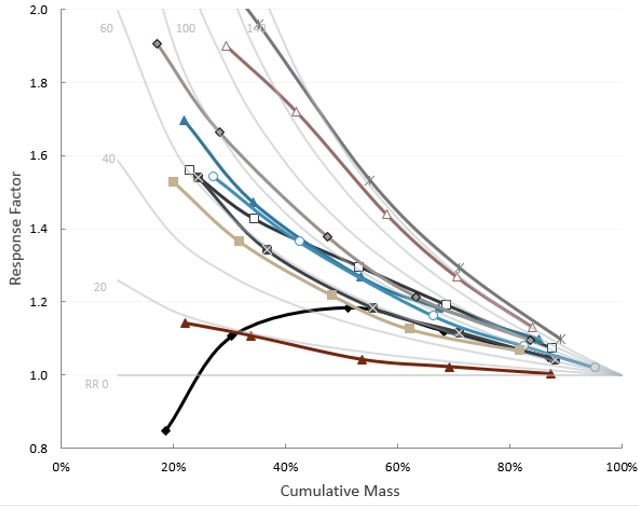](https://res.cloudinary.com/shapeable/image/upload/v1687255689/wikiore/110.jpg) \n\n[response factor](/sub-topics/natural-deportment-characterisation)s have two main properties useful for characterisation. Firstly, there is a maximum theoretical limit for any given mass pull as metal is constrained within the feed sample. This produces a limit of 100%/’m’ where ‘m’ is the cumulative undersize mass. The second useful property defines a no response result. Calculations for this mean that associated metal pulls will always be equal to mass pulls (40% mass = 40% metal, 90% mass = 90% metal etc…). Tabulated results below show both a maximum theoretical |LHS| and a no response |RHS| set of values included associated RF calculations.\n\n| Mass (%) | Metal (%) | RF | Mass (%) | Metal (%) | RF |\n|:-------:|:---------:|:----:|:-------:|:---------:|:----:|\n| 100 | 100 | 1.00 | 100 | 100 | 1.00 |\n| 80 | 100 | 1.25 | 80 | 80 | 1.00 |\n| 60 | 100 | 1.67 | 60 | 60 | 1.00 |\n| 40 | 100 | 2.50 | 40 | 40 | 1.00 |\n| 20 | 100 | 5.00 | 20 | 20 | 1.00 |\n\nMaximum theoretical responses at a given mass pull can be expressed as RF = m -1, while the no response is expressed as RF = m. This provides a list of potential reference curves utilising the equation RF = m RS where RS is a response score between 0 and 1 (assuming upgrading into finer fractions). These curves, once converted to log/-log space, generate straight lines with their respective slope being defined by RS.\n\n [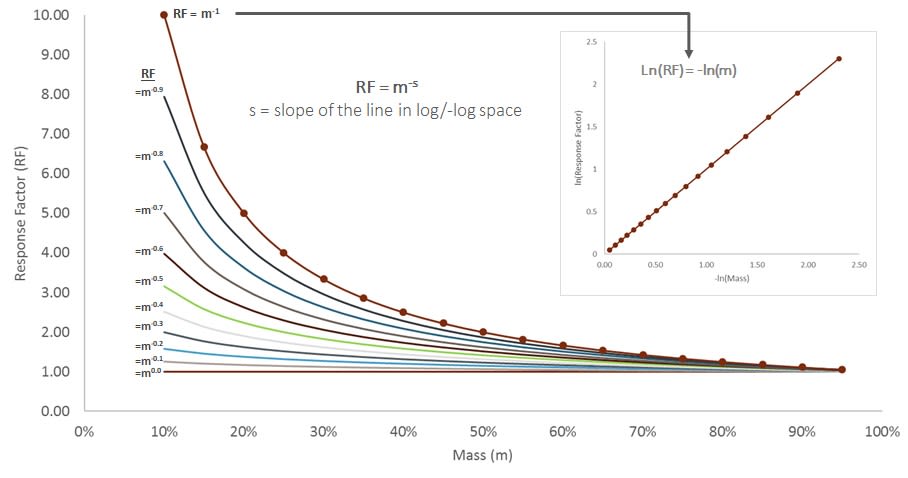](https://res.cloudinary.com/shapeable/image/upload/v1687255691/wikiore/106.jpg) \n\nScaling to Response Ranking[](#Scaling_to_Response_Ranking)\n-----------------------------------------------------------\n\nRR values are calculated by the following equation:\n\n [](https://res.cloudinary.com/shapeable/image/upload/v1687255692/wikiore/111.jpg) \n\nThey are generally scaled from 0-200 with 200 representing a theoretical maximum response. Negative values can be observed, indicating increasing concentration in coarse size fractions, however are not typical. Higher RR values indicate greater potential for separation from a feed material. \n \nRR values are calculated for each individual point within a given [natural deportment](/pages/wikiore-natural-deportment) sample. Resulting average values are then determined along with variations in associated Response Scores to provide a measure of fit to the expected trend. From the example below an average RR value of 68 is produced with an associated [standard deviation](https://en.wikipedia.org/wiki/Standard_deviation) in RS (StDev) of 0.03.\n\n| Size | Mass (%) | Metal (%) | Response Factor (RF) | Response Score (RS) | Response Rank (RR) |\n|:----------:|:--------:|:---------:|:-------------------:|:-------------------:|:------------------:|\n| >50mm | 80 | 86 | 1.08 | 0.32 | 65 |\n| 50-19mm | 60 | 70 | 1.17 | 0.30 | 60 |\n| 19-9.5mm | 40 | 55 | 1.38 | 0.35 | 70 |\n| <9.5mm | 20 | 37 | 1.85 | 0.38 | 76 |\n\n \n[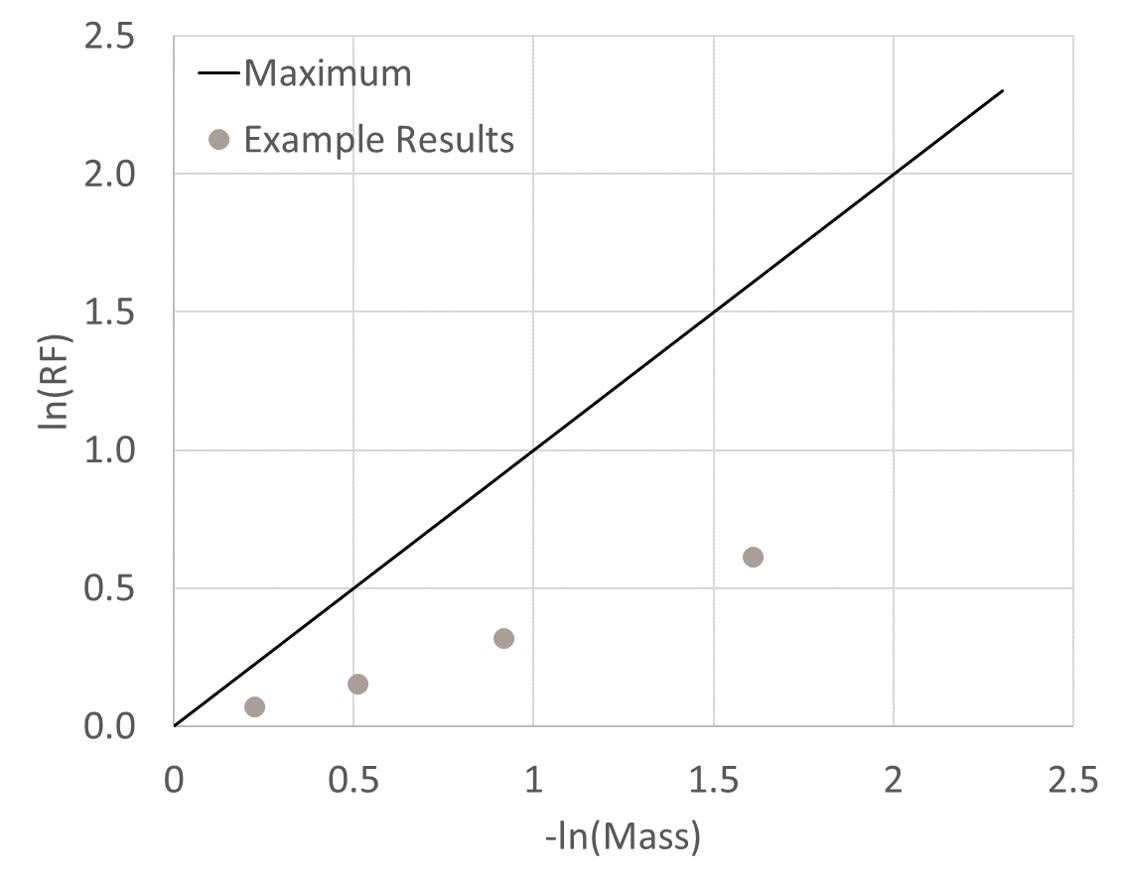](https://res.cloudinary.com/shapeable/image/upload/v1687255694/wikiore/113.jpg)\n\nQA/QC Data Analysis[](#QA_QC_Data_Analysis)\n-------------------------------------------\n\nqa/qc is a measure of curve fit to the mathematical model function which can be expressed as [standard deviation](https://en.wikipedia.org/wiki/Standard_deviation) against the [Response Ranking](/sub-topics/natural-deportment-characterisation). Curve shape and associated response attributes can be displayed using the [grade by size](/pages/wikiore-natural-deportment) Data Viewer. A snapshot of the user interface indicates the key functionalities. Any sample or element in the analytical suite can be selected for visualization. Examples of acceptable and non-acceptable qa/qc results are illustrated below. \n \nIt should be noted that other analytical elements (as proxies for mineralogy) can exhibit different [Response Ranking](/sub-topics/natural-deportment-characterisation)s as a function of different breakage and textural associations coupled with analytical precision. Intra-sample [Response Ranking](/sub-topics/natural-deportment-characterisation) differences between elements become more pronounced when specific elements reflect increasingly diverse mineralogies. As an example Fe can be associated with a wide range of [sulphides](https://en.wikipedia.org/wiki/Sulfide_mineral), oxides, silicates and carbonates. \n \n[Response Ranking](/sub-topics/natural-deportment-characterisation) [standard deviation](https://en.wikipedia.org/wiki/Standard_deviation)s less than 0.05 (10RR units) are considered to be high quality; results between 0.05-0.10 (10-20RR units) are acceptable but are typically individually assessed; whereas values over 0.1 (20RR units) for drill core testing are regarded as failing qa/qc. [standard deviation](https://en.wikipedia.org/wiki/Standard_deviation) plus accurate sieve size selection ensures data points cover the full cumulative mass range and ensures down stream modelling activites are accurate. \n \nIn the example below the sample represented by the black line fails this qa/qc stage due to a significant deviation from the expected trend (this sample has a StDev of 0.18). Response Rankings that pass qa/qc are used for further analysis as well as to compare and bench mark responses for selected [assay](https://en.wikipedia.org/wiki/Assay) elements and associations.\n\n \n[](https://res.cloudinary.com/shapeable/image/upload/v1687255689/wikiore/110.jpg)\n\n### Negative RR Values[](#Negative_RR_Values)\n\nAlthough typical RR values will range from 0 to 200 there is a subset that can present with negative values. Care is needed when dealing with these as, mathematically, they can technically range to negative infinity. It should be noted that an RR of -1200 is completely valid although highly skewed. Given qa/qc steps such values have increased thresholds to pass as they naturally produce high StDev values. Depending on the specific activity leaving negative results as they are may be valid however in cases such as averaging domains or spatial population they can present with challenges. \n \nTo resolve this issue true negative RR values can be calculated which aim to scale all negative results between -200 and 0. This process involves inverting the standard RR equation to calculate a relative upgrade for mass per metal and then taking this calculated value as the true negative result (equation shown below). An example comparison between the standard RR and true negative RR is highlighted in the following table.\n\n[](https://res.cloudinary.com/shapeable/image/upload/v1687255696/wikiore/163.jpg)\n\n| Example | Mass% | Metal% | RR |\n|:-----------------:|:-----:|:------:|:-----:|\n| Standard RR | 60% | 10% | -702 |\n| True Negative RR | 60% | 10% | -156 |\n\n### Activity 1: RR Calculation[](#Activity_1:_RR_Calculation)\n\nClick [Here](/pages/wikiore-activity-1-natural-deportment) for a practical activity to calculate RR values from grade and mass data\n\nRR Analysis[](#RR_Analysis)\n---------------------------\n\nOnce results have been processed and samples put through qa/qc an initial analysis is conducted to determine any high level controls or links on RR. Note: graphs in the following section were generated using [Reflex's ioGAS software](https://reflexnow.com/product/iogas/) however analysis can be conducted in any package. \n \nGenerally the first stage of any analysis is to evaluate each site domain to determine if a uniform response is present across the entire orebody or if specific rock types/domains respond differently. \n \n[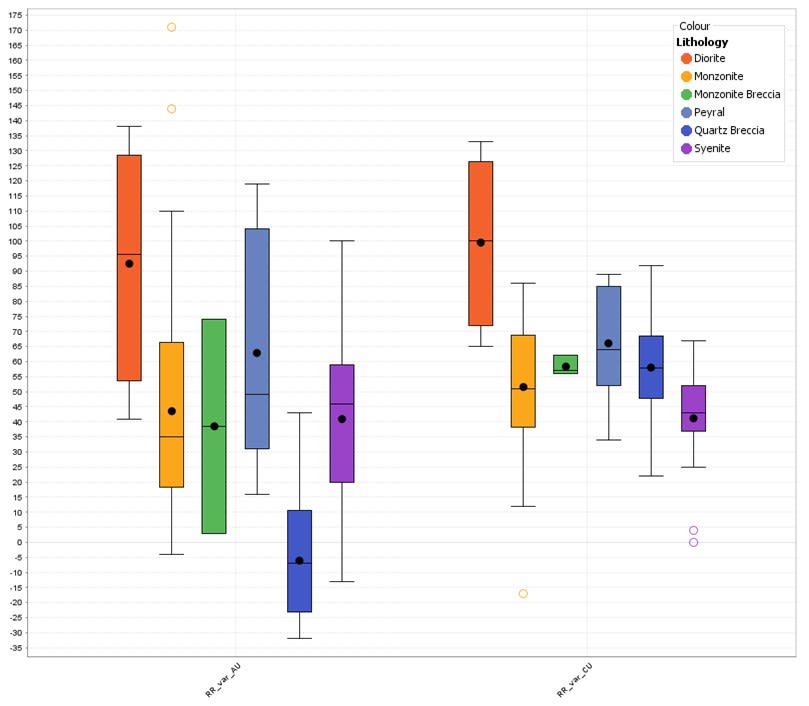](https://res.cloudinary.com/shapeable/image/upload/v1687255698/wikiore/161.jpg) \n \nNext, relationships between each samples individual RRs should be evaluated to define any that present with offset deportment. Meaning as one element upgrades another doesn't, or does so at a different rate. For the [Neytiri](/sub-topics/a-practical-example-of-grade-engineering-evaluation) dataset as both Gold and Copper are present these can be compared. In a [Grade Engineering](/pages/wikiore-introduction-to-grade-engineering) study this should be done for all elements especially including any deleterious elements as this can impact on [Grade Engineering](/pages/wikiore-introduction-to-grade-engineering) application options. \n \n[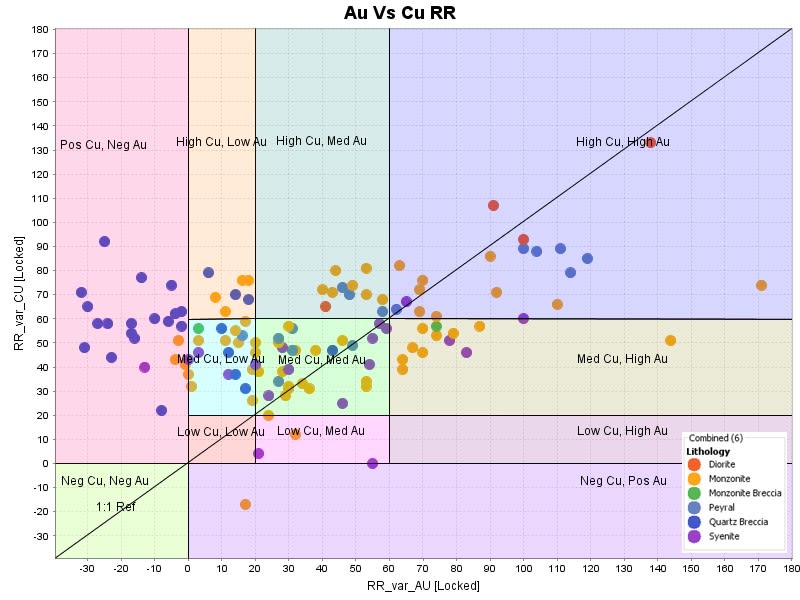](https://res.cloudinary.com/shapeable/image/upload/v1687255699/wikiore/157.jpg) \n \nIn the above figure the 1:1 reference line shows where both elements show identical [natural deportment](/pages/wikiore-natural-deportment) behaviors. Results plotting above this line indicate that Cu is concentrating at a higher rate than Au and vice versa for results below the line. The coloured [Response Ranking](/sub-topics/natural-deportment-characterisation) reference zones can be used to compare and bench mark responses. Based on extensive CRC ORE testing and [Grade Engineering](/pages/wikiore-introduction-to-grade-engineering) assessments across a range of deposits and deposit types, [Response Ranking](/sub-topics/natural-deportment-characterisation)s above 60 for [variability testing](/sub-topics/natural-deportment-characterisation) are considered to show potential for [natural deportment](/pages/wikiore-natural-deportment) as a dominant [Grade Engineering](/pages/wikiore-introduction-to-grade-engineering) value driver. [Response Ranking](/sub-topics/natural-deportment-characterisation)s of 20-60 are considered to indicate that integration of [natural deportment](/pages/wikiore-natural-deportment) with an additional lever such as [differential blasting](/pages/wikiore-induced-deportment) will be required to deliver value. [Response Ranking](/sub-topics/natural-deportment-characterisation)s below 20 are considered to indicate that [natural deportment](/pages/wikiore-natural-deportment) will not be a significant driver. Negative RR values indicate an inversed relationship than expected between size and grade and need to be treated separately. \n \nAny relationships found at this stage of analysis that can discriminate samples falling into these bins should be noted as it will aid in spatial population and downstream predictions. \n \nThis analysis method is useful for tracking mineralogical signatures of [natural deportment](/pages/wikiore-natural-deportment). For example, if significant amounts of pyrite were preferentially deporting by size compared to initial mineralogy of the head sample, it would be expected that the [Response Ranking](/sub-topics/natural-deportment-characterisation) S:Cu ratio would increase. Conversely if high Cu-sulphide phases such as bornite or chalcocite were preferentially deporting then the [Response Ranking](/sub-topics/natural-deportment-characterisation) S:Cu ratio would decrease. \n \nIn the extensive data sets developed in CRC ORE projects to-date, no relationship between head grade and RR has been observed. This reflects the dominant control between association and paragenesis rather than abundance. Although no strong link between head grade and RR has been observed if such a link is ever found at a particular site it will have a profound impact on down streamGE processes. \n \n[Work](/pages/wikiore-p-1-006-geological-controls-on-grade-by-size) is ongoing to determine fundamental geological controls on variable [natural deportment](/pages/wikiore-natural-deportment) responses to develop predictive models. \n \nDiversity of geological control is reflected in significant variability of [Response Ranking](/sub-topics/natural-deportment-characterisation) evident for typical testing programs. It is recommended that for initial assessment of [grade by size](/pages/wikiore-natural-deportment) typically developed using drill core residues; composite sample intervals similar to [metallurgical](https://en.wikipedia.org/wiki/Metallurgy) composites or nominal bench height are used. As an initial assessment a sample selection matrix of different ore types/lithologies, alteration styles and grade classes should be developed until more coherent RR groupings are recognized as discrete domains. This typically involves a minimum of 100 samples to adequately cover a sample selection matrix. As for any [geomet](https://en.wikipedia.org/wiki/Geometallurgy)allurgical style attribute or domaining exercise an extensive sampling and testing program eventually involving thousands of samples, may be required to support domaining in situations of high variability. As the database grows assignment of average RR by geological category is generally undertaken. \n \nFor extensive multi-element data RR’s for individual elements can be comparatively ranked to highlight associations which typically provide information on probable controls. In the case of the mesothermal gold example a very strong correlation between high RR for Au, Bi, Ag and S is evident. In the case of the porphyry Cu example Mo shows high RR while Cu, Zn, Ag, S, Pb and Cu show a closeting of moderate RR. This may indicate that the moderate Cu RR response is related to late stage base metal-bearing veins rather than earlier paragenetic Cu associations in veins or disseminations which are not reporting as preferential [grade by size](/pages/wikiore-natural-deportment) related breakage. \n \nThe [Response Ranking](/sub-topics/natural-deportment-characterisation) approach developed by CRC ORE allows [grade by size](/pages/wikiore-natural-deportment) data to be systematically and routinely processed and interpreted for qa/qc. This facilitates comparative ranking between deposits and definition of variability and domaining within deposits. Comparative ranking is particularly suited for testing of coarse [assay](https://en.wikipedia.org/wiki/Assay) residues where the residues have been generated using a constrained sample preparation and size reduction approach. \n \nAlthough generating [grade by size](/pages/wikiore-natural-deportment) data and more recently processing and interpreting this data is relatively straightforward, systematic databases of [grade by size](/pages/wikiore-natural-deportment) data from drill core testing, production scale testing (e.g. [belt cut](/sub-topics/sampling)s or trucks) or mill surveys, remains rare in the industry. This lack of data means that [grade by size](/pages/wikiore-natural-deportment) opportunity is typically overlooked on most operations stressing the importance of undertaking rapid assessment programs. CRC ORE continues to generate a significant centralized database of [grade by size](/pages/wikiore-natural-deportment) data across a range of deposit styles and sample types which can increasingly be used to rank and compare individual sites against a global dataset. [Response Ranking](/sub-topics/natural-deportment-characterisation)s above 60 for drill core scale testing indicate potential for [grade by size](/pages/wikiore-natural-deportment) to be considered as a dominant [Grade Engineering](/pages/wikiore-introduction-to-grade-engineering) value driver. \n \n[Response Ranking](/sub-topics/natural-deportment-characterisation)s are mathematical functions that can be used as inputs into a range of CRC ORE modelling and simulation software to determine operational [Grade Engineering](/pages/wikiore-introduction-to-grade-engineering) scenarios and value. [Response Ranking](/sub-topics/natural-deportment-characterisation)s are not related to or dependent on head grade, which acts as a modifying attribute. The higher the RR the higher the potential to use [grade by size](/pages/wikiore-natural-deportment) and resulting screening to separate new accept and reject type #feed streams. RR by itself does not indicate what mass pull gives optimum upgrade or what grade categories it should be applied to. These are dynamic operational decisions driven by RR but optimized by operational considerations and economics.\n\n \nDownload the RR data used in this analysis [ ](https://res.cloudinary.com/shapeable/raw/upload/v1687303408/wikiore/357.php)[Neytiri RR data](https://res.cloudinary.com/shapeable/raw/upload/v1687303408/wikiore/357.php)\n\nWorkflow for Natural Deportment Characterisation[](#Workflow_for_Natural_Deportment_Characterisation)\n-----------------------------------------------------------------------------------------------------\n\n [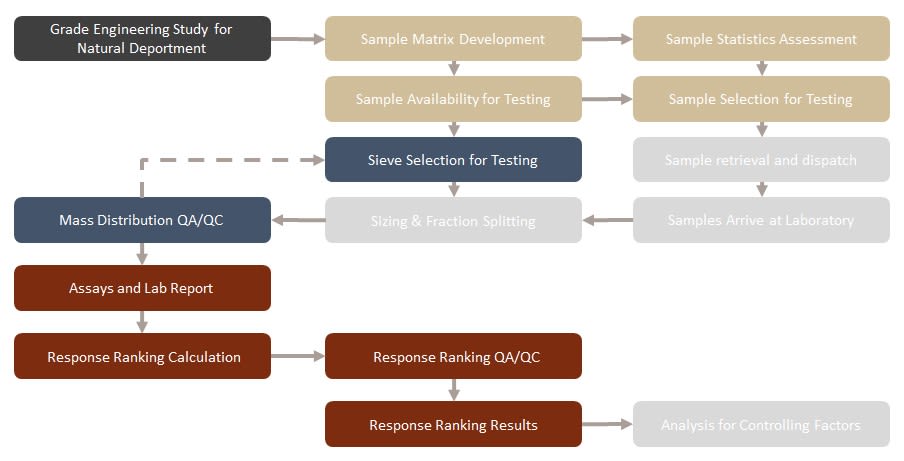](https://res.cloudinary.com/shapeable/image/upload/v1687303115/wikiore/108.jpg) \n\nDomaining Variability Responses[](#Domaining_Variability_Responses)\n===================================================================\n\nOnce analysis has been completed this information passed on for population into the [Grade Engineering](/pages/wikiore-introduction-to-grade-engineering) [block model](https://en.wikipedia.org/wiki/Mineral_resource_estimation#Resource_block_model). More detail on specific methodologies used for this can be found [here](/sub-topics/spatial-population).\n\nProduction [Scale-Up](Scale-Up)[](#Production_Scale-Up)\n-------------------------------------------------------\n\nPrevious CRC ORE studies have observed a relatively consistent increase in [Response Ranking](/sub-topics/natural-deportment-characterisation)s when moving from drill core [variability testing](/sub-topics/natural-deportment-characterisation) scale to production scale. This difference is usually accounted for in what is referred to as a “[scale-up](/sub-topics/natural-deportment-characterisation) Factor”. This is applied across all drill core test results to bring them into line with expected production scale responses. Studies to date have found two common [scale-up](/sub-topics/natural-deportment-characterisation) Factors; the first at approximately x1.20 and a second at x1.60. This has been observed to vary both across and within a given site. \n \nCRC ORE has observed only a single case where production scale responses were lower than those measured at drill core scale ([scale-up](/sub-topics/natural-deportment-characterisation) Factor = x0.50).\n\n \nExample of normal [scale-up](/sub-topics/natural-deportment-characterisation) relationship between drill core (red) and bulk samples (blue).\n\n [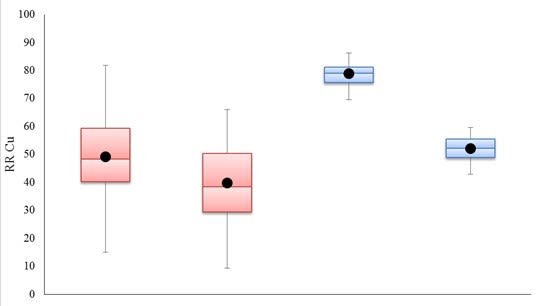](https://res.cloudinary.com/shapeable/image/upload/v1687303116/wikiore/109.jpg) \n\n[Bulk testing](/sub-topics/sampling)[](#Bulk_testing)\n=====================================================\n\n[bulk testing](/sub-topics/sampling) is critical in determining both production scale responses and associated [scale-up](/sub-topics/natural-deportment-characterisation) factors for drill core results. Ideally ROM or post [primary crusher](https://en.wikipedia.org/wiki/Crusher) material should be sampled and evaluated using the exact same protocols as [variability testing](/sub-topics/natural-deportment-characterisation) to determine; ideal sizes, grades, [response factor](/sub-topics/natural-deportment-characterisation)s and [Response Ranking](/sub-topics/natural-deportment-characterisation)s. \n \nMore detail on how to effectively sample bulk material is found [here.](/sub-topics/sampling)\n\nProduction Trials[](#Production_Trials)\n=======================================\n\nDetails on conducting Production Trials can be found here: [Site Trials](/sub-topics/site-trials)"},"organisations":[],"embeds":{"citations":[],"imageAssets":[]},"video":null,"banner":null,"fileAssets":[],"citations":[],"feedEntries":[],"posts":[],"moderators":[]}}},"pageContext":{"lang":{"id":"en","path":"","iso":"en","name":"English","label":"English"},"availableEntities":["Catalyst","CommodityGroup","Innovation","Organisation","Page","Person","Post","SubTopic","Topic","Trend","OrganisationType","HorizonType","Economy","FeedEntry","Video","Citation","Objective","ProfileType","ExpertiseLevel"],"detailEntities":["Catalyst","CommodityGroup","Innovation","Organisation","Page","Person","Post","SubTopic","Topic","Trend"],"site":{"id":"65d2edd1ebf7bb9388ffb0df","slug":"connect-ore","name":"ConnectOre","url":"https://connectore.org","title":"ConnectOre","twitter":null,"threads":null,"facebook":null,"linkedin":null,"instagram":null,"flickr":null,"tiktok":null,"youtube":null,"ownerName":"ICAA","recaptchaKey":"6LfG2J0qAAAAAHDCFfJnrWOj6DiWJGik5BAa_7p8","googleSiteVerification":null,"platformName":"ConnectOre","platformUrl":"https://platform.connectore.org","supportEmail":null,"contactEmail":null,"mainMenu":{"id":"65d2edaaebf7bb9388ffaf79","slug":"website-navigation"},"linearMenu":null,"entityViews":[{"id":"67528c24c135ebcfc668f1ba_65d2edd1ebf7bb9388ffb0df","name":"Value Chain","hash":"value-chain","label":null,"slug":"value-chain","count":0,"showCount":null,"disabled":null,"icon":{"id":"6752a61b8b51dfa7b77b1e37","name":"Connections Navigator Icon Glyph","slug":"connections-navigator-icon-glyph","component":"ConnectionsNavigatorIconGlyph"},"childEntityTypes":[{"id":"6667fa4ff794dd6e045135c1","name":"Value Chain Theme","internalName":"Trend"},{"id":"6667fa58f794dd6e045135c6","name":"Topic","internalName":"Topic"}],"type":{"id":"67528b63c135ebcfc668f19c","name":"Explorer","slug":"explorer"},"slices":[]},{"id":"6757ef1ede8adbd45cf19474_65d2edd1ebf7bb9388ffb0df","name":"Bulletin Board","hash":"bulletin-board","label":null,"slug":"bulletin-board","count":0,"showCount":null,"disabled":null,"icon":{"id":"681c2cebbccc5a72d8382f31","name":"Tag Icon","slug":"tag-icon","component":"TagDotIconGlyph"},"childEntityTypes":[],"type":{"id":"67528b63c135ebcfc668f19c","name":"Explorer","slug":"explorer"},"slices":[]},{"id":"67528d88c135ebcfc668f31b_65d2edd1ebf7bb9388ffb0df","name":"Innovations","hash":"innovations","label":null,"slug":"innovations","count":0,"showCount":null,"disabled":null,"icon":{"id":"67528cddc135ebcfc668f304","name":"Grid Icon Glyph","slug":"grid-icon-glyph","component":"GridIconGlyph"},"childEntityTypes":[{"id":"67528d74c135ebcfc668f315","name":"Innovation","internalName":"innovation"}],"type":{"id":"67528b63c135ebcfc668f19c","name":"Explorer","slug":"explorer"},"slices":[]},{"id":"67625640fbc7c50d8644c592_65d2edd1ebf7bb9388ffb0df","name":"Community","hash":"community","label":null,"slug":"community","count":0,"showCount":null,"disabled":null,"icon":{"id":"67528cddc135ebcfc668f304","name":"Grid Icon Glyph","slug":"grid-icon-glyph","component":"GridIconGlyph"},"childEntityTypes":[{"id":"67528404c135ebcfc668ee1c","name":"Person","internalName":"Person"}],"type":{"id":"67528b63c135ebcfc668f19c","name":"Explorer","slug":"explorer"},"slices":[]},{"id":"67528e1bc135ebcfc668f33a_65d2edd1ebf7bb9388ffb0df","name":"Stakeholder Map","hash":"stakeholder-map","label":null,"slug":"stakeholder-map","count":0,"showCount":null,"disabled":null,"icon":{"id":"67528cddc135ebcfc668f304","name":"Grid Icon Glyph","slug":"grid-icon-glyph","component":"GridIconGlyph"},"childEntityTypes":[{"id":"66680141f794dd6e0451367a","name":"Organisation","internalName":"Organisation"}],"type":{"id":"67528b63c135ebcfc668f19c","name":"Explorer","slug":"explorer"},"slices":[]},{"id":"67529040c135ebcfc668f4ae_65d2edd1ebf7bb9388ffb0df","name":"References","hash":"references","label":null,"slug":"references","count":0,"showCount":null,"disabled":null,"icon":{"id":"67528cddc135ebcfc668f304","name":"Grid Icon Glyph","slug":"grid-icon-glyph","component":"GridIconGlyph"},"childEntityTypes":[{"id":"6752902fc135ebcfc668f4a4","name":"Article","internalName":"FeedEntry"},{"id":"67529039c135ebcfc668f4aa","name":"Citation","internalName":"Citation"},{"id":"67528de9c135ebcfc668f328","name":"Catalyst","internalName":"catalyst"},{"id":"67528df9c135ebcfc668f32d","name":"Page","internalName":"page"}],"type":{"id":"67528b63c135ebcfc668f19c","name":"Explorer","slug":"explorer"},"slices":[]}],"entityAppViews":[],"entityOnboardingViews":[{"id":"680c3a4ebc80e4d0f3cfa2ef_65d2edd1ebf7bb9388ffb0df","name":"Trend Expertise Step","hash":"trend-expertise-step","label":null,"slug":"trend-expertise-step","count":0,"showCount":null,"icon":null,"childEntityTypes":[],"type":{"id":"680c394fbc80e4d0f3cfa2d8","name":"Onboarding","slug":"onboarding"},"slices":[{"id":"680c39f2bc80e4d0f3cfa2e0_65d2edd1ebf7bb9388ffb0df","name":"Trend Expertise Onboarding Grid","slug":"trend-expertise-onboarding-grid","label":null,"updated":"2025-04-26T01:42:10.20","layout":{"id":"680c3993bc80e4d0f3cfa2dd","name":"Slice Onboarding Trend Expertise Grid","slug":"slice-onboarding-trend-expertise-grid","component":"SliceLayoutOnboardingTrendExpertiseGrid"},"connectedEntities":[],"headerFontType":null,"pretitle":null,"pretitleRich":{"id":"680c39f2bc80e4d0f3cfa2e0_65d2edd1ebf7bb9388ffb0df_pretitleRich","text":""},"title":null,"titleRich":{"id":"680c39f2bc80e4d0f3cfa2e0_65d2edd1ebf7bb9388ffb0df_titleRich","text":"Are you **an industry expert** in any of these Value Chain Themes?"}}]},{"id":"680c3a85bc80e4d0f3cfa2fa_65d2edd1ebf7bb9388ffb0df","name":"Profile Types Step","hash":"profile-types-step","label":null,"slug":"profile-types-step","count":0,"showCount":null,"icon":null,"childEntityTypes":[],"type":{"id":"680c394fbc80e4d0f3cfa2d8","name":"Onboarding","slug":"onboarding"},"slices":[{"id":"680c3a82bc80e4d0f3cfa2f7_65d2edd1ebf7bb9388ffb0df","name":"Profile Types Onboarding Grid","slug":"profile-types-onboarding-grid","label":null,"updated":"2025-04-26T01:44:34.63","layout":{"id":"680c3a13bc80e4d0f3cfa2e4","name":"Slice Onboarding Profile Types Grid","slug":"slice-onboarding-profile-types-grid","component":"SliceLayoutOnboardingProfileTypesGrid"},"connectedEntities":[],"headerFontType":null,"pretitle":null,"pretitleRich":{"id":"680c3a82bc80e4d0f3cfa2f7_65d2edd1ebf7bb9388ffb0df_pretitleRich","text":""},"title":"Which best describes you?","titleRich":{"id":"680c3a82bc80e4d0f3cfa2f7_65d2edd1ebf7bb9388ffb0df_titleRich","text":""}}]},{"id":"680c3aaabc80e4d0f3cfa2ff_65d2edd1ebf7bb9388ffb0df","name":"Objectives Step","hash":"objectives-step","label":null,"slug":"objectives-step","count":0,"showCount":null,"icon":null,"childEntityTypes":[],"type":{"id":"680c394fbc80e4d0f3cfa2d8","name":"Onboarding","slug":"onboarding"},"slices":[{"id":"680c3aa8bc80e4d0f3cfa2fc_65d2edd1ebf7bb9388ffb0df","name":"Objectives Onboarding Grid","slug":"objectives-onboarding-grid","label":null,"updated":"2025-04-26T01:45:12.76","layout":{"id":"680c3a3fbc80e4d0f3cfa2ea","name":"Slice Onboarding Objectives Grid","slug":"slice-onboarding-objectives-grid","component":"SliceLayoutOnboardingObjectivesGrid"},"connectedEntities":[],"headerFontType":null,"pretitle":null,"pretitleRich":{"id":"680c3aa8bc80e4d0f3cfa2fc_65d2edd1ebf7bb9388ffb0df_pretitleRich","text":""},"title":"What are your priority objectives?","titleRich":{"id":"680c3aa8bc80e4d0f3cfa2fc_65d2edd1ebf7bb9388ffb0df_titleRich","text":""}}]}],"gptLanguages":[{"id":"65d2eda5ebf7bb9388ffaf1f","name":"English","slug":"english","iso":"en","locale":"en_US","path":"/en","label":"English","menuLabel":null},{"id":"666f70b6e051ad9ef086d1be","name":"Arabic","slug":"arabic","iso":"ar","locale":"ar_AE","path":"/ar","label":"عربي","menuLabel":null},{"id":"666f7161e051ad9ef086d1c4","name":"Spanish","slug":"spanish","iso":"es","locale":"es_ES","path":"/es","label":"español","menuLabel":null},{"id":"666f71c9e051ad9ef086d1c8","name":"German","slug":"german","iso":"de","locale":"de_DE","path":"/de","label":"Deutsch","menuLabel":null},{"id":"65d2eda5ebf7bb9388ffaf20","name":"French","slug":"french","iso":"fr","locale":"fr_FR","path":"/fr","label":"Français","menuLabel":null}],"gptQuestionTemplate":{"id":"662c7f6e81ef1920e3638518","name":"Standard Open Question","slug":"standard-open-question","path":"/prompt-templates/standard-open-question","__typename":"PromptTemplate","_entityTypeName":null,"label":"CopperAI","type":{"id":"662c7f1981ef1920e363850f","name":"Ask","slug":"ask"},"description":{"text":"This template is tailored for providing accurate responses based on specific context. It integrates contextual details from \"contextual information\" and addresses the \"target question\". The response is always in English, prioritizing clarity. If the answer is unknown, the template openly acknowledges this, ensuring honesty and avoiding speculation. This format is ideal for precise, context-sensitive, and truthful answering."},"summary":{"text":"Ask a general question about Website content"},"gptModel":{"id":"67564c4f2f6749787d0e03dc","name":"OpenAI GPT 4o","slug":"open-ai-gpt-4-o","dataSetId":"openai:gpt-4o"},"variablesPrompt":{"text":""},"submitLabel":"Ask","languages":[],"icon":{"id":"67528b9cc135ebcfc668f1a3","name":"AI Lower Case Icon Glyph","slug":"ai-lower-case-icon-glyph","component":"AiLowerCaseIconGlyph"},"variables":[{"id":"6668076bf794dd6e045138d9","name":"question","slug":"question","useVectorStore":true,"label":"What would you like to know?","labelAnother":null,"help":{"text":""},"options":{"text":""},"defaultValue":null,"entityTypes":[],"controlType":{"id":"6667ff19f794dd6e04513656","name":"Textarea","slug":"textarea"},"labelContextual":null,"labelAnotherContextual":null,"helpContextual":{"text":""},"optionsContextual":{"text":""},"defaultValueContextual":null,"entityTypesContextual":[],"controlTypeContextual":{"id":"6667ff19f794dd6e04513656","name":"Textarea","slug":"textarea"}}]},"advertisements":[],"logoVerticalOffset":null,"logoHorizontalOffset":null,"logoVerticalOffsetMobile":null,"logoHorizontalOffsetMobile":null,"logoVerticalOffsetTablet":null,"logoHorizontalOffsetTablet":null,"logoVerticalOffsetDesktop":null,"logoHorizontalOffsetDesktop":null,"logoHeightMobile":44,"logoHeightTablet":null,"logoHeightDesktop":null,"headerHeightMobile":null,"headerHeightTablet":null,"headerHeightDesktop":null,"logo":{"url":"https://res.cloudinary.com/shapeable/image/upload/v1738807465/copper-connect/site/copper-connect_logo__CopperOre_Master_Brand_Identity-colour_cd4vgg.webp","type":"image/webp","width":945,"height":266},"logoInverted":{"url":"https://res.cloudinary.com/shapeable/image/upload/v1738807452/copper-connect/site/copper-connect_logoInverted__CopperOre_Master_Brand_Identity-white_chnucx.webp","type":"image/webp","width":945,"height":266},"footerMenu":null,"footerSecondaryMenu":null,"footerContent":{"text":"© {year} ConnectOre. All Rights Reserved\n"},"creator":null,"poweredBy":{"id":"65d2edadebf7bb9388ffafc8","name":"Shapeable","slug":"shapeable","url":"https://shapeable.ai","logo":{"url":"https://res.cloudinary.com/shapeable/image/upload/v1674010034/platform/organisation/shapeable_logo__shapeable.png","type":"image/png","width":1174,"height":368},"logoInverted":{"url":"https://res.cloudinary.com/shapeable/image/upload/v1729474494/copper-connect/organisation/shapeable_logoInverted__shapeable-logo-inverted_sdcfpk.png","type":"image/png","width":392,"height":118},"logoSubtle":null},"poweredByLabel":null,"poweredByContent":{"text":""},"explorerPage":{"name":"Explorer","title":null,"slug":"explorer","path":"/explorer"},"termsPage":{"name":"Terms of Use","title":null,"slug":"terms-of-use","path":"/terms-of-use"},"homePage":null,"knowledgeHubPage":{"name":"News","title":null,"slug":"news","path":"/news"},"privacyPolicyPage":{"name":"Privacy Policy","title":null,"slug":"privacy-policy","path":"/privacy-policy"},"summary":{"text":"A platform to accelerate industry-wide innovation through collective intelligence and collaborative action"},"thumbnail":{"url":"https://res.cloudinary.com/shapeable/image/upload/v1713942350/copper-connect/site/copper-connect_thumbnail__site-thumb_bmicl8.png"},"openGraph":{"title":"ConnectOre","date":"2026-07-31T04:44:47.80","description":{"plain":"A platform to accelerate industry-wide innovation through collective intelligence and collaborative action\n"},"image":{"url":"https://res.cloudinary.com/shapeable/image/upload/v1713942350/copper-connect/site/copper-connect_thumbnail__site-thumb_bmicl8.png","type":"image/png","thumbnails":{"full":{"url":"https://res.cloudinary.com/shapeable/image/upload/v1713942350/copper-connect/site/copper-connect_thumbnail__site-thumb_bmicl8.png"}}}},"termsAndConditions":{"text":""},"privacyPolicy":{"text":"At ConnectOre we respect your privacy. We want to ensure that you get the information, content, and experiences that matter most to you. ConnectOre is committed to protecting the privacy of its stakeholders, communities, and other contacts.\n\n## Scope\n\nThis privacy policy applies to all personal data processed by full-time and part-time employees, volunteers when acting on behalf of ConnectOre contractors and partners doing business on behalf of ConnectOre, as well as all legal entities, all operating locations in all countries, and all business processes conducted by ConnectOre.\n\n## Information Collected\n\n#### What information do we collect?\n\nConnectOre collects the following personal data in line with the use purposes explained in a subsequent section:\n\n * Your name and contact details\n * Online profile data/usage\n * Contact information\n * Social media profile information\n * Education and professional information\n * Registration and participation in ConnectOre events and activities \n * Information about service usage\n * Cookies\n * Authentication data\n * Location information\n * Author and peer review information\n * Other information you upload or provide to us\n\n#### How do we use your information?\n\nConnectOre uses (and, where specified, shares) your personal information for the following purposes:\n\n * To provide support or other services. ConnectOre may use your personal information to provide you with support or other services that you have ordered or requested. ConnectOre may also use your personal information to respond directly to your requests for information, including registrations for webinars, or other specific requests, or pass your contact information to the appropriate ConnectOre supplier or reseller for further follow-up related to your interests.\n * To provide information based on your needs and respond to your requests. ConnectOre may use your personal information to provide you with notices of new product releases and service developments.\n * To administer products. ConnectOre may contact you if you make use of (digital) products we offer, to confirm certain information (for example, that you did not experience problems in a download process). We may also use this information to confirm compliance with licensing and other terms of use and may share it with your company/institution.\n * To assist in your participation in ConnectOre activities. ConnectOre will communicate with you, if you are participating in certain ConnectOre activities such as ConnectOre Summit, authoring or reviewing a ConnectOre article, or ConnectOre humanitarian activities. ConnectOre may send you information such as update messages related to those activities (such as but not limited to the event's content, and event logistics)\n * To update you on relevant ConnectOre events and opportunities. ConnectOre may communicate with you regarding relevant ConnectOre events and opportunities.\n * To protect ConnectOre content and services. We may use your information to prevent potentially illegal activities and to enforce our terms and conditions.\n * To get feedback or input from you. In order to deliver products and services of most interest to our stakeholders, from time to time, we may ask you to provide us input and feedback (for example through surveys).\n\n#### How can you control your information?\n\nYou can control the information we have about you and how we use as follows:\n\n * If you are a registered guest for ConnectOre Annual Summit 2021, any request for review, revise or correction of your personal data can be sent to john.fennell@copper.com.au specifying your request.\n\n#### Personal data about minors and children\n\nConnectOre does not knowingly collect data from or about children under 16 without the permission of parent(s)/guardian(s). If we learn that we have collected personal information from a child under 16, we will delete that information as quickly as possible. If you believe that we might have any information from or about a child under age 16, please contact us.\n\n#### How will you know if the Privacy Policy is changed?\n\nConnectOre may update its Privacy Policy from time to time. If we make any material changes you will be notified by means of a notice on our website prior on the date the change becomes effective. We encourage you to periodically review this page for the latest information on our privacy practices.\n\n## Technical And Regulatory Information\n\n#### Logging practices\n\nConnectOre automatically records the Internet Protocol (IP) addresses of visitors. The IP address is a unique number assigned to every computer on the internet. Generally, an IP address changes each time you connect to the internet (it is a \"dynamic\" address). Note, however, that if you have a broadband connection, depending on your individual circumstance, the IP address that we collect may contain information that could be deemed identifiable. This is because, with some broadband connections, your IP address doesn't change (it is \"static\") and could be associated with your personal computer.\n\nAs well as recording the IP addresses of users, ConnectOre may also keep track of sites that users visited immediately prior to visiting ConnectOre's website and the search terms they used to find it. We keep track of the pages visited on ConnectOre's website, the amount of time spent on those pages and the types of searches done on them. Your searches remain confidential and anonymous. ConnectOre uses this information only for statistical purposes to find out which pages users find most useful and to improve the website.\nConnectOre also captures and stores information that you transmit. This may include:\n\n * Browser/Device type/version\n * Operating system used\n * Media Access Control (MAC) address\n * Date and time of the server request\n * Volume of data transferred\n\n#### External links behaviour\n\nSome of the links on ConnectOre's websites link to other sites created and maintained by other public- and/or private-sector organizations. ConnectOre provides these links solely for your information and convenience. When you transfer to an outside website, you are leaving ConnectOre domain, and ConnectOre's information management policies no longer apply. ConnectOre encourages you to read the privacy statement of each external website that you visit before you provide any personal data.\n\n#### Cookies and web beacons\n\nCookies and web beacons are electronic placeholders that are placed on your device by websites to track your individual movements on that website over time. ConnectOre uses both session-based cookies (which last only for the duration of the user's session) and persistent cookies (which remain on your device and provide information about the session you are in and waits for the next time you use that site again).\n\nThese cookies and web beacons provide useful information to ConnectOre, enabling us to recognize repeat users, facilitate the user's access to and use of our sites, allows us to track usage behavior, and to balance the usage of our websites on all ConnectOre web servers.\nTracking cookies, third-party cookies, and other technologies such as web beacons may be used to process additional information, enable non-core functionalities on ConnectOre website and enable third-party functions (such as a social media \"share\" link). We may also include web beacons and other similar technology in promotional email messages to determine whether the messages have been opened.\n\n#### Do Not Track (DNT)\n\nThe online advertising industry has self-regulatory initiatives designed to provide consumers a choice in the types of ads they may see online and to conveniently opt-out from online behavioral ads served by some or all of the companies participating in these programs. Our websites do not respond to DNT consumer browser settings.\n\n#### Responses to legal requests\n\nConnectOre reserves the right to share your information to respond to duly authorized information requests of governmental authorities or where required by law.\n\n#### Your data rights\n\nConnectOre complies with all applicable data privacy laws and regulations including, but not limited to, the General Data Protection Regulation (GDPR) and the California Consumer Privacy Act (CCPA). Under these laws and regulations, you may have certain rights to your data. Should you wish to exercise any of these rights, please send an email request to john.fennell@copper.com.au with \"Data Privacy Request'' in the subject line and in the email please identify the specific privacy right you request assistance with. Please note additional information may be requested prior to fulfilling a request and that ConnectOre reserves the right to charge a fee, where permitted, to cover the cost of certain requests.\n\n#### How do I contact you if there is an issue?\nIf you have any questions or concerns about this Privacy Policy or about the use of your personal information, please feel free to contact us by email at john.fennell@copper.com.au"},"welcomeUrl":"https://connectore.org/app/welcome","welcomeTitle":"Welcome to ConnectOre and thanks for joining us! ","invitationAction":"join the ConnectOre community","setupCompletionMessage":null,"languages":[],"brandColors":[],"showLogin":true,"showShareMenu":null,"showFollowMenu":true,"showPlatformLogin":null,"showContactUs":null,"loginLabel":"Explorer Login","platformLoginLabel":"Community Platform","headerButtons":[]},"includeProfile":true,"disableProfileEditing":false,"dynamicEntityTypeNames":["Person","Organisation"],"profilePath":"/app/profile","welcomePath":"/app/welcome","id":"65d2edd7ebf7bb9388ffb178","slug":"natural-deportment-characterisation","entityPath":"/sub-topics/natural-deportment-characterisation","openGraph":{},"entityTypeName":"SubTopic","name":"Natural Deportment Characterisation","updated":"2024-12-20T00:59:07.40","__type":"SubTopic"}},
"staticQueryHashes": ["1044227382","1158597448","1242646999","1427075558","1452322194","1520036161","1545705019","1586309863","1606754935","1816168740","1864381666","1903214493","1945056504","1989845544","2034981229","2181044613","2409034939","2463401854","2526615987","2642656775","2862279633","2867243664","2910164142","2912920178","296816903","3073584486","3150399266","3172506128","3320076387","3447680494","3453148481","3624873332","364221563","3692255024","3778988535","3782604890","4091857177","4216505212","591477963","701411134","758936535","80004486","857137463","881103158"]}