{
"componentChunkName": "component---src-gatsby-entities-sub-topic-tsx",
"path": "/sub-topics/induced-deportment-characterisation",
"result": {"data":{"platform":{"subTopic":{"__typename":"Platform_SubTopic","_schema":{"label":"Sub Topic","pluralLabel":"Sub Topics"},"openGraph":{"title":"Induced Deportment Characterisation","description":{"text":"Introduction[](#Introduction)\n=============================\n\n\nTypically, blast fragmentation models are used to optimise the blast fragmentation models are used to optimise the run of mine (ROM) [particle size](https://en.wikipedia.org/wiki/Particle_size) distribution (PSD) with respect to concentrator productivity (i.e. throughput ), and to a lesser extent for reducing oversize and increasing load and haul productivity."},"description":{"id":"65d2edd7ebf7bb9388ffb171_description","text":"For [Grade Engineering](/pages/wikiore-introduction-to-grade-engineering)™, where the mass pull governs upgrade potential for a domain or rock type, understanding and controlling PSD is crucial in ensuring metal deports as expected to the screen undersize.\n\nblast fragmentation modelling has applications in both Natural and [Induced deportment](/pages/wikiore-induced-deportment) [Grade Engineering](/pages/wikiore-introduction-to-grade-engineering) scenarios. For [natural deportment](/pages/wikiore-natural-deportment), fragmentation modelling can be used to modify blast designs to meet a mass pull requirement for a given screen aperture. In addition, a well calibrated fragmentation model can be used to conduct sensitivity studies to determine the impact that spatially varying rock mass characteristics can have on PSD, and hence expected upgrade for a given screen size.\n\nWhen the response of the rock mass is not strong enough to economically upgrade all ores, deportment can be induced via [differential blasting](/pages/wikiore-induced-deportment), where each blast hole is charged according to a local grade. That is, high grade regions within the blast block are subjected to high energy, and low-grade regions to low energy. This charging strategy attempts to create a bimodal ROM size distribution which can be separated using screening to create a fine, high grade accept stream and coarse, low grade reject stream. This was presented by Bye in 2011. In this example, differentially blasted ore was screened and fed to the concentrator. feed grade [assay](https://en.wikipedia.org/wiki/Assay)s showed a marked and unmistakable upgrade during the period when the differentially blasted ore was fed to the concentrator.\n\n [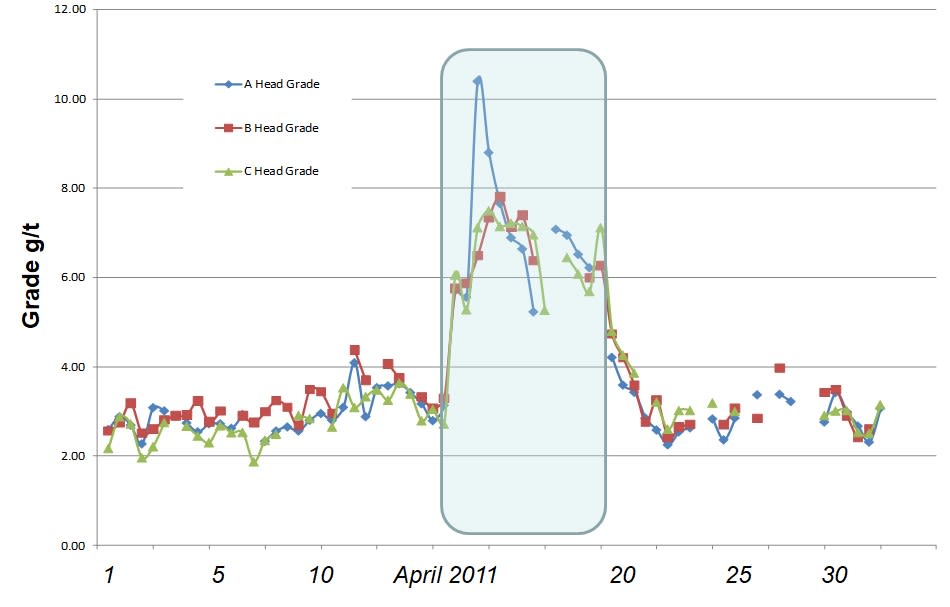](https://res.cloudinary.com/shapeable/image/upload/v1687303118/wikiore/49.jpg) \n\nA perfectly bimodal distribution of fragmentation is the Holy Grail for [differential blasting](/pages/wikiore-induced-deportment). However, due to the difficulty in segregating blast energy between neighbouring holes, this is unlikely to be met using current blasting techniques.\n\n [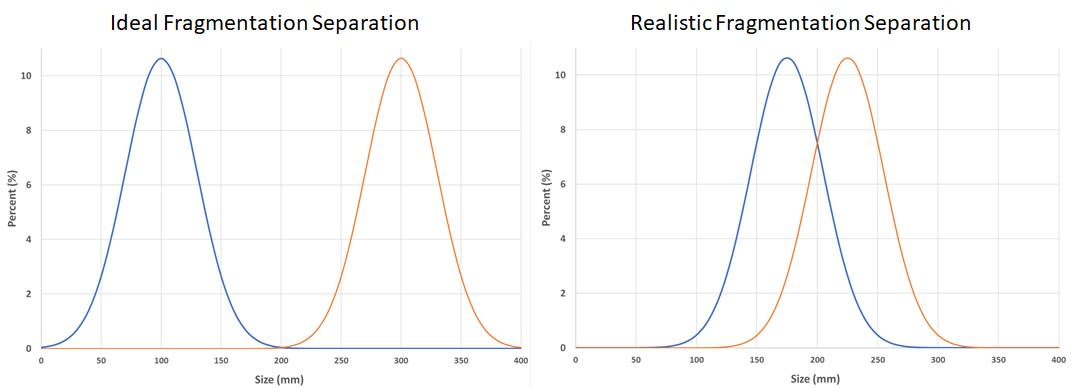](https://res.cloudinary.com/shapeable/image/upload/v1687303120/wikiore/50.jpg) \n\nNonetheless, the shortcomings of the inefficiency of separation between high and low energy blast holes depend on the bench scale [heterogeneity](/pages/wikiore-heterogeneity) across a blast block, and hence the proportion of low and high-grade holes in proximity to one another. If there are clusters of holes that can be blasted in a similar fashion, these inefficiencies can be minimised, and value found using this [Grade Engineering](/pages/wikiore-introduction-to-grade-engineering)™ lever.\n\nFor [differential blasting](/pages/wikiore-induced-deportment), fragmentation modelling is critical in determining potential size distributions that can be achieved given rock mass characteristics such as strength and structure, site constraints such as explosive type availability, and equipment limitations which may limit blast hole diameter, and burden and spacing of a blast pattern.\n\nBlast Modelling Method[](#Blast_Modelling_Method)\n=================================================\n\nGenerally, fragmentation models can be grouped into empirical and mechanistic categories. Empirical models include the common Kuz-Ram model variants and can be easily implemented in a spreadsheet. Mechanistic models are usually developed by research organisations or explosive companies, requiring significant computing power to deal with the complexities of the explosive detonation processes and rock mass descriptors. Each approach has advantages and disadvantages.\n\nCRC ORE uses the so-called Crushed Zone Model (CZM) which incorporates a mechanistic model of the fines generated around the blast hole (i.e. the crushed zone) with the empirical Kuz-Ram empirical model (reference) to describe the coarse end of the size distribution.\n\n [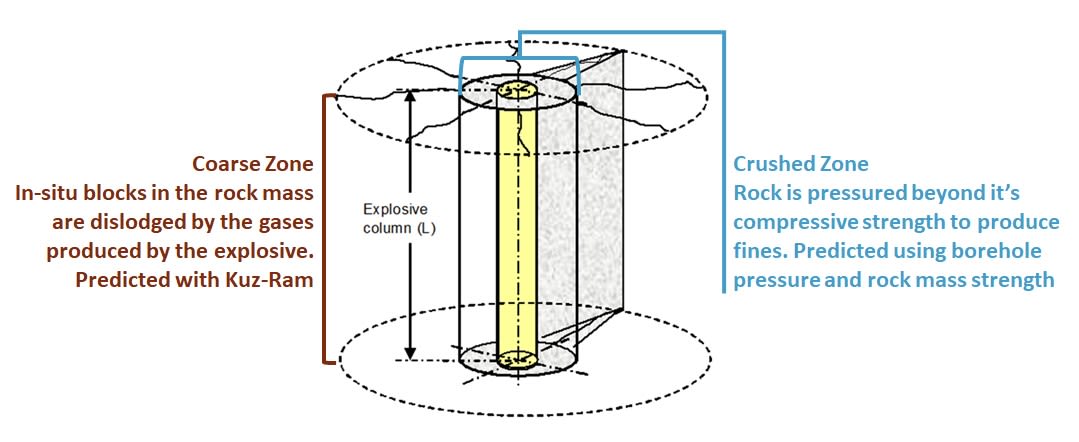](https://res.cloudinary.com/shapeable/image/upload/v1687303122/wikiore/51.jpg) \n\nA significant advantage of this model is that it has been implemented within the [IES](https://www.crcore.org.au/ies) framework, allowing full access to its mass simulation and sensitivity analysis capabilities.\n\nInput [Data Requirements](/sub-topics/data-requirements)[](#Input_Data_Requirements)\n====================================================================================\n\nData needed to develop a fit for purpose model fragmentation can be broken down into three categories; the blast design, explosive description, and geotechnical characteristics of the rock mass. These are described in some detail below.\n\nBlast Design[](#Blast_Design)\n-----------------------------\n\nThe blast design captures how the explosive energy is distributed through the bench and is defined by the parameters described in Table 1.\n\n| **Parameter** | **Description** |\n|:-----------------:|:-------------------------------------------:|\n| bench Height (m) | Height of the bench |\n| Burden (m) | Distance between rows of holes |\n| Spacing (m) | Distance between holes in each row |\n| Sub-drill (m) | Distance blast hole penetrates into the bench below |\n| Hole diameter (mm)| blast hole diameter |\n\n\nExplosive Characteristics[](#Explosive_Characteristics)\n-------------------------------------------------------\n\nThe CZM allows for two decks to be applied per hole, nominally designated toe and collar charges. Where possible, the explosive characteristics should be measured, in particular, the in-hole [velocity of detonation](https://en.wikipedia.org/wiki/Detonation_velocity) (VOD). The bore hole pressure is proportional to the square of the VOD, which has a significant impact on the volume of fines generated around the blast hole, and hence the fine end of the [particle size](https://en.wikipedia.org/wiki/Particle_size) distribution.\n\n| **Parameter** | **Description** |\n|:---------------------------:|:------------------------------------------------:|\n| Explosive Type | Name (for reference) |\n| Charge Length (m) | Length of charge in hole |\n| Charge Mass (kg) | Mass of charge in hole |\n| Explosive Density (kg/m³) | Final explosive density |\n| VOD (m/s) | Steady state [velocity of detonation](https://en.wikipedia.org/wiki/Detonation_velocity) |\n| Relative Weight Strength | Compared to [ANFO](https://en.wikipedia.org/wiki/ANFO) |\n\nRock Mass[](#Rock_Mass)\n-----------------------\n\nThe most important rock mass descriptors are its strength and structure. Density and elasticity of the rock also affect model outcomes to a lesser extent.\n\n| **Parameter** | **Description** |\n|:----------------------------:|:------------------------------------------:|\n| UCS (MPa) | Uniaxial Compressive Strength |\n| E (GPa) | Young’s Modulus of Elasticity |\n| Rock Density (kg/m³) | Density of the Rock Mass |\n| In-situ block size (ISB) (m) | Mean In-situ block size |\n| fines top size (mm) | The top size of the fines in the crushed zone |\n\nIn most cases UCS and ISB will be determined from proxies. The Point Load Index test is a relatively simple way to obtain a proxy for UCS, and as the tester is portable, it can be taken to site and used to gather a statistically representative number of measurements.\n\n [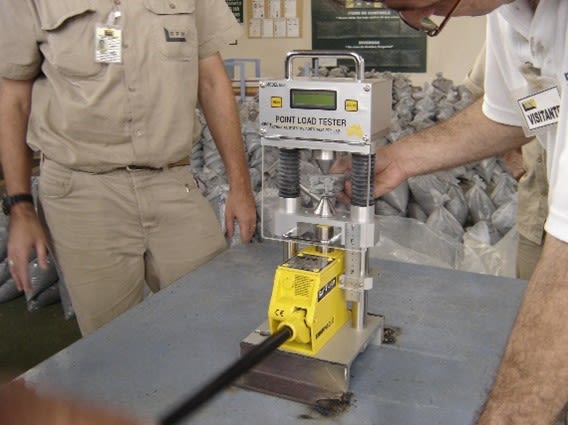](https://res.cloudinary.com/shapeable/image/upload/v1687303124/wikiore/52.jpg) \n\nIn-situ block size can be measured using traditional scan line mapping, or by analysis of 3D point clouds generated by stereogrammetry, or from LIDAR measurements.\n\n [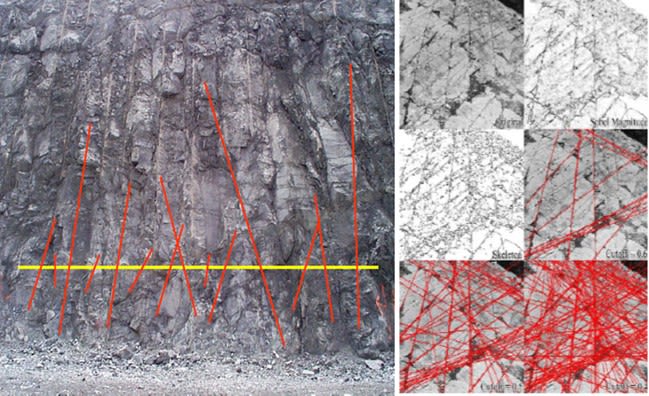](https://res.cloudinary.com/shapeable/image/upload/v1687303126/wikiore/53.jpg) \n\nThe most widely reported geotechnical parameter that relates to rock mass structure across an orebody is the Rockmass Quality Designation (RQD) (Deere and Deere, 1988). This is measured from drill core and is simply the percentage of core longer than 100 mm for a given run of drill core. Calculation of [RQD](https://en.wikipedia.org/wiki/Core_recovery_parameters#Rock_quality_designation) using the equation form of:\n\n [](https://res.cloudinary.com/shapeable/image/upload/v1687303128/wikiore/54.jpg) \n\nWhile it is not a precise measurement, especially as it is affected by drill core orientation to the direction of rock mass structures, it does allow for wide spatial coverage of the rock mass due to its simplicity. Conversion from [RQD](https://en.wikipedia.org/wiki/Core_recovery_parameters#Rock_quality_designation) to IBS varies from scenario to scenario, but CRC ORE tends to use the relationship described by Palmstrom (1982) as shown graphically in Figure 5.\n\n [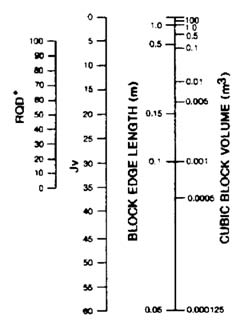](https://res.cloudinary.com/shapeable/image/upload/v1687303130/wikiore/55.jpg) \n\nIdeally, a [block model](https://en.wikipedia.org/wiki/Mineral_resource_estimation#Resource_block_model) that has been populated from dense measurements would be available for blast fragmentation modelling across an orebody. This tends to be rare, so it is more common to perform fragmentation modelling on a domain basis, that is, assigning geotechnical parameters to each [lithology](https://en.wikipedia.org/wiki/Lithology) in the ore body.\n\nData Entry and Model Simulations[](#Data_Entry_and_Model_Simulations)\n=====================================================================\n\nOnce the blast design, and explosive and rock mass characteristics have been collated, these can be entered into the [IES](https://www.crcore.org.au/ies) interface.\n\n [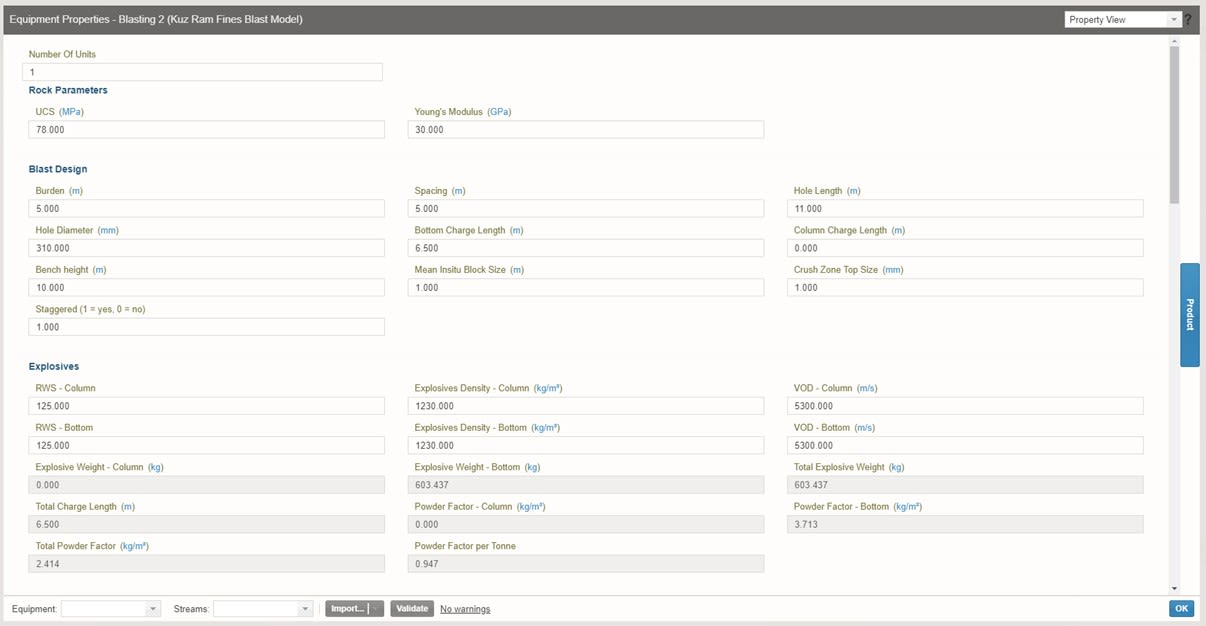](https://res.cloudinary.com/shapeable/image/upload/v1687303132/wikiore/56.jpg) \n\nOnce the model has been simulated the results will be available as stream properties of the BFM. These can then be imported into Excel for further analysis.\n\n [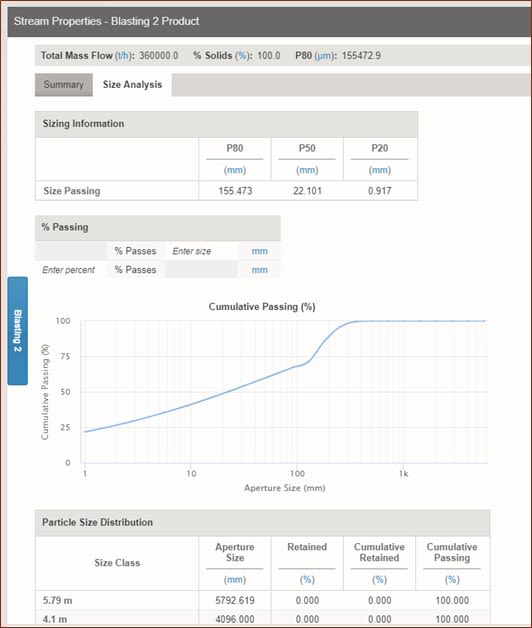](https://res.cloudinary.com/shapeable/image/upload/v1687303134/wikiore/57.jpg) \n\nCalibration Process[](#Calibration_Process)\n===========================================\n\nRegardless of whether a fragmentation model is calibrated or not, it will nonetheless generate results which will appear to be sensible. For this reason, it is critical that field measurements are taken to allow model input variables to be fine-tuned to ensure that the best possible results are obtained from the model simulations.\n\nFull scale ROM [particle size](https://en.wikipedia.org/wiki/Particle_size) distributions are impractical to determine manually (i.e. by sieving) and the widely accepted means for measuring PSD is to use image analysis techniques on images captured at the muckpile or dump pocket. While image analysis techniques have accuracy limitations, especially at the finer end of the PSD, they allow for numerous measurements to be made throughout a blast block, giving some statistical robustness to the model outputs.\n\nTo deal with limitations at the fine end, it is good practice to conduct a [belt cut](/sub-topics/sampling) from the [primary crusher](https://en.wikipedia.org/wiki/Crusher) that has been fed from the blast in question in order to get some indication of the proportion of fines. These results can then be used to calibrate the fine end of the PSD.\n\nWith regards to which ‘knobs’ are available to adjust in the model outcomes; the CZM does not have any fudge factors per se. All that can be adjusted are input parameters where there are uncertainties around their absolute value, for example, the reported [VOD](https://en.wikipedia.org/wiki/Detonation_velocity) of a particular explosive may be an idealised case, or the UCS obtained from a [block model](https://en.wikipedia.org/wiki/Mineral_resource_estimation#Resource_block_model) populated with sparse measurements.\n\nThe following table details what can be adjusted, and their effect on the resultant [particle size](https://en.wikipedia.org/wiki/Particle_size)distribution.\n\n| Parameter | PSD Effects |\n|:------------------:|:-----------------------------------------------:|\n| UCS | Lower UCS will increase fines in PSD |\n| [Explosive VOD](https://en.wikipedia.org/wiki/Detonation_velocity) | Higher [VOD](https://en.wikipedia.org/wiki/Detonation_velocity) will increase fines in PSD |\n| In-situ block size | Affects the coarse end of the PSD |\n| fines top size | Smaller top size increases fines in PSD |\n\nIdeally, the model should be implemented stochastically, i.e. where input parameters are defined by a mean and [standard deviation](https://en.wikipedia.org/wiki/Standard_deviation), and then a Monte Carlo simulation carried out to generate a PSD envelope of results. While the [IES](https://www.crcore.org.au/ies) framework does not allow this, the user could run a sensitivity analysis were the various parameters are flexed. Alternatively, a mass simulation could be run using a spreadsheet populated with stochastically generated parameters.\n\nLimitations[](#Limitations)\n===========================\n\nAssuming modelled results reasonably reflect measured PSDs, it can then be used to vary blast designs to maximise [Grade Engineering](/pages/wikiore-introduction-to-grade-engineering) potential. There are a number of factors that will limit the extents to which the PSD can be adjusted.\n\nDrilling Equipment[](#Drilling_Equipment)\n-----------------------------------------\n\nAvailable site drill fleets dictate drill hole diameters, as well as the minimum burden and spacing of any changed patterns.\n\nWater[](#Water)\n---------------\n\nIf water is present in holes, this limits potential explosives that can be utilised to only waterproof products. These are generally higher energy and especially for [differential blasting](/pages/wikiore-induced-deportment) applications will constrain the difference between high and low energy [particle size](https://en.wikipedia.org/wiki/Particle_size) distributions.\n\nExplosive Types[](#Explosive_Types)\n-----------------------------------\n\nMuch along the same lines, if site only has a low energy explosive available (say [ANFO](https://en.wikipedia.org/wiki/ANFO)) this constrains the maximum energy that can be loaded into a hole, reducing the potential difference between high and low grade holes.\n\nDiggability & Equipment Productivity[](#Diggability_REAL_AMP_Equipment_Productivity)\n------------------------------------------------------------------------------------\n\n[differential blasting](/pages/wikiore-induced-deportment) aims to produce fine, high grade material and coarse, low grade material. While fine ROM enhances equipment productivity and concentrator throughput, coarse ROM can have a negative impact upon diggability and loading rates. This must be taken into account when designing the low energy blast hole s.\n\nRock Mass Characteristics[](#Rock_Mass_Characteristics)\n-------------------------------------------------------\n\nSome orebodies are already too fractured and/or soft to control blast fragmentation to any great extent. In this case, potential [Induced deportment](/pages/wikiore-induced-deportment) due to [differential blasting](/pages/wikiore-induced-deportment) may be evaluated as inappropriate for the site."},"organisations":[],"embeds":{"citations":[],"imageAssets":[]},"video":null,"banner":null,"fileAssets":[],"citations":[],"feedEntries":[],"posts":[],"moderators":[]}}},"pageContext":{"lang":{"id":"en","path":"","iso":"en","name":"English","label":"English"},"availableEntities":["Catalyst","CommodityGroup","Innovation","Organisation","Page","Person","Post","SubTopic","Topic","Trend","OrganisationType","HorizonType","Economy","FeedEntry","Video","Citation","Objective","ProfileType","ExpertiseLevel"],"detailEntities":["Catalyst","CommodityGroup","Innovation","Organisation","Page","Person","Post","SubTopic","Topic","Trend"],"site":{"id":"65d2edd1ebf7bb9388ffb0df","slug":"connect-ore","name":"ConnectOre","url":"https://connectore.org","title":"ConnectOre","twitter":null,"threads":null,"facebook":null,"linkedin":null,"instagram":null,"flickr":null,"tiktok":null,"youtube":null,"ownerName":"ICAA","recaptchaKey":"6LfG2J0qAAAAAHDCFfJnrWOj6DiWJGik5BAa_7p8","googleSiteVerification":null,"platformName":"ConnectOre","platformUrl":"https://platform.connectore.org","supportEmail":null,"contactEmail":null,"mainMenu":{"id":"65d2edaaebf7bb9388ffaf79","slug":"website-navigation"},"linearMenu":null,"entityViews":[{"id":"67528c24c135ebcfc668f1ba_65d2edd1ebf7bb9388ffb0df","name":"Value Chain","hash":"value-chain","label":null,"slug":"value-chain","count":0,"showCount":null,"disabled":null,"icon":{"id":"6752a61b8b51dfa7b77b1e37","name":"Connections Navigator Icon Glyph","slug":"connections-navigator-icon-glyph","component":"ConnectionsNavigatorIconGlyph"},"childEntityTypes":[{"id":"6667fa4ff794dd6e045135c1","name":"Value Chain Theme","internalName":"Trend"},{"id":"6667fa58f794dd6e045135c6","name":"Topic","internalName":"Topic"}],"type":{"id":"67528b63c135ebcfc668f19c","name":"Explorer","slug":"explorer"},"slices":[]},{"id":"6757ef1ede8adbd45cf19474_65d2edd1ebf7bb9388ffb0df","name":"Bulletin Board","hash":"bulletin-board","label":null,"slug":"bulletin-board","count":0,"showCount":null,"disabled":null,"icon":{"id":"681c2cebbccc5a72d8382f31","name":"Tag Icon","slug":"tag-icon","component":"TagDotIconGlyph"},"childEntityTypes":[],"type":{"id":"67528b63c135ebcfc668f19c","name":"Explorer","slug":"explorer"},"slices":[]},{"id":"67528d88c135ebcfc668f31b_65d2edd1ebf7bb9388ffb0df","name":"Innovations","hash":"innovations","label":null,"slug":"innovations","count":0,"showCount":null,"disabled":null,"icon":{"id":"67528cddc135ebcfc668f304","name":"Grid Icon Glyph","slug":"grid-icon-glyph","component":"GridIconGlyph"},"childEntityTypes":[{"id":"67528d74c135ebcfc668f315","name":"Innovation","internalName":"innovation"}],"type":{"id":"67528b63c135ebcfc668f19c","name":"Explorer","slug":"explorer"},"slices":[]},{"id":"67625640fbc7c50d8644c592_65d2edd1ebf7bb9388ffb0df","name":"Community","hash":"community","label":null,"slug":"community","count":0,"showCount":null,"disabled":null,"icon":{"id":"67528cddc135ebcfc668f304","name":"Grid Icon Glyph","slug":"grid-icon-glyph","component":"GridIconGlyph"},"childEntityTypes":[{"id":"67528404c135ebcfc668ee1c","name":"Person","internalName":"Person"}],"type":{"id":"67528b63c135ebcfc668f19c","name":"Explorer","slug":"explorer"},"slices":[]},{"id":"67528e1bc135ebcfc668f33a_65d2edd1ebf7bb9388ffb0df","name":"Stakeholder Map","hash":"stakeholder-map","label":null,"slug":"stakeholder-map","count":0,"showCount":null,"disabled":null,"icon":{"id":"67528cddc135ebcfc668f304","name":"Grid Icon Glyph","slug":"grid-icon-glyph","component":"GridIconGlyph"},"childEntityTypes":[{"id":"66680141f794dd6e0451367a","name":"Organisation","internalName":"Organisation"}],"type":{"id":"67528b63c135ebcfc668f19c","name":"Explorer","slug":"explorer"},"slices":[]},{"id":"67529040c135ebcfc668f4ae_65d2edd1ebf7bb9388ffb0df","name":"References","hash":"references","label":null,"slug":"references","count":0,"showCount":null,"disabled":null,"icon":{"id":"67528cddc135ebcfc668f304","name":"Grid Icon Glyph","slug":"grid-icon-glyph","component":"GridIconGlyph"},"childEntityTypes":[{"id":"6752902fc135ebcfc668f4a4","name":"Article","internalName":"FeedEntry"},{"id":"67529039c135ebcfc668f4aa","name":"Citation","internalName":"Citation"},{"id":"67528de9c135ebcfc668f328","name":"Catalyst","internalName":"catalyst"},{"id":"67528df9c135ebcfc668f32d","name":"Page","internalName":"page"}],"type":{"id":"67528b63c135ebcfc668f19c","name":"Explorer","slug":"explorer"},"slices":[]}],"entityAppViews":[],"entityOnboardingViews":[{"id":"680c3a4ebc80e4d0f3cfa2ef_65d2edd1ebf7bb9388ffb0df","name":"Trend Expertise Step","hash":"trend-expertise-step","label":null,"slug":"trend-expertise-step","count":0,"showCount":null,"icon":null,"childEntityTypes":[],"type":{"id":"680c394fbc80e4d0f3cfa2d8","name":"Onboarding","slug":"onboarding"},"slices":[{"id":"680c39f2bc80e4d0f3cfa2e0_65d2edd1ebf7bb9388ffb0df","name":"Trend Expertise Onboarding Grid","slug":"trend-expertise-onboarding-grid","label":null,"updated":"2025-04-26T01:42:10.20","layout":{"id":"680c3993bc80e4d0f3cfa2dd","name":"Slice Onboarding Trend Expertise Grid","slug":"slice-onboarding-trend-expertise-grid","component":"SliceLayoutOnboardingTrendExpertiseGrid"},"connectedEntities":[],"headerFontType":null,"pretitle":null,"pretitleRich":{"id":"680c39f2bc80e4d0f3cfa2e0_65d2edd1ebf7bb9388ffb0df_pretitleRich","text":""},"title":null,"titleRich":{"id":"680c39f2bc80e4d0f3cfa2e0_65d2edd1ebf7bb9388ffb0df_titleRich","text":"Are you **an industry expert** in any of these Value Chain Themes?"}}]},{"id":"680c3a85bc80e4d0f3cfa2fa_65d2edd1ebf7bb9388ffb0df","name":"Profile Types Step","hash":"profile-types-step","label":null,"slug":"profile-types-step","count":0,"showCount":null,"icon":null,"childEntityTypes":[],"type":{"id":"680c394fbc80e4d0f3cfa2d8","name":"Onboarding","slug":"onboarding"},"slices":[{"id":"680c3a82bc80e4d0f3cfa2f7_65d2edd1ebf7bb9388ffb0df","name":"Profile Types Onboarding Grid","slug":"profile-types-onboarding-grid","label":null,"updated":"2025-04-26T01:44:34.63","layout":{"id":"680c3a13bc80e4d0f3cfa2e4","name":"Slice Onboarding Profile Types Grid","slug":"slice-onboarding-profile-types-grid","component":"SliceLayoutOnboardingProfileTypesGrid"},"connectedEntities":[],"headerFontType":null,"pretitle":null,"pretitleRich":{"id":"680c3a82bc80e4d0f3cfa2f7_65d2edd1ebf7bb9388ffb0df_pretitleRich","text":""},"title":"Which best describes you?","titleRich":{"id":"680c3a82bc80e4d0f3cfa2f7_65d2edd1ebf7bb9388ffb0df_titleRich","text":""}}]},{"id":"680c3aaabc80e4d0f3cfa2ff_65d2edd1ebf7bb9388ffb0df","name":"Objectives Step","hash":"objectives-step","label":null,"slug":"objectives-step","count":0,"showCount":null,"icon":null,"childEntityTypes":[],"type":{"id":"680c394fbc80e4d0f3cfa2d8","name":"Onboarding","slug":"onboarding"},"slices":[{"id":"680c3aa8bc80e4d0f3cfa2fc_65d2edd1ebf7bb9388ffb0df","name":"Objectives Onboarding Grid","slug":"objectives-onboarding-grid","label":null,"updated":"2025-04-26T01:45:12.76","layout":{"id":"680c3a3fbc80e4d0f3cfa2ea","name":"Slice Onboarding Objectives Grid","slug":"slice-onboarding-objectives-grid","component":"SliceLayoutOnboardingObjectivesGrid"},"connectedEntities":[],"headerFontType":null,"pretitle":null,"pretitleRich":{"id":"680c3aa8bc80e4d0f3cfa2fc_65d2edd1ebf7bb9388ffb0df_pretitleRich","text":""},"title":"What are your priority objectives?","titleRich":{"id":"680c3aa8bc80e4d0f3cfa2fc_65d2edd1ebf7bb9388ffb0df_titleRich","text":""}}]}],"gptLanguages":[{"id":"65d2eda5ebf7bb9388ffaf1f","name":"English","slug":"english","iso":"en","locale":"en_US","path":"/en","label":"English","menuLabel":null},{"id":"666f70b6e051ad9ef086d1be","name":"Arabic","slug":"arabic","iso":"ar","locale":"ar_AE","path":"/ar","label":"عربي","menuLabel":null},{"id":"666f7161e051ad9ef086d1c4","name":"Spanish","slug":"spanish","iso":"es","locale":"es_ES","path":"/es","label":"español","menuLabel":null},{"id":"666f71c9e051ad9ef086d1c8","name":"German","slug":"german","iso":"de","locale":"de_DE","path":"/de","label":"Deutsch","menuLabel":null},{"id":"65d2eda5ebf7bb9388ffaf20","name":"French","slug":"french","iso":"fr","locale":"fr_FR","path":"/fr","label":"Français","menuLabel":null}],"gptQuestionTemplate":{"id":"662c7f6e81ef1920e3638518","name":"Standard Open Question","slug":"standard-open-question","path":"/prompt-templates/standard-open-question","__typename":"PromptTemplate","_entityTypeName":null,"label":"CopperAI","type":{"id":"662c7f1981ef1920e363850f","name":"Ask","slug":"ask"},"description":{"text":"This template is tailored for providing accurate responses based on specific context. It integrates contextual details from \"contextual information\" and addresses the \"target question\". The response is always in English, prioritizing clarity. If the answer is unknown, the template openly acknowledges this, ensuring honesty and avoiding speculation. This format is ideal for precise, context-sensitive, and truthful answering."},"summary":{"text":"Ask a general question about Website content"},"gptModel":{"id":"67564c4f2f6749787d0e03dc","name":"OpenAI GPT 4o","slug":"open-ai-gpt-4-o","dataSetId":"openai:gpt-4o"},"variablesPrompt":{"text":""},"submitLabel":"Ask","languages":[],"icon":{"id":"67528b9cc135ebcfc668f1a3","name":"AI Lower Case Icon Glyph","slug":"ai-lower-case-icon-glyph","component":"AiLowerCaseIconGlyph"},"variables":[{"id":"6668076bf794dd6e045138d9","name":"question","slug":"question","useVectorStore":true,"label":"What would you like to know?","labelAnother":null,"help":{"text":""},"options":{"text":""},"defaultValue":null,"entityTypes":[],"controlType":{"id":"6667ff19f794dd6e04513656","name":"Textarea","slug":"textarea"},"labelContextual":null,"labelAnotherContextual":null,"helpContextual":{"text":""},"optionsContextual":{"text":""},"defaultValueContextual":null,"entityTypesContextual":[],"controlTypeContextual":{"id":"6667ff19f794dd6e04513656","name":"Textarea","slug":"textarea"}}]},"advertisements":[],"logoVerticalOffset":null,"logoHorizontalOffset":null,"logoVerticalOffsetMobile":null,"logoHorizontalOffsetMobile":null,"logoVerticalOffsetTablet":null,"logoHorizontalOffsetTablet":null,"logoVerticalOffsetDesktop":null,"logoHorizontalOffsetDesktop":null,"logoHeightMobile":44,"logoHeightTablet":null,"logoHeightDesktop":null,"headerHeightMobile":null,"headerHeightTablet":null,"headerHeightDesktop":null,"logo":{"url":"https://res.cloudinary.com/shapeable/image/upload/v1738807465/copper-connect/site/copper-connect_logo__CopperOre_Master_Brand_Identity-colour_cd4vgg.webp","type":"image/webp","width":945,"height":266},"logoInverted":{"url":"https://res.cloudinary.com/shapeable/image/upload/v1738807452/copper-connect/site/copper-connect_logoInverted__CopperOre_Master_Brand_Identity-white_chnucx.webp","type":"image/webp","width":945,"height":266},"footerMenu":null,"footerSecondaryMenu":null,"footerContent":{"text":"© {year} ConnectOre. All Rights Reserved\n"},"creator":null,"poweredBy":{"id":"65d2edadebf7bb9388ffafc8","name":"Shapeable","slug":"shapeable","url":"https://shapeable.ai","logo":{"url":"https://res.cloudinary.com/shapeable/image/upload/v1674010034/platform/organisation/shapeable_logo__shapeable.png","type":"image/png","width":1174,"height":368},"logoInverted":{"url":"https://res.cloudinary.com/shapeable/image/upload/v1729474494/copper-connect/organisation/shapeable_logoInverted__shapeable-logo-inverted_sdcfpk.png","type":"image/png","width":392,"height":118},"logoSubtle":null},"poweredByLabel":null,"poweredByContent":{"text":""},"explorerPage":{"name":"Explorer","title":null,"slug":"explorer","path":"/explorer"},"termsPage":{"name":"Terms of Use","title":null,"slug":"terms-of-use","path":"/terms-of-use"},"homePage":null,"knowledgeHubPage":{"name":"News","title":null,"slug":"news","path":"/news"},"privacyPolicyPage":{"name":"Privacy Policy","title":null,"slug":"privacy-policy","path":"/privacy-policy"},"summary":{"text":"A platform to accelerate industry-wide innovation through collective intelligence and collaborative action"},"thumbnail":{"url":"https://res.cloudinary.com/shapeable/image/upload/v1713942350/copper-connect/site/copper-connect_thumbnail__site-thumb_bmicl8.png"},"openGraph":{"title":"ConnectOre","date":"2026-07-31T04:44:47.80","description":{"plain":"A platform to accelerate industry-wide innovation through collective intelligence and collaborative action\n"},"image":{"url":"https://res.cloudinary.com/shapeable/image/upload/v1713942350/copper-connect/site/copper-connect_thumbnail__site-thumb_bmicl8.png","type":"image/png","thumbnails":{"full":{"url":"https://res.cloudinary.com/shapeable/image/upload/v1713942350/copper-connect/site/copper-connect_thumbnail__site-thumb_bmicl8.png"}}}},"termsAndConditions":{"text":""},"privacyPolicy":{"text":"At ConnectOre we respect your privacy. We want to ensure that you get the information, content, and experiences that matter most to you. ConnectOre is committed to protecting the privacy of its stakeholders, communities, and other contacts.\n\n## Scope\n\nThis privacy policy applies to all personal data processed by full-time and part-time employees, volunteers when acting on behalf of ConnectOre contractors and partners doing business on behalf of ConnectOre, as well as all legal entities, all operating locations in all countries, and all business processes conducted by ConnectOre.\n\n## Information Collected\n\n#### What information do we collect?\n\nConnectOre collects the following personal data in line with the use purposes explained in a subsequent section:\n\n * Your name and contact details\n * Online profile data/usage\n * Contact information\n * Social media profile information\n * Education and professional information\n * Registration and participation in ConnectOre events and activities \n * Information about service usage\n * Cookies\n * Authentication data\n * Location information\n * Author and peer review information\n * Other information you upload or provide to us\n\n#### How do we use your information?\n\nConnectOre uses (and, where specified, shares) your personal information for the following purposes:\n\n * To provide support or other services. ConnectOre may use your personal information to provide you with support or other services that you have ordered or requested. ConnectOre may also use your personal information to respond directly to your requests for information, including registrations for webinars, or other specific requests, or pass your contact information to the appropriate ConnectOre supplier or reseller for further follow-up related to your interests.\n * To provide information based on your needs and respond to your requests. ConnectOre may use your personal information to provide you with notices of new product releases and service developments.\n * To administer products. ConnectOre may contact you if you make use of (digital) products we offer, to confirm certain information (for example, that you did not experience problems in a download process). We may also use this information to confirm compliance with licensing and other terms of use and may share it with your company/institution.\n * To assist in your participation in ConnectOre activities. ConnectOre will communicate with you, if you are participating in certain ConnectOre activities such as ConnectOre Summit, authoring or reviewing a ConnectOre article, or ConnectOre humanitarian activities. ConnectOre may send you information such as update messages related to those activities (such as but not limited to the event's content, and event logistics)\n * To update you on relevant ConnectOre events and opportunities. ConnectOre may communicate with you regarding relevant ConnectOre events and opportunities.\n * To protect ConnectOre content and services. We may use your information to prevent potentially illegal activities and to enforce our terms and conditions.\n * To get feedback or input from you. In order to deliver products and services of most interest to our stakeholders, from time to time, we may ask you to provide us input and feedback (for example through surveys).\n\n#### How can you control your information?\n\nYou can control the information we have about you and how we use as follows:\n\n * If you are a registered guest for ConnectOre Annual Summit 2021, any request for review, revise or correction of your personal data can be sent to john.fennell@copper.com.au specifying your request.\n\n#### Personal data about minors and children\n\nConnectOre does not knowingly collect data from or about children under 16 without the permission of parent(s)/guardian(s). If we learn that we have collected personal information from a child under 16, we will delete that information as quickly as possible. If you believe that we might have any information from or about a child under age 16, please contact us.\n\n#### How will you know if the Privacy Policy is changed?\n\nConnectOre may update its Privacy Policy from time to time. If we make any material changes you will be notified by means of a notice on our website prior on the date the change becomes effective. We encourage you to periodically review this page for the latest information on our privacy practices.\n\n## Technical And Regulatory Information\n\n#### Logging practices\n\nConnectOre automatically records the Internet Protocol (IP) addresses of visitors. The IP address is a unique number assigned to every computer on the internet. Generally, an IP address changes each time you connect to the internet (it is a \"dynamic\" address). Note, however, that if you have a broadband connection, depending on your individual circumstance, the IP address that we collect may contain information that could be deemed identifiable. This is because, with some broadband connections, your IP address doesn't change (it is \"static\") and could be associated with your personal computer.\n\nAs well as recording the IP addresses of users, ConnectOre may also keep track of sites that users visited immediately prior to visiting ConnectOre's website and the search terms they used to find it. We keep track of the pages visited on ConnectOre's website, the amount of time spent on those pages and the types of searches done on them. Your searches remain confidential and anonymous. ConnectOre uses this information only for statistical purposes to find out which pages users find most useful and to improve the website.\nConnectOre also captures and stores information that you transmit. This may include:\n\n * Browser/Device type/version\n * Operating system used\n * Media Access Control (MAC) address\n * Date and time of the server request\n * Volume of data transferred\n\n#### External links behaviour\n\nSome of the links on ConnectOre's websites link to other sites created and maintained by other public- and/or private-sector organizations. ConnectOre provides these links solely for your information and convenience. When you transfer to an outside website, you are leaving ConnectOre domain, and ConnectOre's information management policies no longer apply. ConnectOre encourages you to read the privacy statement of each external website that you visit before you provide any personal data.\n\n#### Cookies and web beacons\n\nCookies and web beacons are electronic placeholders that are placed on your device by websites to track your individual movements on that website over time. ConnectOre uses both session-based cookies (which last only for the duration of the user's session) and persistent cookies (which remain on your device and provide information about the session you are in and waits for the next time you use that site again).\n\nThese cookies and web beacons provide useful information to ConnectOre, enabling us to recognize repeat users, facilitate the user's access to and use of our sites, allows us to track usage behavior, and to balance the usage of our websites on all ConnectOre web servers.\nTracking cookies, third-party cookies, and other technologies such as web beacons may be used to process additional information, enable non-core functionalities on ConnectOre website and enable third-party functions (such as a social media \"share\" link). We may also include web beacons and other similar technology in promotional email messages to determine whether the messages have been opened.\n\n#### Do Not Track (DNT)\n\nThe online advertising industry has self-regulatory initiatives designed to provide consumers a choice in the types of ads they may see online and to conveniently opt-out from online behavioral ads served by some or all of the companies participating in these programs. Our websites do not respond to DNT consumer browser settings.\n\n#### Responses to legal requests\n\nConnectOre reserves the right to share your information to respond to duly authorized information requests of governmental authorities or where required by law.\n\n#### Your data rights\n\nConnectOre complies with all applicable data privacy laws and regulations including, but not limited to, the General Data Protection Regulation (GDPR) and the California Consumer Privacy Act (CCPA). Under these laws and regulations, you may have certain rights to your data. Should you wish to exercise any of these rights, please send an email request to john.fennell@copper.com.au with \"Data Privacy Request'' in the subject line and in the email please identify the specific privacy right you request assistance with. Please note additional information may be requested prior to fulfilling a request and that ConnectOre reserves the right to charge a fee, where permitted, to cover the cost of certain requests.\n\n#### How do I contact you if there is an issue?\nIf you have any questions or concerns about this Privacy Policy or about the use of your personal information, please feel free to contact us by email at john.fennell@copper.com.au"},"welcomeUrl":"https://connectore.org/app/welcome","welcomeTitle":"Welcome to ConnectOre and thanks for joining us! ","invitationAction":"join the ConnectOre community","setupCompletionMessage":null,"languages":[],"brandColors":[],"showLogin":true,"showShareMenu":null,"showFollowMenu":true,"showPlatformLogin":null,"showContactUs":null,"loginLabel":"Explorer Login","platformLoginLabel":"Community Platform","headerButtons":[]},"includeProfile":true,"disableProfileEditing":false,"dynamicEntityTypeNames":["Person","Organisation"],"profilePath":"/app/profile","welcomePath":"/app/welcome","id":"65d2edd7ebf7bb9388ffb171","slug":"induced-deportment-characterisation","entityPath":"/sub-topics/induced-deportment-characterisation","openGraph":{},"entityTypeName":"SubTopic","name":"Induced Deportment Characterisation","updated":"2024-12-20T00:59:30.33","__type":"SubTopic"}},
"staticQueryHashes": ["1044227382","1158597448","1242646999","1427075558","1452322194","1520036161","1545705019","1586309863","1606754935","1816168740","1864381666","1903214493","1945056504","1989845544","2034981229","2181044613","2409034939","2463401854","2526615987","2642656775","2862279633","2867243664","2910164142","2912920178","296816903","3073584486","3150399266","3172506128","3320076387","3447680494","3453148481","3624873332","364221563","3692255024","3778988535","3782604890","4091857177","4216505212","591477963","701411134","758936535","80004486","857137463","881103158"]}