
Stream Heterogeneity
Stream Heterogeneity
Stream Heterogeneity
Stream Heterogeneity
Introduction
Stream heterogeneity presents itself as variations in grade as the ore progresses through the delivery phase of the mining Value Chain (VC). Stream heterogeneity can be exploited on trucks or conveyor belts using sensor-based grade engineering levers such as bulk sorting. When ore is transported through the mining VC, heterogeneity changes from spatial heterogeneity at the mining face or bench to temporal heterogeneity during the deliver phase. Sensors are required to monitor the grade heterogeneity over time in order to make an ore/waste sorting decision
Sensors
Sensors can be employed in either monitoring or intervention mode. Monitoring mode is suitable for sensing grade variations across accept and reject streams or for process control whilst intervention mode is required to make the ore/waste sorting decision. Sensors suitable for sensor-based sorting can be categorised as either surface or penetrative; and on the basis of whether they detect, identify or quantify the grade attribute/proxy as shown in the following figure.
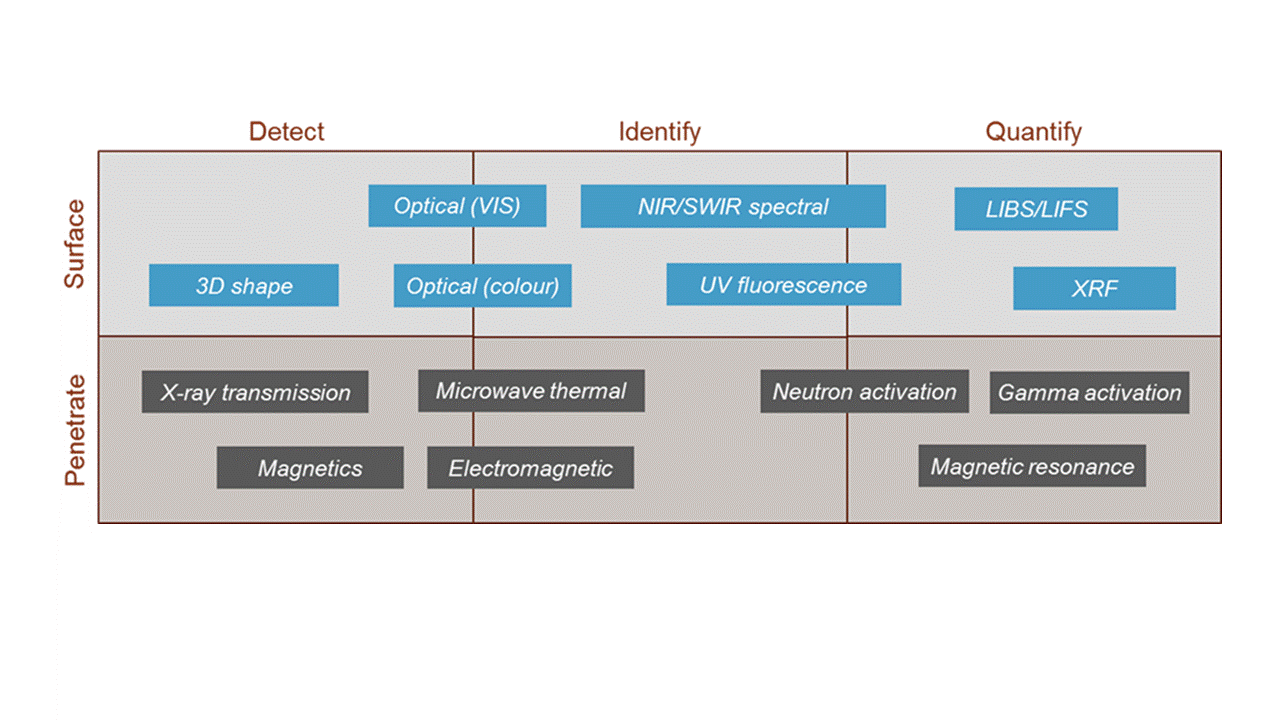
Surface based sensors such as the various optical and fluorescence techniques monitor the grade attribute/proxy at the surface of the broken rock mass and may therefore suffer from bias if the surface is not representative of the bulk ore. By contrast penetrative sensors such as Neutron Activation, Gamma Activation and Magnetic resonance monitor the grade attribute/proxy of the bulk material and are therefore less effected by sampling bias. The choice of which sensor technology is appropriate is dependent on the properties of the ore and the sensitivity of the sensor. Some ores exhibit excellent optical and fluorescence signatures to grade attributes/proxies which means that these relatively simple sensors are suitable for that application. Others require full quantification of the grade attribute/proxy to make the ore/waste decision.
Sensor Research
Many of the sensor technologies shown in the above diagram are mature technologies that have been applied to the mining industry to varying degrees of success over many years. These include, optical, fluorescence, X-ray transmission, magnetics and electromagnetics. More recently, new technologies have been investigated to populate the quantitative sensor space in order to make sensor based sorting more widely applicable.
Quantitative sensors may also be classified based on whether they measure elements or minerals. Of these, elemental sensors such as Neutron Activation and XRF have progressed to fully commercial products whilst new elemental sensors like Gamma Activation are progressing through to site trials. New mineral sensors such as LIFS and LIBS are also being actively researched and are progressing to site trials with support from CRC ORE.
Table of contents:

