Ultimate Pit and Pushbacks
Ultimate Pit and Pushbacks
Ultimate Pit and Pushbacks
Ultimate Pit and Pushbacks
ultimate pit optimisation provides the first estimate of value and ore reserves for a mineral deposit. However, the ultimate pit optimisation does not account for time-based constraints of production and the timing of cashflows for valuation. It also does not generate mineable volumes that maximise the NPV of production. To do this, mining pushbacks are designed to provide a rudimentary sequence of extraction from the highest value to the lowest value material within the ultimate pit. The design of pushbacks also accounts for the maximum slope angles and minimum mining width of benches and provide greater detail for the optimisation of the production schedule , which accounts for time-based constraints to maximise the NPV of production.
In the context of Grade Engineering, the ultimate pit and pushback optimisation evaluates the possible expansion of reserves due to potential changes in pit geometry and pushback design as a result of GE increasing the value of marginal material and lowering the cut-off grade for economic treatment of material previously classified as mineralised waste. The Grade Engineering ultimate pit can be calculated using the Grade Engineering economic block model and the Lerchs-Grossman algorithm to develop a series of nested shells by adjusting the revenue factor applied to each block. These nested shells provide guidance to the selection of the ultimate pit and design of pushbacks to be mined. The material can then be scheduled, and cut-off optimised, for all processing destinations in the operation.
The parameters that need to be imported from the Grade Engineering economic block model are the optimised maximum value ($/t) per block, and the highest value destination for each block (plant, leaching,waste dump, Grade Engineering). In the case that a block has chosen GE as its highest value destination, then the final destination for each of the separated streams need to be imported, together with the mass and grade for each of the streams. This information allows quantification of the amount of material that ultimately could report to ore and waste.
It is critical to note that the GE ultimate pit and pushbacks are designed using the maximum value processing pathway for each block. This will only occur when the maximum value processing pathway is free of all constraints. In most cases the maximum value path becomes a bottleneck, meaning that material must compete for treatment at the process bottleneck. This competition introduces an opportunity cost to production through the bottleneck which raises the cut-off required for material to be treated at the process bottleneck. Period costs to keep processing equipment available also influence the highest net cash path.
For pit sizing, it is fair to assume, at the base of the pit the processing limits are no longer bottlenecks and therefore opportunity costs of processing pathways do not need to be considered in calculating the maximum cash path for each block. Only the mining and processing, variable and period costs need to be considered. The opportunity cost to production is considered in the optimisation of the production schedule and cut-off grades.
Increasing Reserves Through Grade Engineering
According to JORC (2014), the definition of Ore is as follows; “An ‘ore reserve ’ is the economically mineable part of a Measured and/or Indicated Mineral Resource.”
Two most used techniques to estimate the final pit limit and reserves of a mineral resource are ‘floating cone’ and ‘Lerchs and Grossmann’. These two techniques assume as a base that mining value ($/t) of each block in a GEEBM has been calculated. This mining value ($/t) is critical in terms of economic decision during a final pit limit optimisation. Usually mining value or maximum value ($/t) are estimated through the value equation.
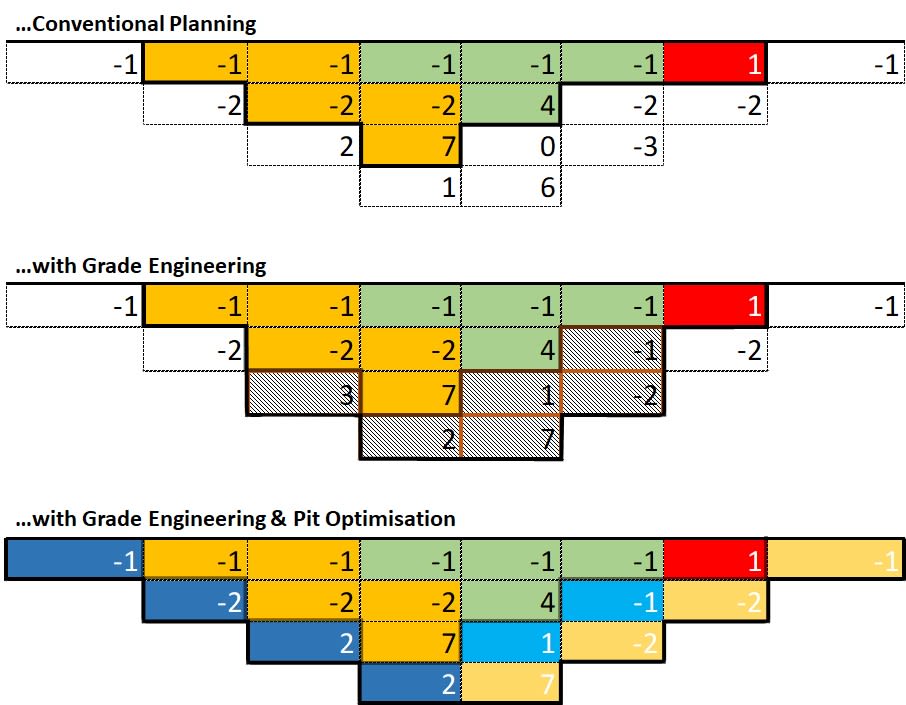
Blocks that have negative value ($/t) may also be considered ore if they are to be removed (economically) to access economical blocks with positive and higher value ($/t). At the same time, not every positive value ($/t) block in the resource will be considered as ore, as there might be several uneconomical blocks that need to be removed (pre-stripping) to be able to access them, therefore making those positive value blocks uneconomical. This is the logic typically followed by the ‘floating cone’ and ‘Lerchs and Grossmann’ techniques. GE pre-concentration techniques however, present the opportunity to turn uneconomical blocks into economical blocks, by turning negative blocks into positive blocks and/or by increasing the value of positive blocks. This is achieved through the Grade Engineering capability of separating blocks into a higher and lower value component and sending each of these components to the best destination to maximise the value of production.
A simple example to show how these properties influence the final pit limit optimisation process is depicted in the next figures. Figure 1 shows a 2D cross section of a GEEBM, where each block has a unique mining value ($/t) calculated with the traditional destinations (milling, leaching, and waste), and three different extraction pushbacks or phases. The first extraction phase commences with the red block, followed by the green phase blocks, and finishing with the yellow phase blocks. Note that blocks with positive values ($/t) at the bottom of the resource where not extracted, as they were not economically extractable. Therefore, the reserves and final pit limit geometry are limited by the coloured blocks.
Figure 2 shows the same 2D cross section but this time with Grade Engineered blocks at the bottom of the resource coloured in light red. These GE blocks have a higher value than the original blocks shown in Figure 1, which were treated with conventional economic destinations.
Figure 3 shows the same GEEBM, where the FPLO finds three more economical extraction phases (light blue, yellow, and dark blue), due to the new mining value ($/t) in the blocks due to GE processing. This results in a better utilization of the resource, increment of reserves, and increment of the final pit limit geometry.