Sampling
Sampling
Sampling
Sampling
Depending on the level of study being undertaken sampling design and requirements range from straightforward to more complex full geometallurgical style programs. opportunity assessments utilise current site domains as a basis for generating a simple testing matrix. This then generates a first order result which is used to refine a second phase of testing. If separation potential is found, subsequent characterisation steps are designed to increase confidence and understanding of key response drivers. Alternatively, if no separation is found, then subsequent testing campaigns refocus efforts onto other options more likely to impact a given site.
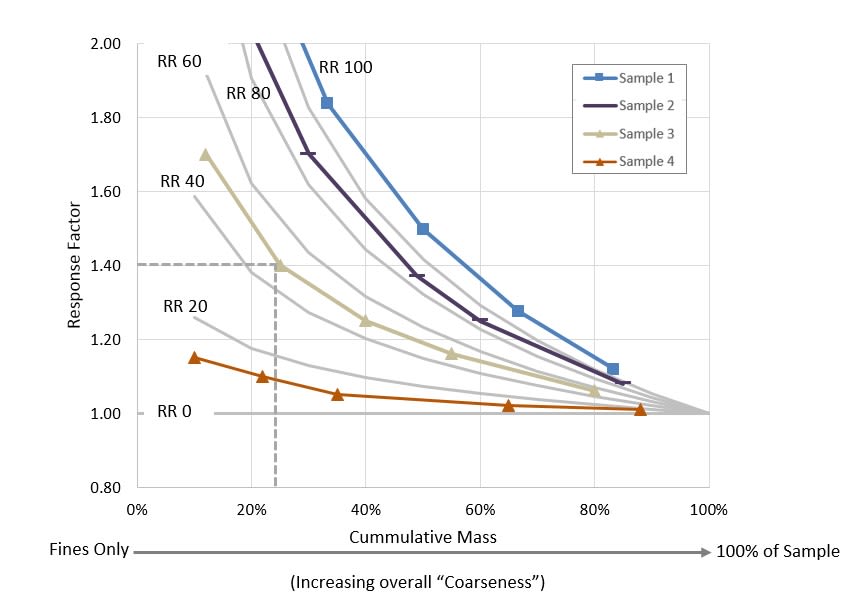
The purpose of the grade by size testing is to define if specific assay elements (as a proxy for mineralogy) are preferentially deporting into specific size fraction s. This typically involves a systematic increase in finer fractions. assays from a series of size fractions for each sample are used to generate Response Curves. A mathematical function is fitted to individual curves to generate a Response Ranking (RR) - a single number used to describe the magnitude of a Response Curve. Response Rankings are used as inputs into Grade Engineering process simulation. Testing can be carried out at drill core, blast hole chip or RC - though both these methods tend to provide less robust data most probably due to the impact or percussion impact nature of the breakage - or mill feedproduction scale although there are obviously transforms required to compare different scales.
Drill Core Sampling
grade by size testing can be carried out using coarse residues generated by crushing during routine laboratory assay preparation as a precursor to pulverisation. Many projects/sites routinely store coarse residues specifically for future testing or check assaying. In this case stored coarse residues can be used for cost effective grade by size testing. Stored pulps are not suitable for grade by size testing as the material is too fine.
Intrinsic rock characteristics can be measured using a range of tools available (e.g. core scanning devices, visual logging etc…) pre breakage and then linked to subsequent separation characteristics to aid in model development.
Specific samples should be selected to ensure coverage of both relevant domains and production years. As a guide to commence a study, each domain as defined by the resource model is a good statrting point. Ideally each domain should have at least 10 samples included in the first round of testing.
In many cases drill core testing is the only method to evaluate future ores/domains in the mine plan, unless they are exposed in the current mine workings.
crushing Protocols
crushing protocols for coarse residues vary between sites and companies. The protocol is capable of being replicated in almost any onsite lab, and all commercial laboratories. It requires no special or unique methodology or equipment.
The prime purpose of coarse residues is to reduce the size of a drill core sample to a particle size distribution that is statistically suitable for splitting off a fraction which can be used for fine pulverising prior to chemical assaying. A typical top size for coarse residues is 99% passing -3.35mm or the equivalent #6 mesh. This is sometimes expressed as 80% passing 2mm.However, very little quality control on the particle size distribution of coarse residues is generally carried out. particle size distributions are a function of the crusher gap setting, size of the initial drill core and hardness of the rock. Crusher gap settings in particular can vary between laboratories or drift over time.Within limits this variability does not affect use of coarse residues for grade by size testing. However, it is necessary to establish actual particle size distributions for site specific coarse residues as part of an initial evaluation program in order to select optimal sieve sizes for routine testing. Mass of specific sieve size fractions is also monitored during routine testing before samples are sent off for grade by size assaying to provide a qa/qc flag for samples that show unusual mass distribution that may not be suitable for grade by size testing.The key overriding decision point on sieve size selection is generation of the minimum number of data points to define a statistically meaningful Response Curve and Ranking. This requires a minimum of three sieve sizes (generating four size fractions) that cover the cumulative mass range as shown.
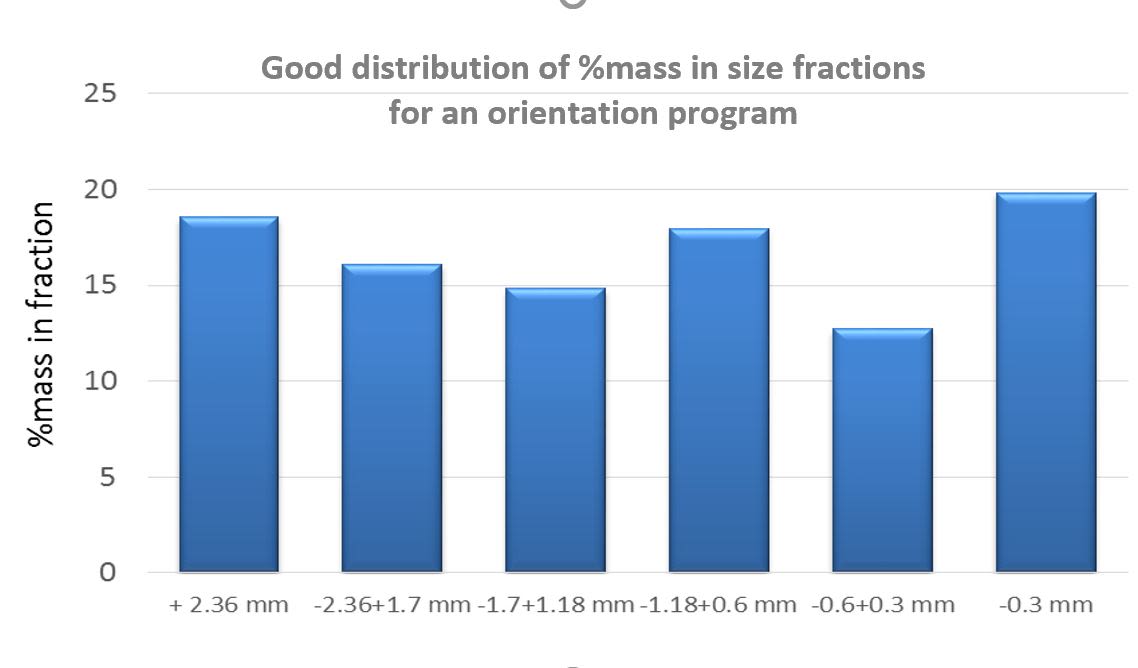
For an initial orientation program it is recommended that 5 sieves are used generating six size fractions. An example is shown below.
Bulk Sampling Options
In Pit or Stockpile Meso Sample
This method can be used as a guide to determine the "real world" response of the RR from run of mine ore. Note the sample is NOT fully representative of the rock mass to be sampled, and will contain a bias that is unquantified at this stage.
The actual method to be deployed will vary to the equipment and resources available, but may follow the below as a guide. It is reccommended to sample minimum of 500-600kg with small loader, escavator or bobcat (or 2 x 44 gallon drum equivalent) and upto 4-5 tonnes at the maximum.
Sample WILL be biased as the method will likely avoid rocks >200-300mm. However it is relatively easy to collect and process and will provide initial guide to natural deportment response. Second stage representative bulk sampling can be completed later, if initial test work warrants follow up
Laboratory Screening
Meso Sample
At either the onsite lab, or a commercial lab the sample needs to undergo preparation for screening, weighing and assay. The method will vary from location to location. As a guide the below method has been utilised several times, with the ability to process approximately 100 meso samples in 2 weeks on site.
- Transport sample to onsite/offsite lab
- Dump sample onto a large tarp for contamination purposes, and ease of retaining the fines
- Several technicians manually screen entire pile manually with sequentially reduced sized Gilson screens
- Finer fractions screened with RoTap in the lab
- Initial screen sizes need to be assessed but the sites prior knowledge of blasting particle size distribution should assist. Otherwise a common starting point may be: +110mm, -110+60mm, -60+30mm and -30mm
- Weigh each fraction when entire sample has been processed
- Crush and split for assay (all material) each fraction for assay
- Multiple spliiting and reduction stages maybe required depending on starting mass
- assaying method, assay suite and repeats/duplicates etc should be determined by sites current knowledge, requirements and methods
- It may be important to assay not only for target elements, but delaterious elements in case they are also upgraded (or downgraded) by metal deportment
Bulk Sample - Manual Preparation[](#BulkSample-_title_Create_page:_Manual_Preparation_class_wiki_wikinew_text-danger_tips_Manual_Preparation)
Preparation for a bulk sample is essentially the same for meso samples, but the starting sample is larger and is more represenataive of the entire PSD.
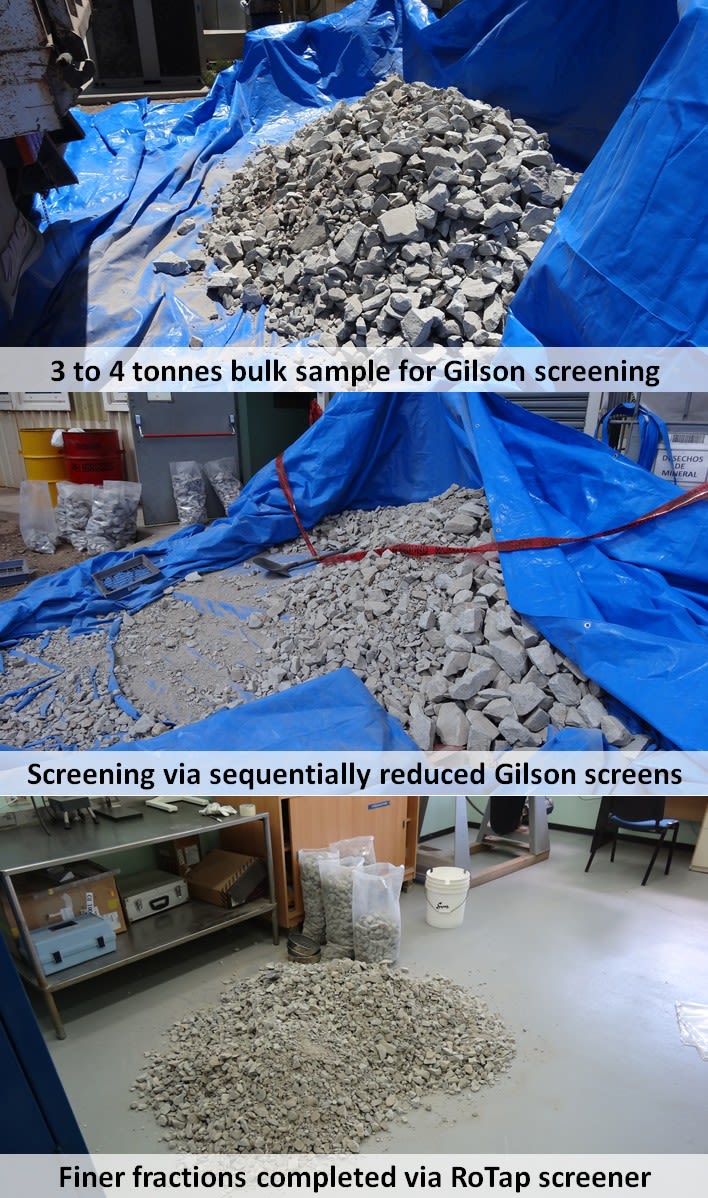
- Collect 3 to 4 tonne of run of mine sample collected by excavator or loader - expit or stockpile
- Dump sample onto a large tarp for contamination purposes, and ease of retaining the fines
- Several technicians manually screen entire pile manually with sequentially reduced sized Gilson screens
- Finer fractions screened with RoTap in the lab
- Initial screen sizes need to be assessed but the sites prior knowledge of blasting particle size distribution should assist. Otherwise a common starting point may be: +110mm, -110+60mm, -60+30mm and -30mm
- Weigh each fraction when entire sample has been processed
- Crush and split for assay (all material) each fraction for assay
- Multiple spliiting and reduction stages maybe required depending on starting mass
- assaying method, assay suite and repeats/duplicates etc should be determined by sites current knowledge, requirements and methods
- It may be important to assay not only for target elements, but delaterious elements in case they are also upgraded (or downgraded) by metal deportment
Commercial Gilson Screen (or equivalent)
This sample preparation is effectively the same as a meso sample however with some modifications. They key difference is the use of a large Gilson Screen (or equivalent) to remove the manual labour. Size is generally limited to several 100's kilograms.
- Top screen size is generally 100mm. Visually remove oversize manually
- Sequentially fed balance through Gilson in smalerl batches
- Trays emptied and material stockpiled as required
- Repeat until entire sample processedInitial screen sizes need to be assessed but sites knowledge, but approximately +110mm, 110 - 60mm, 60 - 30mm and -30mm
- Weigh each fraction
- Crush and split for assay (all material) each fraction for assay
- Multiple spliting and reduction stages maybe required depending on starting mass
- assaying method, assay suite and repeats/duplicates etc should be determined by sites current knowledge, requirements and methods
It may be important to assay not only for target elements, but delaterious elements in case they are also upgraded (or downgraded) by metal deportment
Note: This process is readily available in commercial laboratories. It is reccommended to closely supervise all sample preparation methods as the preparation is labourious. CRC ORE has found "short cutting" has been an issue on several occassions where supervision is lacking.
Bulk Sample - Custom Jig
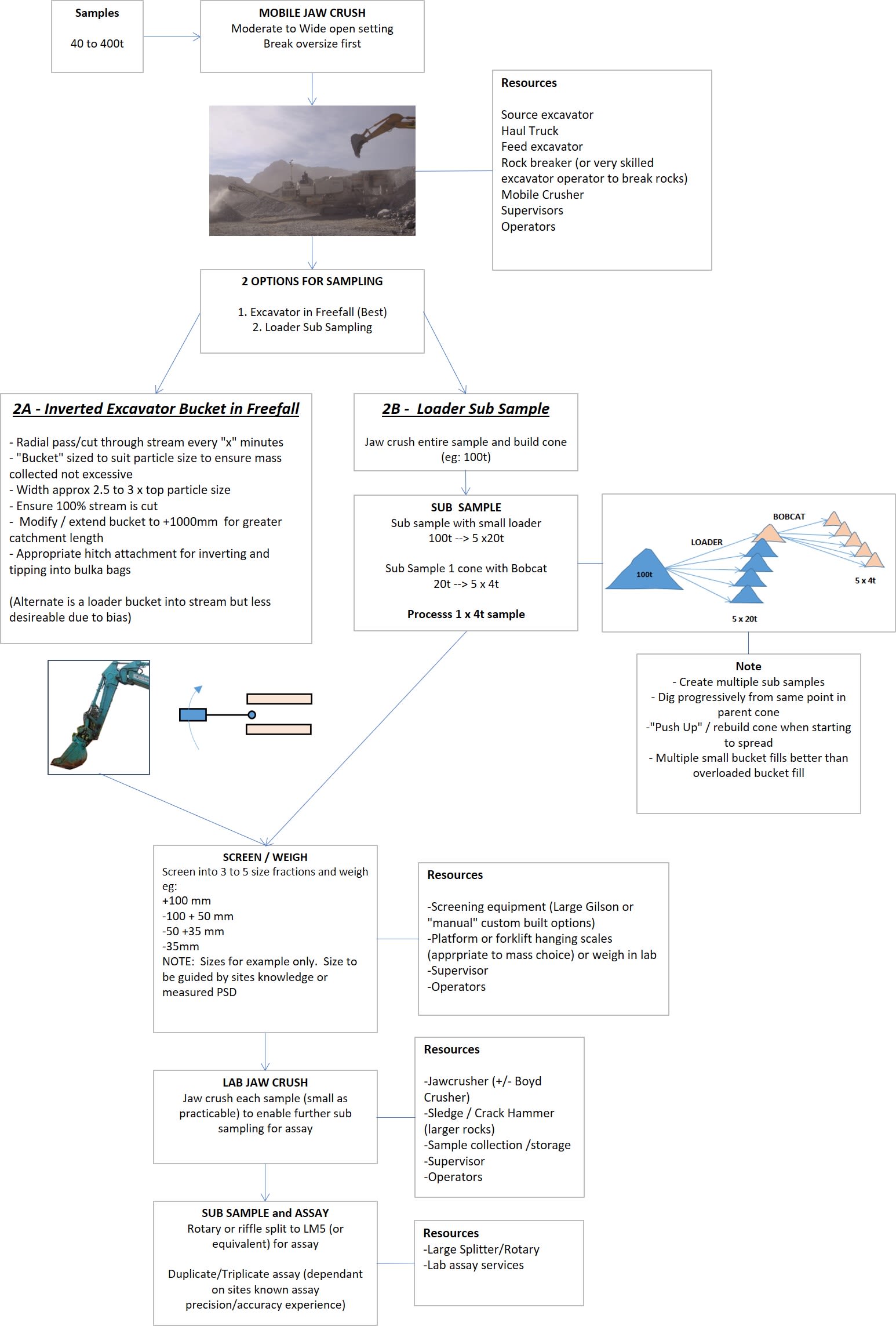
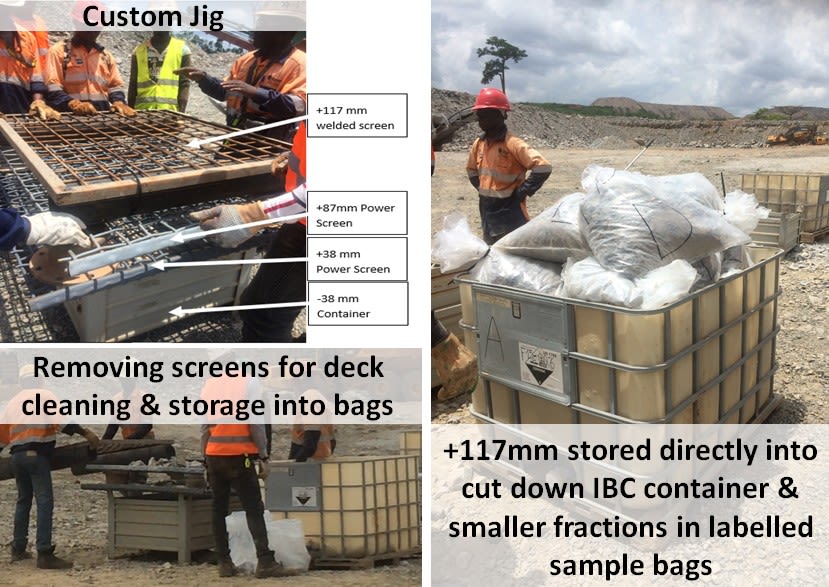
CRC ORE has built and supervised a custom screening JIG that has proven to be effective and efficient. All parts are generally available on most mine sites. It is particlarly effective when utilised for screening the sub-samples collected by either loaders or excavators from a mobile jaw crusher as discussed below.
- Collect appropriate sized sub-samples in free fall from a mobile crusher
- Collected by either excavator (preferred - less sample bias) or loader (potential sample bias)
- Standard screens maybe sourced from a screening deck that are commonly used on site for roadbase and/or stemming
- A topsize screen maybe welded up from re-bar if standard screens are not available
- Requires appropriate sized collection box for final fines at the bottom - or a heavy duty tarp for subsequent collection
- Spacers are required for each screen
- Material fed in 50-100kg batches onto screen jig
- Manually shake/roll screens
- As screens fill transfer topsize material directly into a storage container, and smaller "middling" fractions into double bagged sample bags
- shovelfinest fraction into bags and clean up with dustpan & brush to ensure all material is collected
Weighing, crushing and assay is as per above methods
Manual Belt Cuts
meso scale belt cuts can also be obtained from production conveyors. meta data relevant to the sample should try and be captured where possible, such as the source dig block, truck number or shovel. This allows sample characterisation to be matched to ore types or domains.
Consideratyions that need to be taken into account are;
- Sample meta data
primary crusher – Normal operating mode should be maintained and close size setting confirmed
- Sampling at the conveyor after primary crushing
If in a crushing line/system a grizzly screen is present before the crusher, the following considerations need to be considered before sampling:
- Sample truck should try to skip the grizzly screen, and try to dump straight into the crusher. Only if operational and safety protocols permit.
- If Grissly screen can not be skipped, sampling can go ahead with screen in place only if Grissley screen is not scalping or separating more than 2% of the total material. If the Grissly scalps less than 2% then the material not sampled is minimal and should not effect preliminary studies.
- If Grissly screen scalps more than 2% of the material, then that specific crushing line can not be utilized for sampling, or consideration needs to be given to rock breaking the oversize for sampling purposes. The need to sample the oversize is less critical for ortientation studies, but becomes increasingly relevant for operational deployment studies.
Identify the following meta data details before dumping at the primary crusher for testing:
- What region and polygon is the truck load coming from.
- Expected tonnage of truck
- Expected rock type
- Expected average grades for elements of interest.
- truck ID, time of dumping, and final destination of material.
If practical ensure conveyor belt has no material from other truck load before sample truck dumps on primary crusher, or feed 3-4 trucks of same material to "flush" the system.
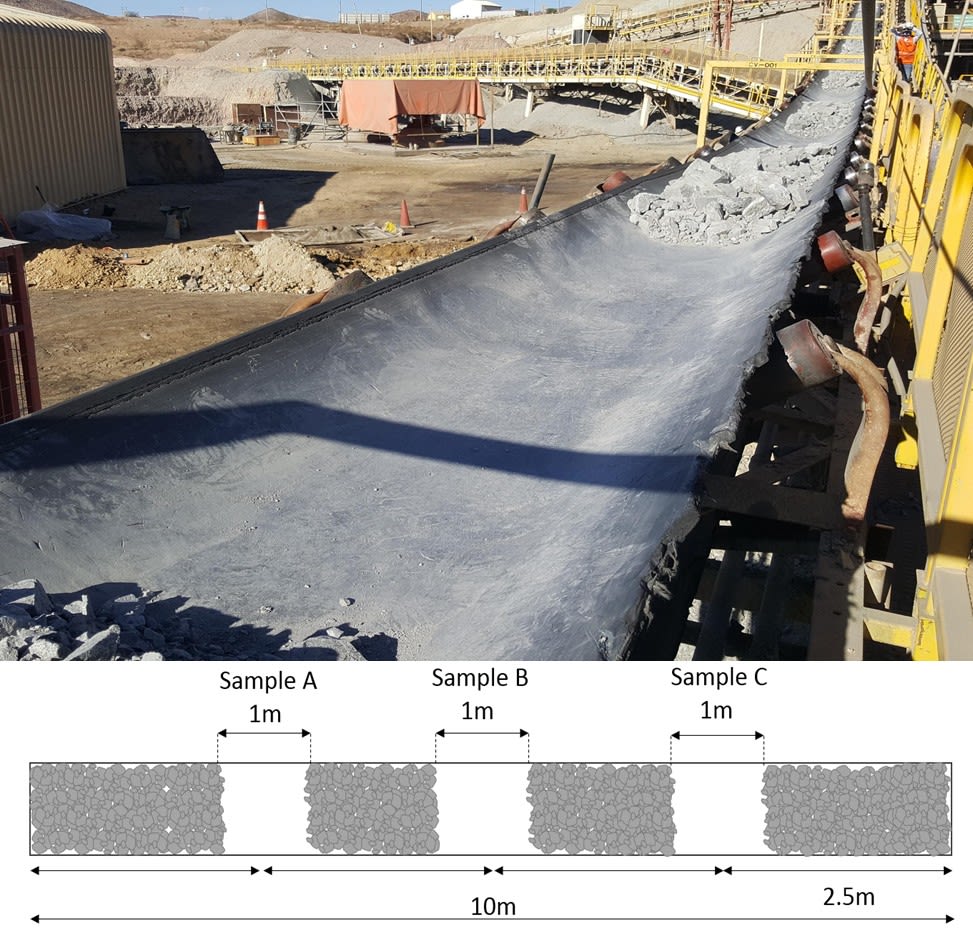
Once sample truck load dumps on primary crusher and material is visible on at least 10 meters of conveyor belt, stop conveyor belt. Isollation and sampling practices should be developed and followed according to sites requirements.
Take upto 3 samples as in the figure (e.g. Sample A, Sample B, Sample C) from conveyor belt, with a spacing of at least 1.5m between samples. Sample mass should be calculated from sampling theory according to particle sizes, metal distribution and sampling constants if known.
After samples have been taken, the rest of the truck load passing through the crusher can continue to its original destination without further interruptions.
- Each sample should be of around 1m (or more) of conveyor length. Each sample will have a weight between 200 to 400 kg.
- Ensure that 100% of the sample is collected (fines and coarse) of the conveyor belt cross section. Use a broom and dustpan for final clean up.
- As significant effort is required to stop and sample on the main conveyor it is reccommended to take 3 x coarse "duplicates" from the same sampling station. This allowes for;
- Primary sample for natural deportment testwork
- Secondary duplicate (or "near duplicate" as a true duplicate is not acheivable) for repeatability if required
- Tertiary sample kept in reserve for follow up testwork and/or geomet synergies
- Repeat this process for every truck sample
crushing, sub sampling and assaying should follw one of the sample preparation methods discussed above.
Bulk Sample - Screen Deck Option
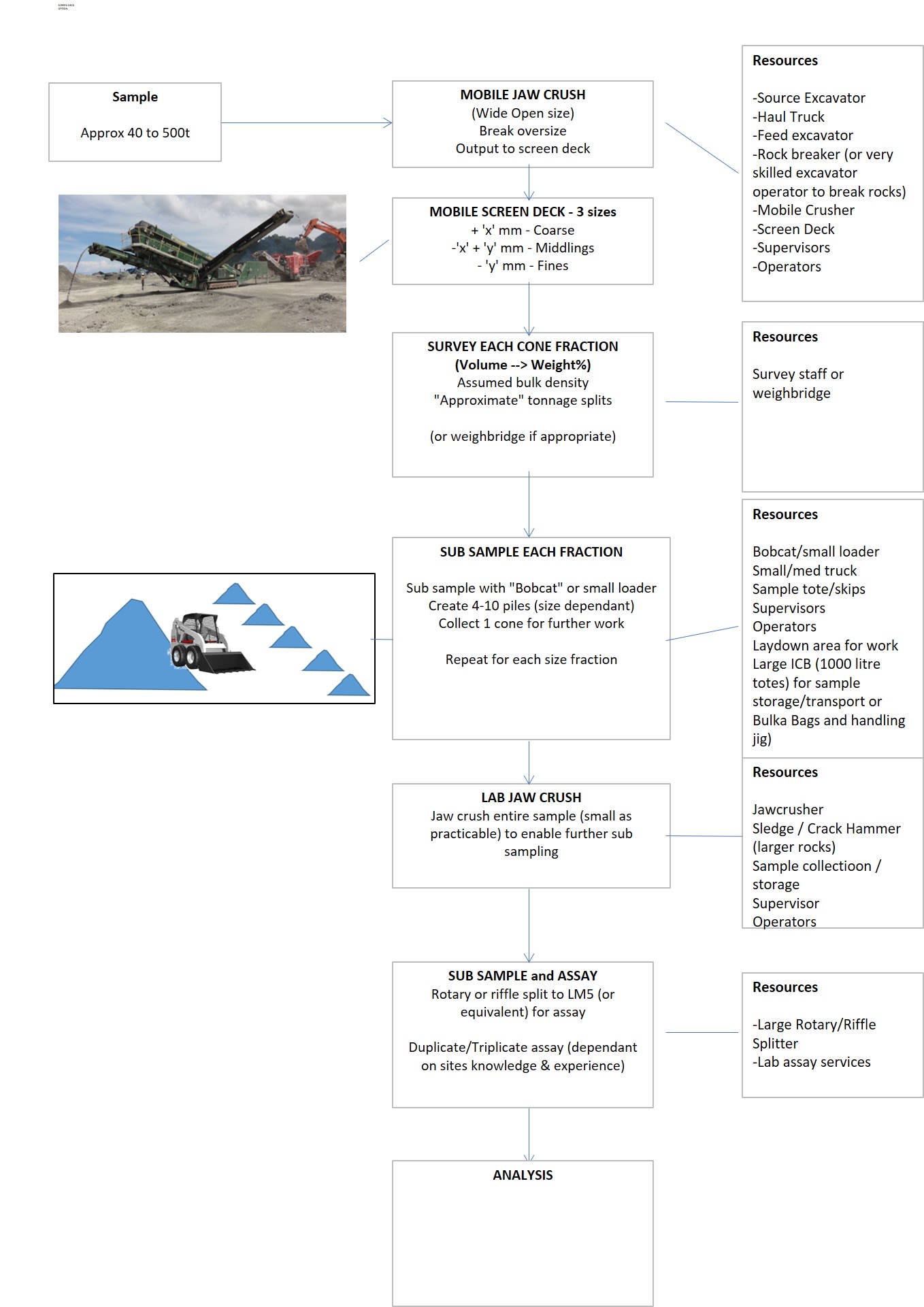
Bulk or small pilot trial options can be completed using a Mobile jaw crusher and a Screen Deck. The below image provides a pictorial guide.
While suited to larger trials, and 100% of the sample is screened thus reducing the potential for bias, this method can be difficult for orientation studies due to the large sample masses generated. As 100% of the sample is seperated into size fractions, subsequent sub sampling of each pile is then required. The sub sampling method can then re-introduce substantial bias risk through partcile segregation on the stockpile cone, as well as biased sampling through mass reduction in the subsample.
Bulk Sample – Mobile Crusher Option
The below discusses a methodolgy to subsample directly post mobile crushing. Sampling via an inverted excavator bucket is the prefrerred option as it reduces the bias potential due to the ability of the excavator to make a single direction radial pass through the stream in freefall. Sub sampling by using a loader bucket to pass into the stream (either front on or side on) introduces bias potential as not all the rock stream is collected into the buccket for the same amount of time.
The below image provides a pictorial guide.